A website dedicated to animation, awards, and everything in between.
Oscar-Nominated Animated Short Butterfly Director Florence Miailhe Interview

Credit: Butterfly - Papillon (Sacrebleu Productions)
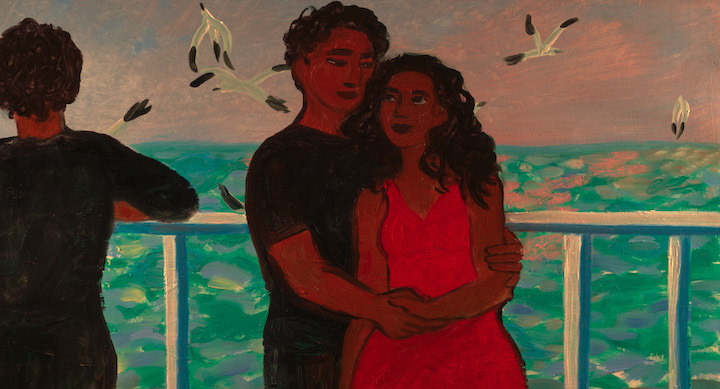
Butterfly (Papillon) has been nominated for Best Animated Short at the 98th Academy Awards. Cartoon Contender previously spoke with the short’s producer, Ron Dyens, who shared in last year’s Best Animated Feature win for Flow. We caught up with Butterfly’s director, Florence Miailhe, who has been making short films for over thirty years. Her signature “film-painting” style is on full display in Butterfly, which centers on Olympic swimmer and Holocaust survivor Alfred Nakache. Miailhe has a personal connection to Nakache, which is evident in every frame of her film. Cartoon Contender spoke with Miailhe about her relationship to Nakache’s story and telling his story one brushstroke at a time.
Q: When I spoke to Ron Dyens, he mentioned that you have a personal connection to Alfred Nakache, learning to swim with his brother, William. What are your recollections of Alfred and his family?
A: This is a very personal story for me. My father knew Alfred Nakache and always spoke of him with enormous respect. He admired the swimmer as much as the man. He had met him during the Resistance against the Germans in Toulouse in the south of France. When I was a child, I took swimming lessons with his younger brother, William Nakache, and at every session, my father repeated to me: “You know, William is the little brother of Alfred Nakache, the great swimming champion!”
I remember very precisely the day I met Alfred. I was about ten years old. He must have been around fifty years old, which, for a child, seemed extremely old to me for a swimming champion. My father then whispered to me: “That’s Alfred Nakache. Show him how you swim the butterfly.” I found myself doing a few movements in front of him, very embarrassed, without really understanding the importance of the moment. But I have always had the feeling that through William’s teaching, I was swimming Alfred’s butterfly a little.
When the film was finished, I met one of his nephews. He came with a cousin to the first screening with the team. They recognized their uncle in the portrait I made of him, despite the artistic liberties I took. They were moved by the poetic approach of the film to tell this tragic story, and that is undoubtedly the most beautiful reward I could receive.
Q: You've been familiar with Alfred Nakache for most of your life. What inspired you to tell his story now?
A: Even though I had heard about Alfred Nakache since childhood, my image of him was in fact very fragmented. I did not know his story, probably because I was too young to be told about it.
In 2015, I was preparing my feature film The Crossing. The project was moving forward, but we were struggling to secure the necessary funding. I then thought of a new project, this time a short film, and the memory resurfaced of the day I met Alfred when I was ten years old, and when my father encouraged me to show him how I swam the butterfly. Out of curiosity, I began researching online and gradually discovered the scope and strength of his life. I found his journey extraordinary, and certain details struck me deeply: the fact that he had developed a fear of water at a very young age and overcame it, that he was known as the “swimmer of Auschwitz,” and that he died while swimming, not far from the beach where I used to spend my holidays…
My first motivation for telling this story now is quite simply that, when I discovered it, it moved me profoundly. I found it beautiful and deeply emotional. It brought together many themes I had long wanted to explore.
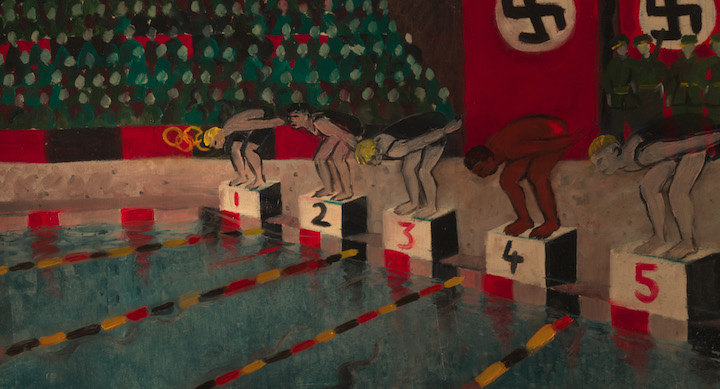
I also felt it was important, in today’s context, to recall certain elements of History. There are always artists and athletes who, regardless of their achievements, are excluded or discriminated against because of their skin color, nationality, gender, or whom they love… and they are only the visible part of a broader rise in racism, antisemitism, and homophobia.
We are living in a time of closed borders and hardened identities, with a global threat to fundamental freedoms and civil rights. Nakache’s story is also one of the loss of rights, set against the backdrop of the rise of fascism in Europe.
Credit: Butterfly - Papillon (Sacrebleu Productions)
Q: Although you already knew Alfred, did you do any further research into his life when you started making Butterfly? If so, were there any facts about Alfred that surprised you?
A: Yes, of course. As I was saying, I initially had only a very fragmented understanding of his life story.
What first struck me was his lifelong relationship with water. Then there was what he endured during the war: his deportation to Auschwitz with his wife and daughter, the fact that he returned alone, and the condition in which he came back from the camps. In 1945, he weighed barely 40 kilos, which is staggering when you consider that he had been an elite-level athlete. And yet, less than three years later, in 1948, he was selected for the London Olympic Games.
I also discovered a chapter of history I had been completely unaware of: the revocation of French nationality for Jews from Algeria under the Vichy regime. Because of this, Alfred Nakache was excluded from French competitions, as he was no longer considered a French citizen. Even today, the idea of stripping people of their nationality is still being discussed, and it seems essential to me to remind ourselves how violent and deeply unjust such a measure can be, and what dramatic consequences it can have on a person’s life.
I also realized how little known his story was, even in Toulouse, despite the swimming pool that bears his name. Since then, there has been a genuine rediscovery of his life and achievements, through books, a stage play, radio programs, and his induction into the International Swimming Hall of Fame. And of course, during the Olympic Games, this great French champion was remembered — a swimmer who, like Léon Marchand, racked up victories. Both of them were trained at the same swimming club, Les Dauphins du TOEC in Toulouse
Q: Every image in Butterfly is hand-painted, which is a staple of your work. What drew you to this animation technique, which suits the story so well?
A: This technique lies at the very heart of my work. I have been using it since my very first films.
I was trained as a painter, so when I began working in animation, I naturally turned toward highly pictorial materials such as dry pastel, sand, or paint on glass. But the fundamental principle remains the same in all my films: animating directly under the camera. The different phases of movement are invented as the work progresses. It is a fairly demanding technique, but one that allows for great fluidity in the transitions between movements and shots.
I have made several short films and one feature film, and I believe that water is present in almost all of them. I had already explored ways of rendering the transparency and movement of water in The Crossing, and I was able to reuse and further develop these techniques for Butterfly.
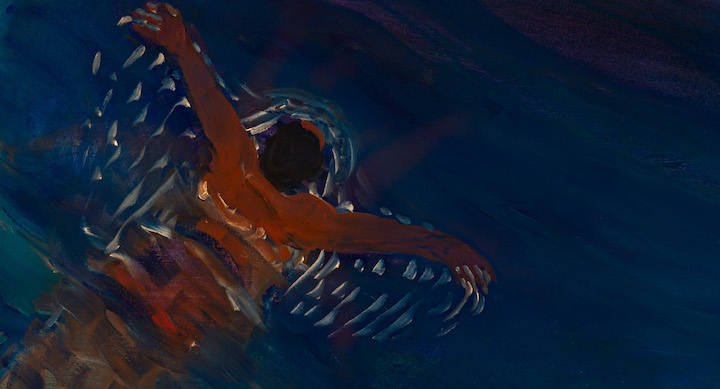
Water is always a challenge to animate, because it is constantly changing. The approach is never the same, whether it is the sea, a swimming pool, a river, or a retention basin. Each situation requires finding a specific visual solution.
We used two levels of animation. One was done directly on painted canvas backgrounds. This layer was mainly used to paint the bodies under the water, which were distorted, often with an animated oil layer on top. The other level was used for the bodies above the water, which were painted on glass. Some shots were relatively easy to achieve, as the animated oil layer over the backgrounds conveyed the transparency of the water and its ripples very effectively. For the sea and the waves, we worked more with the materiality of the paint and color mixing. We also projected and animated soap bubbles onto the glass — a more unpredictable and experimental technique, but one that produced beautiful results.
Q: A few years ago, you made the feature, The Crossing, which employed similar techniques seen in Butterfly. Would you be interested in pursuing more features, or do you prefer to work in shorts?
A: I think that from now on I will limit myself to short films. I am very happy to have been able to make a feature film, but it was particularly long and difficult, and I don’t think I will have the courage or the time to go through that process again.
I do, however, have a documentary project in mind that might incorporate some animated sequences. But it is still too early to talk about it…
Credit: Butterfly - Papillon (Sacrebleu Productions)
Q: What are the challenges of depicting water in animation?
A: Water is always a challenge to animate, because it is constantly changing. It is transparent, and sometimes it is visible only through its movement and the distortions it creates in what lies beneath. The approach is never the same, whether it is the sea, a swimming pool, a river, or a retention basin. Each situation requires a specific visual solution.
Together with the two animators who worked with me, we used two levels of animation. One was done directly on painted canvas backgrounds. This level was mainly used to depict bodies underwater, which were distorted, often through an animated oil-paint layer applied on top. The other level was used for bodies above the water, which were painted on glass. Some shots were relatively easy to achieve, as the animated oil layer over the backgrounds conveyed the transparency of the water and its ripples very effectively. For the sea and the waves, we worked more with the materiality of the paint and with color blending. We also projected and animated soap bubbles onto the glass — a more unpredictable and experimental technique, but one that produced beautiful results
Q: Although Butterfly is set against the backdrop of the Holocaust, its themes feel eerily relevant. Is there a particular event we're living through now that inspired you while making this film?
A: I first conceived this film almost ten years ago, and issues such as discrimination in sports, racism, antisemitism, the persecution of migrants, the stripping of nationality, and homophobia were already highly topical at the time. They are even more so today…
Butterfly can currently be streamed on The Animation Showcase and will be playing in select theaters with this year's other Best Animated Short nominees starting February 20, 2026.

Nick Spake is the Author of Bright & Shiny: A History of Animation at Award Shows Volumes 1 and 2. Available Now!