A website dedicated to animation, awards, and everything in between.
2026 Oscar-Eligible Animated Short Butterfly Producer Ron Dyens Interview

Credit: Butterfly - Papillon (Florence Miailhe)
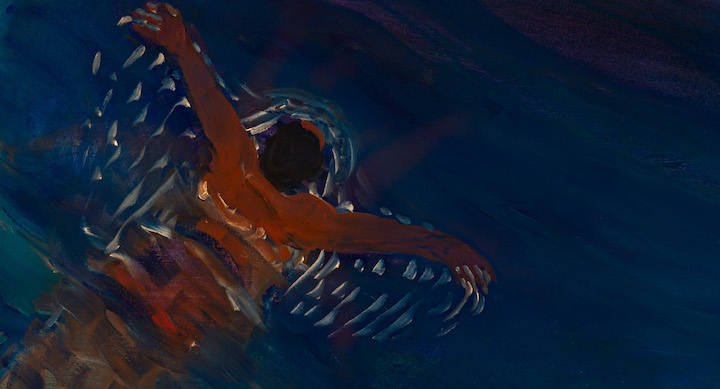
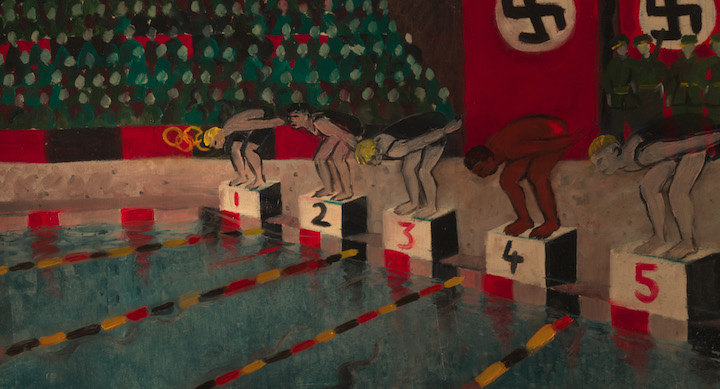
Ron Dyens of Sacrebleu Productions shared in a Best Animated Feature Oscar win for Flow last awards season. Dyens may have a Best Animated Short contender in Butterfly (Papillon), which has qualified for consideration at the 98th Academy Awards with its victory at the Stuttgart Festival of Animated Film. Co-produced with XBO Films, director Florence Miailhe’s film paints a poignant portrait of Alfred Nakache, a Jewish French Olympic swimmer. Surviving the Holocaust, Nakache came to be known as “the Swimmer of Auschwitz.” Cartoon Contender spoke to Dyens about his recent Oscar win, Miailhe’s fluid animation, and why Nakache’s story is still relevant today.
Credit: Ron Dyens
Q: Director Florence Miailhe had a chance to meet Alfred Nakache before his death. When did you first hear Nakache’s story?
A: Florence Miailhe speaks so highly of Alfred Nakache because their stories are deeply intertwined. Florence's father was a member of the Resistance during the Nazi invasion of France and was in the same group as Alfred. Florence also learned to swim when she was very young with Alfred's brother in the south of France. So, from a very young age, Florence had a “spiritual” but also an “imaginary” connection between her and the image she had of Alfred, both in the stories her father told her as a child (during a troubled period for France) and in her relationship with learning to swim through Alfred's brother, who was so proud of Alfred and ready to tell any anecdote about him.
For me, Alfred Nakache has always been part of a kind of pantheon of French athletes with tragic destinies. Florence's exploration of this subject has been a way for me to get to know the man beyond the historical figure he had represented until then.
Q: Butterfly has the visual essence of a living painting, which is common in Florence Miailhe’s work. How would you describe Miailhe’s artistic process?
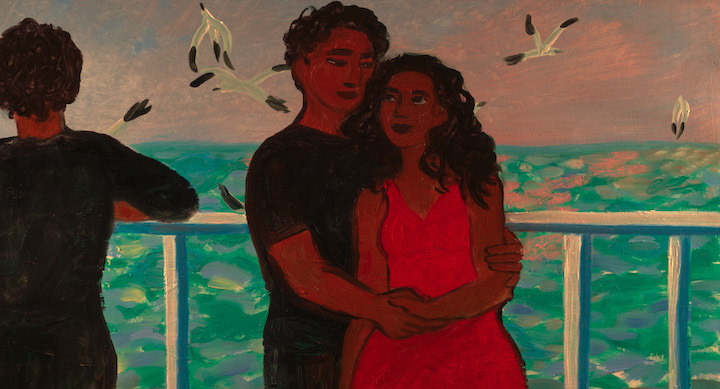
A: Florence's artistic approach is rooted in handcrafted animation. Each image is hand-painted, resulting in a remarkable fluidity, particularly in the transitions. She typically works with paint, pastels, or sand directly onto the glass. This method, unique in animation, demands immense and meticulous work, as she must repaint sections of the image for each frame. Her technique is internationally renowned, making her one of the most iconic figures in glass painting animation.
This approach lends her films a singular fluidity and serves the themes and emotions of the narrative, allowing the images to reflect the characters' states of mind. It enables her to create true "living paintings," where forms and colors transform before the viewer's eyes. Furthermore, her work with color also plays a major role in Butterfly, where she associates a specific color palette with a period of Alfred Nakache's life and his memories. This unconsciously influences the audience's feelings and allows them to better understand the characters' emotions.
Credit: Butterfly - Papillon (Florence Miailhe)
Q: When did you and Sacrebleu Productions come on board to this project?
A: I have known Florence for 25 years. We used to attend festivals together when I was also a short film director. I was captivated by her short film Au premier dimanche d'août (A Summer Night Rendez-Vous), which was so beautiful and poetic and won numerous awards at festivals. Florence was already a highly experienced and recognized artist. We kept in touch over the years, and when her longtime producer retired after the beautiful animated feature film The Crossing, it was only natural that Florence asked me to become her producer and produce Butterfly.
Q: How has the Oscar win for Flow impacted Sacrebleu Productions?
A: Flow was an extraordinary experience. First and foremost, it was a human experience, getting to know Gints [Zilbalodis] and some of his personal convictions, but it was also an intense spiritual adventure through what the film tells us. Its impact on Sacrebleu was very powerful for many reasons. Firstly, because it was the first time we had produced a 3D film. Sacrebleu was previously known for its many successes, mainly in 2D (in short films, we can mention the Palme d'Or, the Golden Lion in Venice, the Silver Bear in Berlin, and two Cristals in Annecy; in feature films, three Audience Awards and two Jury Awards in Annecy, and the Grand Prix in Zagreb). But we know that 2D is often less commercial than 3D. Flow also shows that Sacrebleu can now be successful at festivals, but also produce artistic films that can be commercially successful. From now on, we are allowing ourselves to do anything in the series, short films, and animated feature films that will be produced in the future.
Q: What was the collaboration between Sacrebleu Productions and XBO Films like?
A: I knew little about XBO, except for its producer Luc Camili, whom I like very much. The fact that Florence spends much of her time in the south of France near Toulouse, where Alfred Nakache lived and where Luc Camili lives, made us think it would be a good idea to co-produce with him. He knows Florence well, which reassured everyone. What's more, XBO is a well-established organization that is deeply involved in the Occitanie region. I have long been an advocate of co-producing short films with regional French organizations. It's better to produce less and produce better than to want to own all the rights to a film. And the exchange is always a rich learning experience. That's kind of what Flow tells us, too. So the collaboration unfolded very naturally, and since then, we've decided to collaborate more on other films and with other directors.
Q: Water seems to be a theme in a lot of the projects that Sacrebleu takes on, from features like Flow to other shorts like Une Fugue and Like a Fairy Tale. Coincidence?
A: I admit I hadn't noticed that. Thank you for pointing it out. If there is a reason, then it is unconscious.
Q: Butterfly has qualified for Oscar consideration by winning the Grand Prix at the Stuttgart Festival of Animated Film. What have been some standout moments from the film’s festival run?
A: There have been many intense moments in Butterfly's journey. One example that comes to mind is its first selection for the Berlinale's Generation KPlus section. The fact that such a film was selected in Germany speaks volumes not only about the quality of the film, but also about Germany's efforts to preserve the memory of the Holocaust. And the fact that it is in the Generation section, which is aimed at young audiences, is a real honor for us, because there is obviously a real lesson to be learned from this film and passed on to younger generations.
It is also interesting to note that its Oscar-qualifying award came from another German festival, in Stuttgart! Today, the film has been selected for more than 140 festivals and has won more than thirty international awards, including audience awards and grand prizes, all over the world. It is therefore a universal film that speaks to us, through Nakache's life, of love, respect, and transmission, but also of cruelty, and it is the latter that is important to confront. Let's not forget the last words of the film: “Come on, kids, we're not afraid”...
Credit: Butterfly - Papillon (Florence Miailhe)
Q: How do you think Alfred Nakache’s story is still relevant in today’s world?
A: That's pretty much the conclusion of my previous answer. Faced with increased and unrestrained military power and the ethnocidal conflicts we are experiencing (Azerbaijan attacking Armenia, the conflict between Gaza and Israel, Putin's threatening tone towards Ukraine, or even the tensions between India and Pakistan), we must constantly remind ourselves of the value of human life, which is affected today in a thousand ways, socially, politically, economically, militarily, and even technologically. This film, with its narrative simplicity and visual beauty, reminds us that not so long ago—two or three generations ago—between fifty and sixty million people died for economic and racial reasons. The future is very uncertain. Flow told us so. Butterfly reminds us of it.
Nick Spake is the Author of Bright & Shiny: A History of Animation at Award Shows Volumes 1 and 2. Available Now!