A website dedicated to animation, awards, and everything in between.
To the Woods Director Agnès Patron Interview | Oscar-Eligible Animated Short

Credit: To the Woods (Agnès Patron, Sacrebleu Productions)
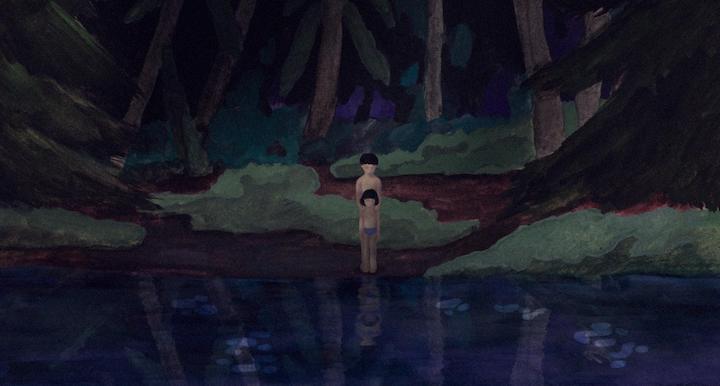
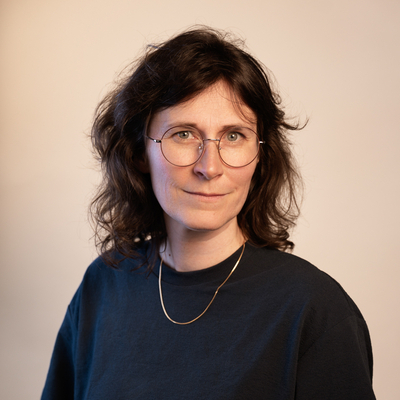
Director Agnès Patron studied under Florence Miailhe, who received an Oscar nomination earlier this year for her animated short Butterfly. Patron may receive a nomination next for To the Woods, which has qualified for Oscar consideration by winning the Grand Prix Anima for Best International Short Film at Anima - The Brussels Animation Film Festival. To the Woods is a reflective story of siblinghood as a sister looks back at her childhood with her brother. Cartoon Contender spoke with Patron about how her family history inspired the film, its hand-painted artistry, and taking a deep dive into her own memories.
Credit: Agnès Patron
Q: In what ways did your own family inspire what feels like an incredibly personal film?
AP: My family memories were a genuine source of inspiration for the film. On my mother’s side, my grandmother, on whom the story is based, lost her older brother in a car accident when she was very young. She loved and admired him deeply, and this loss remained with her throughout her life. I grew up with this story, and I also have a brother whom I love. Today, I am the mother of a son and a daughter, so questions around family bonds, love, and loss have naturally become part of my own reflections. In that sense, the film is rooted in something very personal, but I wanted to explore it in a way that could resonate beyond my personal experience. It is a story about grief, memory, and the way those we have lost remain a part of us.
Q: To the Woods speaks to the nature of memories. Even the clearest memories that define us can feel almost abstract as we look in the rearview mirror. While making this film, did childhood memories naturally come back, or did you have to dig deep to remember?
AP: My childhood memories are still very vivid, and they naturally come back to me when I make films. They have always been a part of my creative process, even when I am not consciously looking for them. At the same time, being a mother has opened up another very strong source of inspiration for me. Watching my own children grow, seeing the world through their eyes, and experiencing their emotions alongside them constantly feeds my imagination. In many ways, my films come from this dialogue between the child I once was and the children I see growing up today.
Q: The film’s visuals were achieved through TVPaint, hand painting, and Photoshop. This living painting aesthetic adds to the atmosphere, as if we’re watching a lucid dream. Was that the intent?
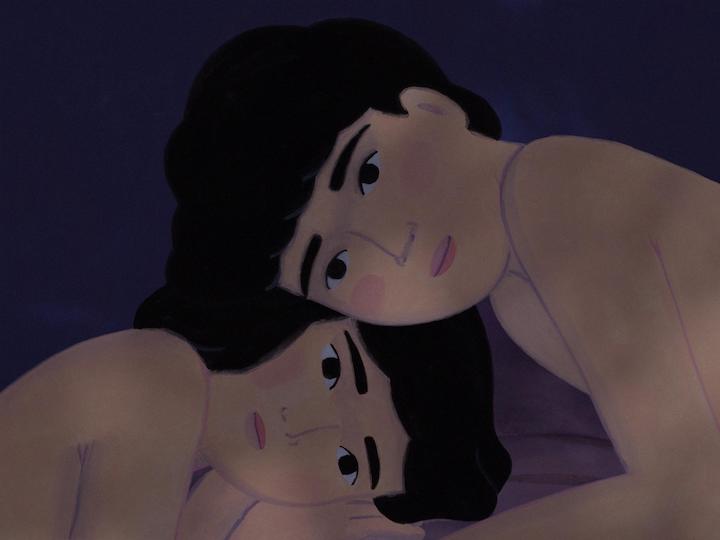
AP: Absolutely. I wanted to preserve a very tactile, organic quality throughout the film, so that the images would feel alive and slightly dreamlike — almost as if they were constantly shifting between reality and a lucid dream. The film was primarily painted by hand. We started with a line-based animation, created in TVPaint by a wonderful team, and then brought the images to life through hand painting using Linel gouache. All of the backgrounds were also painted by hand. For the shots where the background remains still, I manually cut out the characters in Photoshop. During the compositing, we integrated them into the painted backgrounds. But for the swirling moments, when Sister is searching for Brother, everything was painted together on the same sheet of paper.
Q: How did your past work with Florence Miailhe (Butterfly, The Crossing) prepare you to make this film?
AP: Florence was also my teacher during my studies at EnsAD. She has a very intuitive way of working, she looks for an animation that feels precise and essential. I deeply admire the freedom with which she builds her stories and her way of trusting her own instincts. Having had the chance to work alongside her really inspired me. That experience has guided me in my own approach to filmmaking.
Credit: To the Woods (Agnès Patron, Sacrebleu Productions)
Q: You wrote To the Woods with Johanna Krawczyk, who you previously collaborated with on And Then the Bear. What did each of you bring to your latest film on a narrative level?
AP: We have been working together for a long time now. Our process is a bit like playing ping-pong: we exchange versions of the script, each adding details, making small changes, and gradually shaping the film together. But on this film, Johanna played a particularly important role. It was during one of our writing sessions that I suddenly remembered my great-uncle, a memory I had somehow buried after my grandmother’s death. That moment became a turning point in the writing and, ultimately, in the film itself. In a way, the process of writing together allowed a memory I had forgotten to find its way back to me.
Q: Your work as a graphic author on Freedom Swimmer also shines through here. What is it that draws you to stories set on the water?
AP: Water is a place for dreams, but also of passage and transformation. In Freedom Swimmer, I was drawn to the story of exile, and to the idea that water can be a border you have to cross to find freedom. In To the Woods, water has another meaning. Many years later, it is still there, almost unchanged, like a memory that has stayed intact. I think this is what attracts me to water in cinema: it can separate people, but it can also keep something alive through time.
Q: Pierre Oberkampf’s musical score practically feels like a third character, expressing what dialogue can’t. How did you go about striking the right note with him?
AP: My usual way of working is to edit to Pierre Oberkampf’s music, but for this film, I wanted to do things differently. I needed to find the right rhythm on my own, without the music guiding me. So I told Pierre that I would finish the editing first, and that he would compose the music afterward. Very early on, I knew that the voices had to express something of the characters’ inner lives. The brother’s and sister’s voices would weave together in a tender, almost whispered chant, while the voices of the forest would offer a counterpoint — more powerful, almost like cries coming from far away.
Q: To the Woods has won several awards, including the Oscar-qualifying Grand Prix Anima for Best International Short Film at the Brussels Animation Film Festival. What have been some other standout moments on the festival trail for you?
AP: First, the premiere at Critics’ Week in Cannes. The whole team there was so warm and welcoming with all of us (I came with a part of the crew), and the screening conditions at the Miramar were incredible. I really loved that screening. It was a very special moment! And then, of course, the award at the Toronto International Film Festival, because it was the first one ! But I also love going to festivals and seeing other films receive awards. There is such a pleasure in discovering new short films and seeing so many different ways of telling stories. I’ve been lucky to attend many wonderful festivals and discover so many beautiful films. That feeling of discovery is something I really cherish.
Q: Going home is another key theme of the film. For some, going home is comforting. For others, it’s painful. In both cases, though, going home can be therapeutic. Would you say that making this film was like going home?
AP: Absolutely! I would also say that making this film was a way of reconnecting with those I have lost. And in a way, the film has become a kind of talisman for me, a way of keeping them close.

Nick Spake is the Author of Bright & Shiny: A History of Animation at Award Shows Volumes 1, 2, and 3. Available Now!