A website dedicated to animation, awards, and everything in between.
Gods Don’t Give Gifts - An AI Movie - To Submit for Best Animated Feature Oscar… Is It Even Eligible?

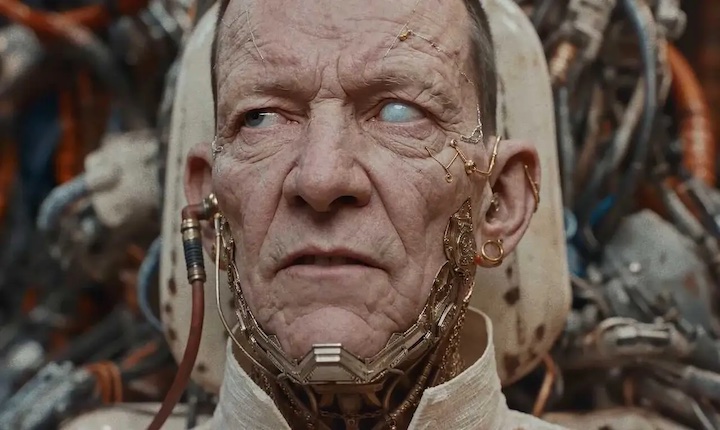
Credit: Gods Don’t Give Gifts (Fable Studio)
Gods Don’t Give Gifts, an AI-generated feature from Fable Studio and YouTuber Gossip Goblin (aka Zack London), is getting a theatrical release on December 4. The sci-fi film, which is comprised of four stories, will not only be the first fully AI feature to receive a general theatrical release in the U.S. It already has the distinction of being the first AI film to warrant an MPA rating, ultimately walking away with an R. Fable Studio is eyeing another first for their debut feature. According to Variety, Fable will submit Gods Don’t Give Gifts for the Best Animated Feature Oscar, complete with billboard ads, advance screenings for Academy members, and a release date with awards season in mind.
I’m just gonna get this out of the way: the nomination isn’t happening. Who knows? Maybe the film’s story, which was reportedly human-scripted, will wind up surprising. Maybe it won’t. Either way, AI remains one of the most divisive topics in Hollywood, particularly among animators. By divisive, I mean artists generally hate it and executives generally love it. The point is that there’s too much animosity surrounding AI for Gods Don’t Give Gifts to attain a nomination, especially with the competition including Toy Story 5, Wildwood, Ray Gunn, Iron Boy, Forgotten Island, Hoppers, and Tangles, among others.
The question isn’t whether or not Gods Don’t Give Gifts will get a Best Animated Feature nomination. It’s whether the Animation Branch will even deem it eligible. In the category’s history, at least three films have been submitted for consideration, only to be disqualified: Arthur and the Invisibles, Yogi Bear, and The Smurfs. All three were live-action/animated hybrids that fell short of the Academy’s rule that “At least 75 percent of the motion picture’s running time, without opening or end credits, must include animation of the primary subject or subject.” Coyote vs. Acme may face the same hurdle this year. Gods Don’t Give Gifts isn’t a live-action film, but some would argue that it isn’t an animated film either.
The debate perhaps shares the most in common with Richard Linklater’s Apollo 10½: A Space Age Childhood. That 2022 film utilized a form of rotoscoping, shooting certain scenes in live-action with animation following. The Animation Branch initially rejected Apollo 10½ due to its use of live-action. The filmmakers fought the decision, arguing that less than 20% of the film employed rotoscoping technology and it was only for character outlines. The Academy ultimately reversed their decision, although Apollo 10½ still wasn’t nominated. Producer Tommy Pallotta nonetheless saw it as a victory that the film was considered animation in the end. Robert Zemeckis’ The Polar Express and his other motion-capture features were met with similar pushback.
Rotoscoping and motion capture are two things, but AI is an entirely different beast. Many firmly believe that AI-generated imagery doesn’t count as real animation. There isn’t anything in the Academy rule book definitively saying it isn’t, however. Academy rules define an animated film as “one in which characters or objects are given the illusion of life by having movement created for them, by any human means.” While the imagery in Gods Don’t Give Gifts was AI-generated, it still has crew members credited as visual leads, designers, and animation leads (per IMDb). Does that count as “by human means?” Quite frankly, the branch’s definition of animation is too vague.
The rules for Best Animated Feature make no mention of artificial intelligence whatsoever. In the past, the branch might’ve been able to tiptoe around the matter. Now that an AI movie is being submitted for Best Animated Feature, though, it may be time to lay out more conclusive rules. Other branches have set up AI guardrails, prohibiting AI-generated performances and screenplays from being nominated. Where should the Academy draw the line with AI in animation, however?
Some might say that any productions that use AI should be banned, although it’s not that simple. While Pixar’s Elemental didn’t use generative AI, it employed neural style transfer, a machine learning algorithm, for its fire characters. That might not be the same thing as a fully AI production, but you see what I mean. In the same vein as the 75% rule for live-action, a line in the sand needs to be drawn for AI. Maybe the Animation Branch will draw that line by next year. For now, the branch will have to make an important decision this year.
The broader Academy rules read, “With regard to Generative Artificial Intelligence and other digital tools used in the making of the film, the tools neither help nor harm the chances of achieving a nomination. The Academy and each branch will judge the achievement, taking into account the degree to which a human was at the heart of the creative authorship when choosing which movie to award.” For Best Animated Feature, “filmmakers must provide information supporting how the motion picture qualifies as an animated film.” Fable will make their case for why they consider Gods Don’t Give Gifts an animated film. If the branch accepts their argument, it won’t matter if Gods Don’t Give Gifts gets the nomination. The branch will have recognized generative AI as animation, setting a precedent that will surely anger many in the animation community.

Nick Spake is the Author of Bright & Shiny: A History of Animation at Award Shows Volumes 1, 2, and 3. Available Now!