A website dedicated to animation, awards, and everything in between.
Tangles Director Leah Nelson Interview | Cannes, Annecy Animated Feature

Credit: Tangles (Giant Ant Films)
It isn’t often that I award five stars, but Leah Nelson’s Tangles stands out as the best film I’ve seen in 2026 thus far (animated or live-action). Nelson’s deeply moving adaptation of Sarah Leavitt’s graphic memoir chronicles a family’s emotional journey as their matriarch succumbs to Alzheimer's disease. Balancing tragedy with unexpected levity, Julia Louis-Dreyfus and Abbi Jacobson lead a cast that also includes Bryan Cranston, Samira Wiley, and Seth Rogen, to name a few. Tangles premiered at the 2026 Cannes Film Festival and is part of this year’s Official Competition lineup at Annecy. Cartoon Contender spoke with Nelson about her connection to the source material, taking the film to Cannes, and more.
Q: How were you introduced to Sarah Leavitt’s source material, and when did you decide to adapt it into an animated feature?
LN: It was 2010! A producer friend handed me a copy of the graphic novel and said, “You need to do something with this—and you need to meet Sarah.” At the time, it was a difficult read for me because dementia had touched my own family. But I’m so grateful I read it. The story completely captured my heart and made me feel less alone in the heartbreak of watching someone you love live with dementia. It was brave, funny, dark, and utterly honest—it didn’t pull any punches. The illustrations in the book are gritty and expressive, and I knew it was a dark comedy and that animation was the best medium for telling the story.
I went back to that producer, Teri Snelgrove, and asked to be introduced to Sarah immediately! She knew that I owned an animation company in Vancouver, so I think the matchmaking was strategic! But as soon as I met Sarah, I fell in love with her too, and we’ve been dear friends and collaborators ever since. It was a great honor to be trusted to translate and adapt her and her family’s story for this film. We made something completely new, but her blessing and collaboration was very important to me.
Side note: only a few people gave speeches at my 40th birthday party. One was my mom; the other was Sarah! Haha. It’s been a long, hard, and wonderful road making this film together!
Q: The film is true to Leavitt’s graphic memoir, both being presented in (mostly) black and white. Yet, your film also has its own unique style. How did you strike a balance between being faithful while crafting your own visual language?
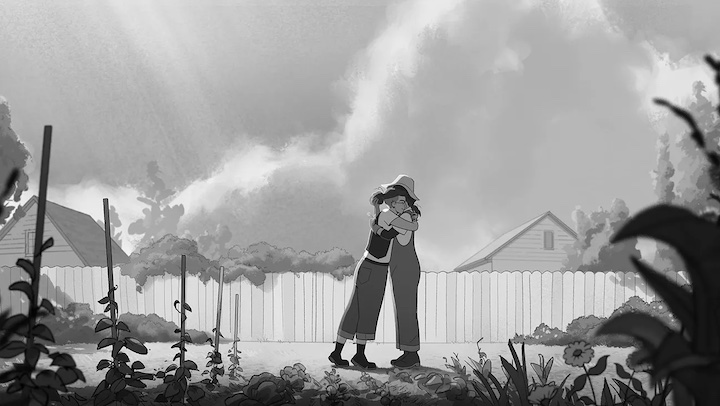
LN: Although I love it and it’s what drew me in to this story, the film doesn’t replicate the visual style of the graphic memoir. We developed a distinct visual language of our own, giving the world a cinematic sense of depth, atmosphere, and dramatic lighting. At the same time, I wanted to preserve the hand-drawn quality that I loved in the comic. I wanted audiences to feel the presence of the artists behind every frame, like you can when you experience Sarah’s drawings, which is why I made the decision to create the film entirely in hand-drawn 2D animation.
Yes, the stark black-and-white palette was something I was sure we would keep. I felt it complemented the sharp wit and uninhibited honesty of the storytelling! We created two distinct visual worlds: the “sober world” and the “surreal world.” The sober world is grounded in naturalistic cinematography, lighting, and production design, which I felt we needed to help immerse the audience in Sarah’s experience and allow them to relate to it and see themselves in that world—a believable portrayal of an average family going through something agonizing together. On the other hand, I wanted to use animation in a way that I knew would be dynamic, entertaining, but also emotionally effective, which was to create the inner world of the character—what we called the surreal world. This world gave us permission to be much bolder and more expressive—to dive deep into our protagonist’s psyche and embrace a stranger, more imaginative visual language.
For me, striking this balance was less about being faithful to the visual style of the graphic novel and more about making sure I did justice to what I felt was a powerful and moving story. I think the risk with adaptation is that you try to keep so much of the original content that it stifles the opportunity to create something fresh—and ultimately honours neither version. For me, my north star was that I honored Sarah’s story and designed a world in which our story could best be presented. What I did do during the process was remind myself what it was about the book that made me feel so deeply. Although we adapted the screenplay and also developed an original art direction for the film, the book was always at arm’s length, and I referred to it often.
When Sarah screened the film just before Cannes, she told me that she was so happy that it was still weird (and that it was queer)! These were the best reviews (from the most important audience) I could have received because I felt that I had done what I’d set out to do!
Q: Tangles has a stacked cast of voice talent. Who was the first actor to come on board, and what was the hardest role to cast?
LN: True! I still cannot believe the incredible talent we brought onto our film and that I got to direct them! It was a dream come true. I can’t remember who came onto the project initially but the casting process was very collaborative and we were focused on putting together a believable family.
Honestly, none of the roles were hard to cast because they all said yes! I’m well aware that this rarely happens, but I’m not complaining! We aimed very high with our cast and did not squander that incredible opportunity. We made an effort to get our talent together in the recording booth (which is also very rare!) because we wanted to capture the most authentic performances of family members or in the case of Sarah (Abbi Jacobson) and Donimo (Samira Wiley), navigating a very difficult time. I wanted to capture the intimacy of these conversations and arguments, but I also wanted to allow for the magic that can happen when you give time for improv and play! In Julia Louis-Dreyfus, Bryan Cranston, Abbi Jacobson, Seth Rogen, Sarah Silverman - just to name a few - we had some of the best comedic and improv talent on the planet! This space and time for riffing gave us beautifully honest but also very funny dialogue that we then animated our characters to!
Q: It’s not the first time Julia Louis-Dreyfus and Bryan Cranston have been costars. Their characters had a make-out session on Seinfeld and, more recently, both voiced characters in The Sheep Detectives. How did you land on this pairing for Tangles?
LN: The character of Midge is such a pivotal role in the film, so we needed to start here. As we were working with Julia as a producer as well as an actor, we appreciated her input on all things! When she suggested Bryan for the role of Rob, we absolutely loved this idea. It was a complete dream to get to work with them and witness them bringing the Leavitts to life. I hope they keep working together forever because it’s pure magic!
Q: The producing team is equally stacked with Julia Louis-Dreyfus and Seth Rogen also attached on that front. Louis-Dreyfus has a personal connection to Alzheimer’s, losing her grandmother to the disease while her mother-in-law is currently going through it. Likewise, Rogen and Lauren Miller, who’s also a producer, started the Hilarity for Charity to raise awareness about Alzheimer’s. How did they come to be involved with Tangles?
LN: I knew about Seth and Lauren’s relationship to the disease through Lauren’s mother, Adele, and about their organization, Hilarity for Charity, so I hoped they might be interested in being a part of this project—although initially, I didn’t have expectations that they’d come on as producers or even as part of the cast! Also, I’m from Vancouver and roughly the same age as Seth; we have some mutual friends, so I figured they could do a quick background check on me to make sure I wasn’t a weirdo (which it turns out they did! haha!) but once I was able to get the book into their hands, we were on a call almost immediately. There are many similarities to Lauren’s personal story with her mother’s Alzheimer’s, so they felt a
connection to the story but also loved the graphic novel and trusted my vision for where I wanted to take it. It’s been a 10-year journey since I first reached out to them, believe it or not! It all came together the way it was meant to, and they have been incredible partners, producers, and great friends.
youYes, Julia Louis-Dreyfus unfortunately has personal connections to Alzheimer’s, as does Bryan Cranston and many other people on our cast and crew, including our financier, Vicky Patel, whose father died from the disease and who was moved to support our film. We didn’t seek this out in bringing our team together, but the sad truth is that we’ve realized it’s hard to find people who don’t have some connection to Alzheimer’s or dementia through family members, colleagues, or friends. For us, it’s meant that the people who have come onto Tangles and poured their hearts into it care deeply about this story and believe that it is important to tell a story like this.
Q: The film is full of tears. Was there a single moment during the production, be it in the recording booth or throughout the animation stages, that made you cry?
LN: So many moments! I cried all through the recordings, through audio and music sessions, animation launches! We all cried together during the recordings, the cast, our producers. It was cathartic! The scenes that got me the most sometimes changed, and sometimes they snuck up on you when you didn’t expect it. It depends on what’s going on in your life. Grief is a nuanced and ever-changing journey, and losing a parent, at any age, is profound. I lost my dad (note: not from Alzheimer’s) very suddenly, just 3 days before production started, and it was difficult for me at times to be our creative team captain and move through the process of telling a story about the death of a parent, particularly while this was still so raw- so yeah, I cried a hell of a lot. But I tried to use my grief and personal pain to guide my directing, and in a way, it helped me to relate to the character more and to be brave when depicting heart-wrenching moments that I know now to be very authentic and relatable. There are a lot of ways in with this story, and I think that’s why we had such a strong response from audiences who have told us that they can relate and see themselves or their loved ones in it. We’ve also heard from people who felt really seen as caregivers, and that the way we portrayed this experience was very truthful and authentic. Others said they were able to understand their loved ones better after watching Tangles. Then some people said it made them want to call their moms immediately after watching, which is nice
too!
Q: As heartbreaking as Tangles is, it’s also surprisingly humorous in parts. Was there a particular way you maintained high spirits throughout production?
LN: Yes! We laughed A LOT. We laughed until we cried! As I mentioned before, we were able to have some of our talent together in the recording booth, and these were incredibly fun sessions! We had Sarah Silverman and Pamela Adlon riffing together, and I didn’t ever want to say cut! We had Bowen Yang and Wanda Sykes! We ruined MANY takes in the recordings due to uncontrollable laughter. This was also true through the screenwriting, the character design, the sound and music, and especially animation! It’s a funny movie, and we had a lot of fun making it!
Q: Tangles was produced through Giant Ant. How did Tangles stand out from past projects the studio worked on?
Jay Grandin (Nelson’s husband, a co-producer on Tangles, and co-founder of Giant Ant) chimed in for this question: It’s easy to make the mistake of thinking that animation is animation, but in reality, the process of making the film bore little resemblance to business as usual at Giant Ant. The obvious difference was timeline — a decade compared to a month or two — which brought with it a very different sense of patience compared to the high turnover world of advertising; it required a different sensibility from our team of artists. Another way that we were challenged was around process. We’re so accustomed to building the plane while we’re flying it on fast turn projects. Process is important, but not in the same way as on such a large project like Tangles. It became more important to measure twice before cutting, and to make decisions that scaled elegantly across 90 minutes of effort.
For these reasons, we built a team highly experienced in long-form for the core effort on Tangles, with a couple of longtime Giant Ant artists bringing continuity in leadership roles. Later in the production process, the commercial team at Giant Ant joined the project for a series of “surreal” sequences that visualize the main character’s psyche, done in a unique style based on our protagonist’s artwork. In many ways, these sequences were more like our traditional commercial work in that they were short in run time and, because they live outside of the house style of the film, gave us the latitude to treat them in isolation, varying the tools in service of how we wanted to immerse the audience in the particular moment.
Being number and having the opportunity to blend teams and modes of working in this way was a real gift and, in the end, was one of the things that made it really feel like a Giant Ant project.
Q: Tangles made its premiere at the 2026 Cannes Film Festival, where it received a seven-minute standing ovation. Can you take me through that experience?
LN: Oof. I’ll try. It still feels like a dream that I’m not sure really happened. ;)
First of all, we had just finished the movie after a 10-year journey of screenwriting and development and 3 years of breakneck hand-drawn animation production! So it was wild to be packing and getting on a plane to show it to the world at Cannes after all this time. An insane, crazy honor to be invited to premiere there. Before I knew it, we were on the red carpet then sitting down in the Agnes Varga Theatre. Some people in our cast and entourage at Cannes were seeing the completed film for the first time! My daughter, Fern Grandin, plays the voice of Young Sarah, and this was the first time she saw the movie as well, so it was very moving for me to watch her watching it!
The standing ovation was surreal. I mean, you hear about these ovations in the
news after Cannes - long ovations for the big movies, but it honestly never
crossed my mind for our film! When people started standing up, I was completely overwhelmed, but when the clapping just kept going, I think that’s when we all kinda lost it. It was so overwhelming, but such a sweet release for those of us, including my screenwriting partners, Sarah Leavitt and Trev Renney, and Seth and Lauren, who had been a part of this project from the beginning. It was very emotional for us all!
What was the most special was that Sarah Leavitt was there with us. Being able to
hold her hand and cry through the standing ovation. This whole journey started
with her and I being set up on a friend/collaborator date and it turned out to
completely change both of our lives.
Q: I feel Tangles deserves a Best Animated Feature Oscar nomination, although I wouldn’t stop there. It’d be great to see the screenplay and casting get some love. Whatever awaits Tangles on the awards trail, what has been the rewarding part of the film’s journey for you?
LN: Thank you so much! I hope you are right ;) Yes, it would be very cool if the screenwriting and casting were acknowledged! I also think there should be an ACTOR (SAG) awards for voice work. I witnessed these incredible actors pour their hearts and souls into the words we wrote, and they truly gave our characters their beating hearts. Award-worthy performances that should be acknowledged!

Nick Spake is the Author of Bright & Shiny: A History of Animation at Award Shows Volumes 1, 2, and 3. Available Now!