A website dedicated to animation, awards, and everything in between.
Lucy Lost Review | 2026 Cannes Film Festival

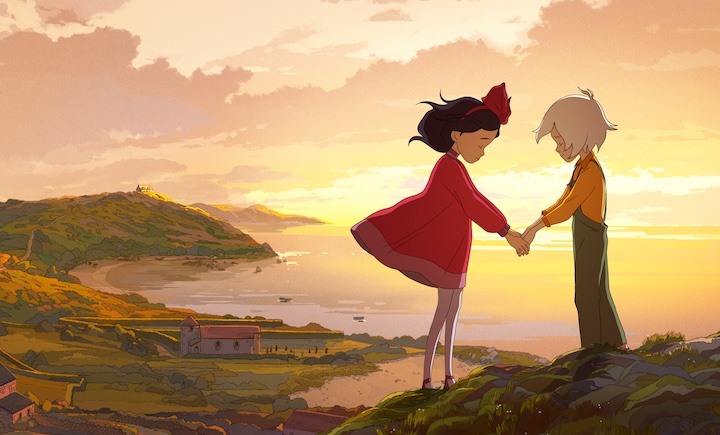
Credit: Lucy Lost (Xilam Animation)
Xilam Animation is best known for their work on the Oscar-nominated I Lost My Body, a film made strictly for adults. Lucy Lost is aimed at the whole family, although it explores mature themes from a child’s perspective. The film is set against a wartime backdrop. It isn’t spelled out which war at first, but those familiar with certain historical events can connect the dots. Of course, some things never change about war. While Lucy Lost mostly takes place away from the combat, the paranoia and prejudice stemming from the war have reached the titular character’s backyard. Locals are looking for an enemy, and little Lucy is an easy target.
Lucy stands out from everyone else in town, being the only child with white hair. The other children spread rumors that she’s a witch. To the fair, Lucy has a hard time proving them wrong. Lucy has talents that she can’t explain. She sleepwalks at night, as if something beyond the isles is calling out to her. It’s clear that her mother, father, and brother are hiding something about her past, but what exactly? Lucy also has visions that nobody else can see. This extends to a little girl named Milly, who starts visiting Lucy. Milly looks a lot like the protagonist from Kiki’s Delivery Service, adding to the witch theory.
Lucy Lost has the essence of Studio Ghibli production, most notably When Marnie Was There. Both coming-of-age films revolve around memories and the mysterious relationship between two girls. Lucy Lost still develops its own identity, just as the main character searches for hers. Compared to the introverted Lucy, Milly is a social butterfly. Granted, Lucy is the only one Milly can interact with, but she bounces off the walls with every word she says. The film keeps the audience guessing how Lucy and Milly are connected. Is it supernatural or psychological? Even if you see the explanation coming after a while, Lucy Lost leaves you hooked from start to finish.
Although Milly seems like the only person that she can confide in, Lucy’s family does love her. Her parents are overprotective, though the rest of the community views her as an outsider. While the adults might not believe in witches, many suspect Lucy of being a foreigner. Whether or not Lucy actually has powers, a witch hunt is a witch hunt. Lucy Lost approaches such xenophobia in a way that younger audiences can understand. However, the image of a parent standing between their child and an angry mob may resonate more with adults, especially in our current political climate.
As difficult as the subject matter can be, Lucy Lost overflows with vibrant animation. This marks the feature directorial debut of Olivier Clert, although his past credits on Klaus, The Little Prince, and Little Amélie or the Character of Rain shine through here. Clert and co-writer Helen Blakeman draw from Michael Morpurgo’s book, Listen to the Moon. It’s been a good couple of years for animated adaptations of Morpurgo’s works, with Lucy Lost coming out on the heels of 2023’s Kensuke's Kingdom. The rights to Listen to the Moon have been in Xilam’s pipeline for years, at one point being planned as a TV series. Like Lucy herself, the project got lost, but eventually found its way.
While Lucy Lost is a wonderful film, an extra ten or fifteen minutes could’ve pushed it to another frontier. A teacher who recognizes Lucy’s gifts is one of several side characters who might’ve benefited from more screen time. The resolution, in particular, can feel like a speedrun as we zoom through several key milestones in Lucy’s journey. That said, these moments still hit emotionally, with the bittersweet final line leaving us on a satisfying note. It’s a beautifully crafted blend of fantasy, history, and memory, with all three shaping (or perhaps reshaping) a young person’s sense of self.

Nick Spake is the Author of Bright & Shiny: A History of Animation at Award Shows Volumes 1, 2, and 3. Available Now!