A website dedicated to animation, awards, and everything in between.
Viva Carmen Director Sébastien Laudenbach Interview

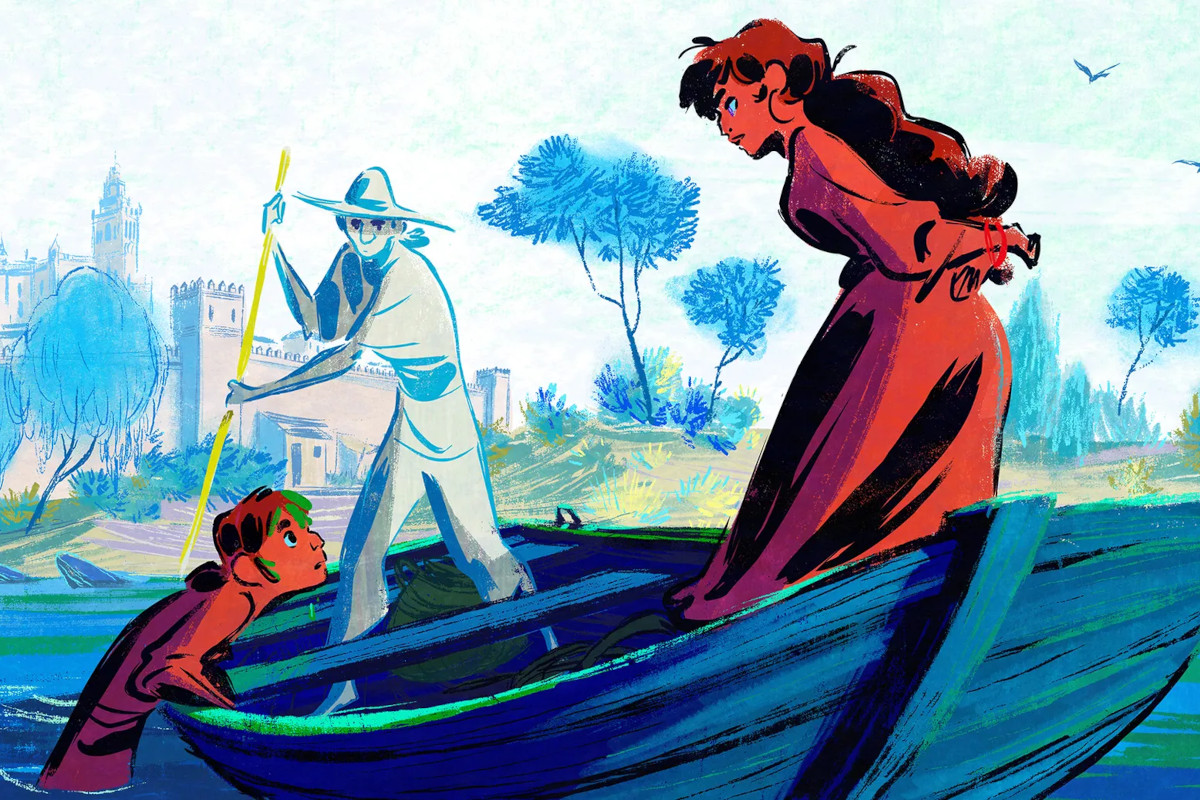
Credit: Viva Carmen (Folivari)
Viva Carmen is the latest film from Sébastien Laudenbach, who previously brought us The Girl Without Hands and Chicken for Linda!, the latter being co-directed by Chiara Malta. Laudenbach's third animated feature brings a fresh perspective to Georges Bizet's opera Carmen, both visually and narratively. Viva Carmen was selected for Directors' Fortnight at the 2026 Cannes Film Festival. It's also among this year's feature film competition at the Annecy International Animation Film Festival. Cartoon Contender spoke with Laudenbach about the craft behind Carmen, his creative collaborations, and reinterpreting a classic story for a new generation.
Q: There was a roughly seven-year gap between your first feature, The Girl Without Hands, and your second, Chicken for Linda!. Thankfully, we didn’t have to wait as long for your third, with Viva Carmen premiering three years after Linda!. Was there a particular reason for this quicker turnaround?
A: Writing and financing an animated feature film in Europe is quite a long process because we depend a lot on public funding, which is necessary for our ecosystem and to guarantee a certain plurality. I started working on Viva Carmen in 2018, when, with Chiara Malta, we were making the trailer for Chicken for Linda!. Thanks to Folivari and my co-writer, Santiago Otheguy, we were able to develop Viva Carmen while we were in production on Linda. The fact that Linda was co-written and co-directed by Chiara was also a great opportunity. Moreover, with Chiara, and on her initiative, we are writing a new joint project. Let's hope it takes us less than eight years to show it to you!
Q: While The Girl Without Hands, Chicken for Linda!, and Viva Carmen all have a similar aesthetic, each film is also stylistically distinct. With Viva Carmen, in particular, your use of colors and shadows is taken to the next level. How do you feel your craft has evolved with each film?
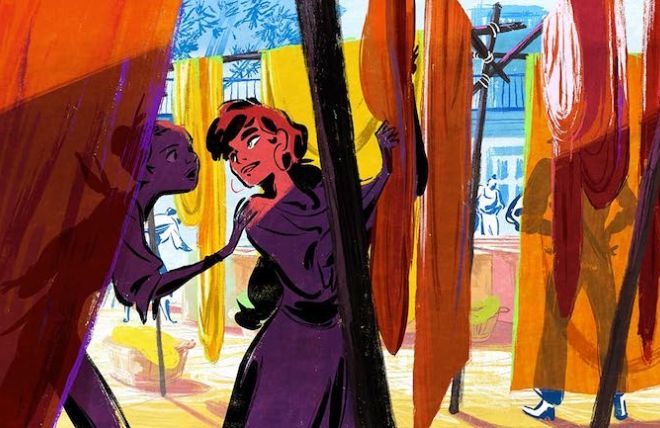
A: Every film is different. And although I am committed to continuing in the same direction, I don't like to do the same thing twice. Unlike the other two, I'm not the graphic designer of Viva Carmen (by the way, for Linda, I only created the characters). I asked Cyril Pedrosa to take care of it, and he was quickly helped by Elodie Rémy for the sets and Eléa Gobbé-Mévellec for the characters. She was inspired by the line of The Girl Without Hands to create these characters. The colors, initiated by Pedrosa, are clearly the work of Elodie Rémy, and the film owes a lot to her. I wouldn't say I've taken it to a level, because there's no scale of value. Chicken for Linda!, even though there is no shade, has a strong artistic value. With Chiara, we wanted a simple and readable film for a young audience. Viva Carmen takes place in Seville, a city of color and contrasts. It was essential to play with sharp shadows.
Q: Carmen herself has a striking design, but it took me a little while to realize what made her stand out from the rest of the cast. Then it hit me. She’s the only character with pupils in her eyes. Is there a deeper symbolism to this, or is it just an extra touch that hints at what makes Carmen unique?
A: Bravo for your sense of observation! Carmen was a complex character to define visually. She comes from opera, she is an icon, an archetype. She had to retain this power of fascination. However, everyone imagines their ideal Carmen. There is no such thing as a "good" Carmen, and we searched a lot, with Pedrosa and Gobbé-Mévellec. Green eyes, that was noted in the script. And that gives it that presence that you're talking about. She is a central character, although she is not the main character of our adventure. It is the challenge of the mission. But as the story unfolds, she becomes more human, gradually leaving her iconic status to become a normal woman. She's attractive, but she's also a good friend, she has friends... It is richer than in Bizet's opera.
Q: Certain elements of the story and even a few visuals reminded me of Disney’s The Hunchback of Notre Dame. Funnily enough, the art director on Carmen, Cyril Pedrosa, was an inbetweener on Hunchback. What can you tell me about your collaboration with Pedrosa?
A: I met Cyril when he was finishing a comic book that had taken him a lot of time. When I read this book (The Golden Age), it seemed obvious to me that I had to work with him. Santiago Otheguy and I had been writing Carmen for two years, but I was unable to produce any images. Cyril accepted right away! He really wanted to come back to hosting. He started by making illustrations for the film, very large drawings 1m20 wide, in charcoal. When the producers came to see these drawings at Cyril's house, they were all scattered on the floor. It was magnificent! We felt like we had the film at our feet! Cyril worked on the film for three or four years. Artistic director, he was also a decorator since he created more than 200 collections under the direction of Elodie Remy. This is an example of the fluidity of the functions that we wanted to put in place. Eléa Gobbé-Mévellec is a character designer, but she also did 29 minutes of storyboard and all the posings! Danaé Mikrogeorgiou is an animator, but also did storyboarding! I wanted the functions not to be too compartmentalized. Regarding the Disney film, we avoided Carmen looking too much like Esmeralda because there was indeed this risk. The two characters are quite similar in their personalities. In the end, we opted to put a shirt on Carmen rather than a low-cut collar that made her lean too much towards the archetype of the seductive gypsy (which Esmeralda does). It also modernized the character.
Q: Speaking of art direction, were the backgrounds all hand-painted? They certainly appeared to be.
A: What interested me about Cyril was his relationship with drawing. He and Elodie went to Seville, and Cyril came back with a lot of sketches. We wanted to keep this artisanal, sketchy aspect. And it was a real gamble for the great team of decorators to adopt this style! Cyril himself no longer knew if he was the author of this or that set or not! The sketch is alive, it is the unfinished. There is a mystery in the notion of the unfinished that always attracts us. My concern, at each stage, has been to bring life everywhere. I hope I succeeded. To create the illusion of life, to quote the famous book by Ollie Johnston and Frank Thomas, we can make the most realistic animation possible. But you can also play on many other aspects that are rarely taken into account by animation filmmakers. The sketch (of the sets, the characters) is a means. Recording the voices in-situ, as Chiara had done on Linda, is another. Finally, the "beautiful animation" must be part of a general direction, which is the staging. It is only one way among others to create this feeling of life, and to make the characters palpable.
Q: Music plays a significant role in the film, with a mix of familiar and original melodies. What was the inspiration behind the music?
A: The inspiration was obviously the work of Bizet. We are adapting an opera! Just as our story uses narrative motifs from this opera, the music is also inspired by them. The fine connoisseurs of Bizet will be able to recognize many elements. It will be like a game. The musical composition of the score was divided between Isabelle Laudenbach and Amine Bouhafa. Amine is a great composer of film music and had already collaborated with Folivari on The Summit of the Gods. His music accompanies above all what happens with Carmen, the meeting with Salva, the relationship with José, Seville, destiny, the river, etc. Isabelle lives in Spain and is a flamenco guitarist and composer. She has taken a lot of care for children living on the streets or in a mine. I asked him for music in which there was gravel, dust. Camélia Jordana, who lends her voice to Carmen, is also a composer and singer. She composed the last song when the house was being built. These three talents produced a varied, contrasting score, using very diverse instruments, which produces a certain richness.
Q: It only makes sense that music would be integral, as the film draws from Georges Bizet’s opera, Carmen. What enticed you to reinterpret the opera for a new generation?
A: This stems from a discussion with a fan of this opera. This friend wondered what a Carmen would look like from the point of view of the children who are in the first act of the opera. These children bring a lot of life to the opera, but they don't serve the story. You see them at the beginning and then not at all.
So we started imagining one of these children, Salvador, who knows that Carmen could die. The film is therefore an incongruous proposition. It's a bit like opera, without really being one, there are two narrative lines, that of the children and that of the adults, of the new characters. It's a kind of spin-off that we immediately wanted to make accessible to a young audience. It's an adventure story, with an epic dimension, but in the end, one of the most important things for me is what Salva, Belén, Piri, and Bola become, who end up being like a small clan, a small tribe. This collective dimension, which was at the heart of the film's making, is also found at the end with the construction of a new world, perhaps less patriarchal, a world in which little Carmen could no longer be threatened.
Q: In what ways do you think Carmen’s story can resonate with modern audiences?
A: The opera ends with the death of Carmen, killed by José. This is not the case in our film, which, of course, addresses the possibility of femicide, but which goes beyond that, which proposes something else, a more utopian but necessary world. Our character is much more modern than the one in the opera, and our children embody this new generation, this "rising guard." I wouldn’t call it a feminist film, it's a film that wants to be humanist, inclusive, and gentle. The end credits are sung by children who sing Bizet's aria, but one word has been changed. In the opera, they sing "with the rising guard we arrive, here we are." They imitate the soldiers. In our credits, they sing "we are the rising guard, we are coming, here we are," which has a completely different meaning: it means we are the new generation and be careful, we are coming! Let's hope that this film can speak to this new generation, precisely.

Nick Spake is the Author of Bright & Shiny: A History of Animation at Award Shows Volumes 1, 2, and 3. Available Now!