A website dedicated to animation, awards, and everything in between.
Sulaimani Director Vinnie Ann Bose Interview | Oscar-Eligible Animated Short

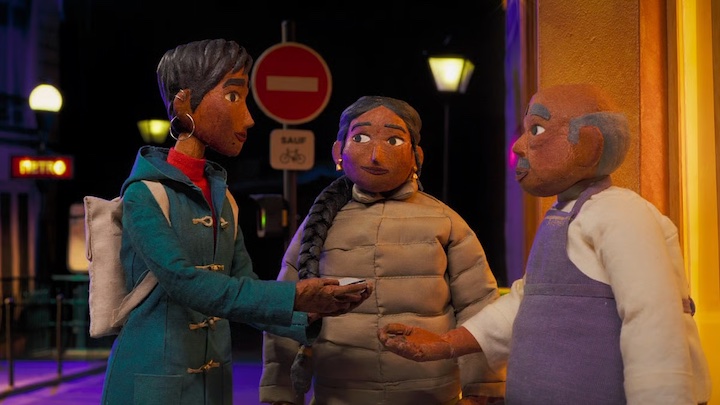
Credit: Sulaimani (Vinnie Ann Bose)
Vinnie Ann Bose is the director behind the animated short Sulaimani. This personal film centers on Alia and Neena, two Indian women living in France who have a chance encounter one evening over the holidays. Sulaimani has qualified for Oscar consideration through its wins at Best Animation at Aspen Shortsfest and Best Short Film at Manchester Animation Festival. Cartoon Contender spoke with Bose about her own immigration story that helped inspire the film, mixing stop-motion with 2D animation, and how cuisine connects us to our culture.
Q: From what I understand, you got the idea for Sulaimani while studying at La Poudrière in France, thinking about home. Was there a specific event that sparked your homesickness and desire to make this film?
VB: I moved to France in 2016 for my studies at La Poudrière, and I started writing Sulaimani in 2018 when I graduated. At the time, I couldn’t travel to India because of visa issues, and I was feeling homesick quite often. But at the same time, I was slowly starting to feel at home in France. So that really made me question myself about my identity, my relationship with the two countries, and why I had left India in the first place. During the difficult days, home food was a big source of comfort for me. But in the city I live in, there aren't any Indian restaurants that serve food from Kerala. So I guess Sulaimani actually started with just me craving for a restaurant that served food from my hometown.
Q: Culture and its ties to identity are key themes in Sulaimani. It explores what we leave behind, what we take with us, how we adapt, and what we rediscover upon immigrating from one country to another. In what ways does this theme speak to you?
VB: Sulaimani is a very personal film. The themes that have been treated in the film are close to my personal life and of other Malayali women in my entourage. The film was a way for me to explore the difficult choices that I and other women have had to make in life. Immigration is never an easy choice. The work that needs to be put in to move and adapt to another country that is so different from yours requires immense mental strength. As a brown woman in a European country, unfortunately, most have to go through a phase of erasing a part of your culture in order to be accepted. This phase comes at a cost, of course. But at the same time, the time spent in the new country comes with new experiences that you learn to navigate through, a new language and culture learnt, and also a newfound independence acquired, which in every way kind of molds you into a different person, whether you like it or not. And this creates a distance between the "new you" and the people close to you back home. I personally found it difficult to strike a balance between what was to be unlearned and what was to be preserved from the past. I think that making this film helped me clarify these themes that were very present in my mind.
Q: The film notes at the top that the following will be spoken in two languages: French in white subtitles and Malayalam in yellow. How important was it to you that both languages were represented here?
VB: Malayalam is my mother tongue, and French is the language that I speak in my day-to-day life now. I felt that to understand the duality of the characters in the film, both languages had to be heard, and one has to see the effect each language has on both characters. The film starts with Alia getting intrigued on hearing Malayalam in the Parisian metro, which is a very rare case. Hearing her mother tongue in a context where the language she communicates with, is French, is what brings her attention towards Neena. On the other hand, Neena is still very much in touch with Malayalam. Her French is very basic, and she has surrounded herself with the Malayali diaspora. Through the language spoken by each character, we learn a lot about them and their backgrounds. After the meal, when Alia speaks for the first time in Malayalam to Neena, this for me was a way to show that Alia has taken a step forward to reconcile with her past. The language does play an important role in this film, as I consider it to be an essential part of one's culture, just like food.
Q: Sulaimani may sound like a simple title, but it carries great weight for Alia. What inspired you to make this beverage a key component of your film?
VB: Sulaimani is a drink that we drink in Kerala, usually after a heavy and festive meal, like a Biriyani. It is considered as a drink that helps with digestion, so I wanted to use it as an element that not only digests the food, but also the emotions the characters have had to feel during the meal. Sulaimani after a Biriyani is a go-to Sunday lunch combo or a festive meal at a wedding, especially for Muslim families in Kerala. Alia, being from a Muslim family, and having hundreds of memories linked with the Sulaimani, the drink strikes a sensitive chord. For the cook, Sulaimani is a sort of a magic potion that soothes the troubles of the mind, hence I wished to dedicate an entire sequence on how he makes the Sulaimani.
Q: Stop-motion food might not be edible, but I always find it visually appetizing nonetheless. The food in Sulaimani is no exception. How did you craft the cuisine here?
VB: Stop-motion, in general, is a lot of cheating. It was the same with the food elements as well. I used the weirdest things that I found in thrift shops and garage sales to make the trick work. Hair gel with tiny pearls made boiling water, cling wrap sculpted into the form of pouring liquid did the trick for when the Sulaimani is poured into the glass, glycerine with ink made the miniature hand-modelled chicken pieces appetizing. The porottas were made with paper maché, and hundreds of hand-sculpted (with sculpey) tiny grains of rice made up the Biriyani. I really wanted the food to look appetizing in this film, where one could forget that what you see isn't edible in any way. So a lot of trials and errors were done before reaching a satisfying result.
Q: My next question is something of a two-parter since your film utilizes two styles: stop-motion is used for the scenes in the present, while scenes in the past are conveyed with 2D animation, calling to mind a living painting. Can you take me through the processes for both sequences?
VB: I was lucky enough to have a wonderful team of talented artists to work on both styles. Each step never included more than four artists, making the creating process very intimate and artisanal.
The stop-motion part was entirely shot on camera (no green screen). The movement of the metro was created at the same time as the character animation, while moving the tunnel and the metro station millimeter by millimeter. There were three shooting sets in all, with two sets being used at a time by an animator each, while the third was being prepped to permit the rotation of the two animators. Fourteen puppets were made, including a copy each for Alia and Neena in order to be able to shoot parallely on either sets. All of the props, sets, and puppets were handmade by the team. The animators often used video references for the acting of the characters, and would animate roughly four to six seconds per day (on 2's, 12 FPS). The whole fabrication and shooting process of the stop motion part took eight months, and was done at the Ciclic Animation residency in Vendôme, France.
The 2D animation was done on TV Paint (hand-drawn animation on 3's, 8 FPS). The same method of using video references for animating was extremely helpful in creating movements that are realistic and authentic to Malayalis. The character animation was later printed on paper, and then hand-painted with ink on the other side of the paper using a light table (to avoid lines drawn on TV Paint). The backgrounds were hand painted with ink on a single sheet of paper, creating a complete painting for each background. The finished frames of the character animation were shot under camera while aligning them with reference points directly on Dragon Frame so that the animation remained accurate (to avoid aligning them on the computer). On After Effects, the white part of the paper surrounding the character animation was erased, and the character animation was placed on the backgrounds. The 2D backgrounds, animation, coloring and shooting took eight months and was done at Studio Les Astronautes in Valence, France.
The compositing of the stop-motion and 2D part took one month's time, and was done at Studio Chromatik in Marseille, France.
Q: Was the plan always to tell the story with two animation styles, or did that develop over time?
VB: The idea of using two animation techniques was present right from the beginning. Cracking the structure of the film was quite complicated, as there are two characters, two countries, two languages, and two temporalities (the present and the past). I figured that using two animation styles would help the audience to follow the back and forth in time. The idea of using two styles started off as a tool to facilitate the comprehension of the storyline, but the choice of the techniques was linked to what it represents to me, personally. I feel that stop-motion has a tangible, concrete, and realistic aspect to it, which corresponds with the present, the reality. On the other hand, 2D animation with ink paintings has a blurry, vibrant, and abstract aspect to it, which I feel is similar to our memories. Our memories are often tainted by the emotion we have experienced in it, with certain details that are very clear, and others not. This is why the colors in the 2D part of the film are very vibrant, graphic, and unrealistic. I felt it would enhance the idea of treating memories as something that is perceived and unclear, rather than factual.
Q: It feels like you could’ve set this story at any time of the year, but the Christmas backdrop does add a certain warmth to it. Was there a specific reason why you set the film over the holidays?
VB: In France, Christmas is probably the one time of the year when everybody spends time with their families. For immigrants who don't have family around, this time of the year is particularly heavy, because even if you've surrounded yourself with friends in your day-to-day life, it is a season when you often end up alone. I felt that setting the film during the Christmas season would be powerful to portray the sudden loneliness that Alia is confronted with, and also a poetic way to show the meeting with Neena and the cook, as creating a new chosen family with the diaspora.
Q: Sulaimani has won multiple Oscar-qualifying prizes, including Best Animation at Aspen Shortsfest and Best Short Film at Manchester Animation Festival. What have been some other standout memories from its festival run?
I got the opportunity to attend multiple festivals, and it has always been a great pleasure to interact with the audience, share the process behind the film with them, and also a wonderful way to meet fellow filmmakers and discover their art.
One stand-out moment was when Sulaimani won the grand prize of Ajyal competition at Doha Film Festival 2025. What touched me was the jury, which was composed of around 100 young film enthusiasts (aged 19 to 25) from all over the world. Their reaction after the screening, with a huge applause was heartwarming, and I was fortunate enough to be able to discuss with them afterwards, where especially young brown girls expressed their feelings of being heard and well represented in the film.
Another standout memory was in Rome, when I bumped into Irene, a young Italian girl born to Malayali parents, after Sulaimani won the Best Fiction award at WFF Youth Film Festival. She invited me to her home for dinner, where her parents had laid out an amazing platter of food from Kerala. I showed them the film after dinner, and they were touched as their lives are very similar to the film, especially the mother, who had the exact same trajectory as Neena.
Q: Which character do you identify with more: Alia or Neena?
VB: I identify more with Alia. Her trajectory is very similar to mine, so it was quite clear to me that the film should start off from her point of view, and slowly discover Neena. In fact, I gave the voice for Alia in the film.
Neena is very close to my life as well. Her character is written based on many women from my parents' village, who have immigrated to America, Europe, or Gulf countries as nurses or home nurses, leaving their family and children behind, and at times apart for over ten years due to visa and financial issues. Neena's voice is given by Jessin Jacob, my neighbor in my parents' village. At the time, she was waiting for her visa to go to Saudi as a nurse. And now, she is married to her husband, who works in Dubai, and she's in Kerala preparing for the nursing exam that would permit her to go join him in Dubai.
For all of the characters, I preferred casting people who were very similar to the character written, to get the most authentic and natural acting for the film. It was important to me, especially because language played such an important part in the film.

Nick Spake is the Author of Bright & Shiny: A History of Animation at Award Shows Volumes 1, 2, and 3. Available Now!