A website dedicated to animation, awards, and everything in between.
The Doomies Season 1 Review | Binge With a Bag of Halloween Candy

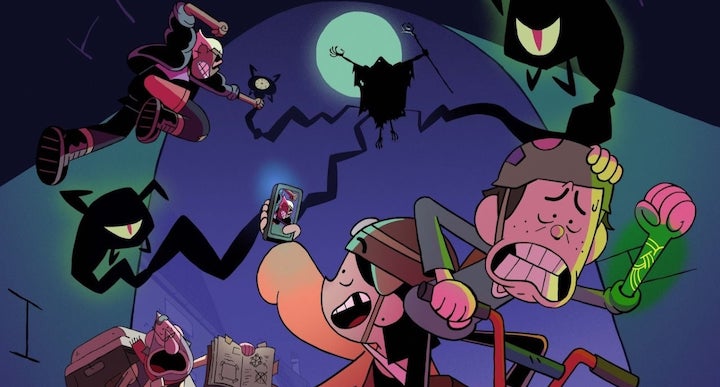
Credit: The Doomies (Disney+, Disney Channel)
Last June, The Doomies quietly arrived on Disney+ to little fanfare. I myself didn’t learn of the show’s existence until a couple of months after its debut. October seems like the ideal time to finally review the first season. Not just because Halloween is on the horizon, but this is arguably when the series should’ve premiered. To be fair, the show is airing internationally on Disney Channel this month. For horror comedy fans who’ve felt a void since Gravity Falls ended almost a decade ago, The Doomies is the spiritual successor you’ve been long anticipating.
This isn’t to say that The Doomies is a Gravity Falls retread. Where Gravity Falls mainly borrowed from Twin Peaks and The X-Files, The Doomies is Disney’s answer to Evil Dead. It feels weird even typing that, but it’s hard not to think of Ash severing his hand with a chainsaw as protagonist Bobby becomes cursed, causing his arm to glow green. Naturally, The Doomies never gets as gory as Evil Dead. It’s aimed at a family-friendly audience after all. Much like Sam Raimi’s original Evil Dead trilogy, though, the show blends body horror, supernatural horror, and skeleton-related slapstick.
As you might’ve guessed from the title, The Goonies was another inspiration, although The Doomies is a smaller group. Initially, the only other member is Bobby’s friend Romy. Together, they try to grow their social media following as they chronicle the paranormal activity plaguing their seaside town, Ouimper. If that name sounds distinctly French, that’s because co-creator/director Andrés Fernandez was largely inspired by his hometown of Brittany, France. Likewise, co-creator/art director Rémi Zaarour is French, while French-based animation studio Xilam (Lucy Lost, I Lost My Body) co-produced the series. Despite the numerous French references, most of the characters speak with American accents. Then again, you could say the same about Disney’s Beauty and the Beast.
Bobby and Romy’s inner circle grows with Doug, the local lighthouse keeper who knows all about the town’s supernatural roots. To call him absent-minded would be an understatement, however. He’s like a cross between Merlin from The Sword in the Stone and the titular character of Ash vs. Evil Dead. By that point, Ash was a little older and a little wiser… but still sort of a doofus. So is Doug. The gang finds its muscle in Kim, a “Chosen One” who initially seems like an unstoppable enemy. Calling the Terminator to mind, though, Kim soon allies with the mortals, learning what it means to be human in the process.
The Doomies gets off to a solid start, with Zaarour’s charmingly creepy designs and co-creator Henry Gifford’s character-driven dialogue drawing me in. I was officially won over by the eighth episode, which delves deeper into Bobby’s absentee mother. Ironically, she’s a traveling author who specializes in child psychology, all while overlooking her own son. Bobby lives with his aunt Jenny, who may or may not be dating a vampire. Bobby is so afraid of telling his mom how he feels that he’d rather summon a demon who looks like her. The demon, dubbed Momster, initially wants to eat Bobby, but eventually forms a material bond. Of course, still being a demon, Momster takes nurturing to extreme lengths.
Not only does the comedy fire on all cylinders in this episode, but it encompasses one of the show’s simpler yet most valuable messages: “If you don't speak up, nothing will ever change.” We see the abandoned Bobby combating an inner demon in more ways than one. Sometimes, the hardest thing for a child to do is to tell a parent how they really feel. Bobby’s issues aren’t resolved in twenty minutes, although he takes the first step. The fact that this lesson stems from his relationship with a demon also makes Ouimper’s connection to the supernatural more interesting, showing that even the seed of evil can have a soul.
Bobby isn’t the only one who forms an unlikely bond with the supernatural. Romy takes in an army of skeletons, Doug romances a quote-unquote monster, and Kim becomes something of a bridge between worlds. While The Doomies gains momentum as the season goes on, it never quite cracks its big bad problem. For much of the season’s first half, a witch known as Mordam is built up as the ultimate evil, although she feels kind of generic compared to villains like Bill Cipher. Then, about halfway through the season, another big bad is plopped into her story, only for them to be replaced by someone else in the finale suddenly.
The most interesting villain is Killjoy, a lighthouse keeper so obsessed with destroying the supernatural that he becomes the very thing he hates. Killjoy is more of a side villain, though, with his arc only lasting a few episodes. Even if the villains leave something to be desired, the charm of our heroes is more than enough to carry The Doomies. Although it initially seems the series will be about humans fighting the supernatural, The Doomies becomes more about finding a middle ground. It’s only natural that the middle ground would be filled by the town misfits, who never felt like they entirely belonged in either world.
In many respects, The Doomies feels like what the recent Ghostbusters movies tried to be, but never entirely found their groove. One could also compare it to another show that premiered this year: Widow’s Bay, which swept the Primetime Emmys. Here’s hoping The Doomies can pull a similar feat at the Children's and Family Emmy Awards. Both shows not only blend horror and comedy, but also center on an endearing group of “losers.” I suppose that isn’t anything new, between Stephen King’s It and Stranger Things. However, there’s only one Bobby, one Romy, and one Doug. Technically, there’s more than one Kim, but as a whole, The Doomies is more than good enough.
Awards Prospects:
Outstanding Children's or Young Teen Animated Series (Children's and Family Emmy Awards)
Best Animated Television Production for Children (Annie Awards)

Nick Spake is the Author of Bright & Shiny: A History of Animation at Award Shows Volumes 1, 2, and 3. Available Now!