A website dedicated to animation, awards, and everything in between.
The Social Reckoning Review | More The Newsroom Than The Social Network

Credit: The Social Reckoning (Sony Pictures Releasing)
At Cartoon Contender, we mainly discuss animation and awards, but also everything in between. Nick’s Flick-Reel is that in-between, reviewing live-action films and more!
The Social Network was instantly hailed as a generation-defining masterpiece. Since Facebook was still relatively new to our culture, though, there was reason to believe the film might be viewed as a time capsule down the line. Fast-forward sixteen years, The Social Network not only holds up, but it remains so relevant that many wanted a sequel. Specifically, a sequel that brought back Jesse Eisenberg as Mark Zuckerberg, David Fincher as a director, and Aaron Sorkin as a writer. Well, we just got the latter for The Social Reckoning. While it may not be everything we hoped for, the film works just enough to warrant a like.
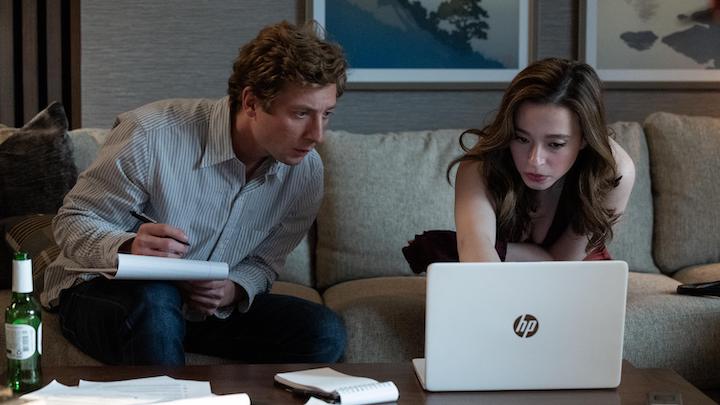
Sorkin also steps in as the director of The Social Reckoning, which isn’t so much a direct sequel to the 2010 Best Picture nominee as it is a spiritual successor. This isn’t unwelcome in an era where most legacy sequels exist to push at our nostalgia buttons. There are no glorified cameos from Andrew Garfield, Justin Timberlake, Rooney Mara, or (thank god) Armie Hammer. The closest we get to a callback is when Bill Burr’s character brings up the site Mark Zuckerberg created to rate the attractiveness of Harvard girls. Sorkin shifts the focus to journalist Jeff Horwitz (Jeremy Allen White) and whistleblower Frances Haugen (Mikey Madison). Both know that Facebook is negatively impacting mental health, although he needs evidence and she knows what happens when Facebook unfriends you.
Madison and White deliver solid performances in an engaging investigative reporting story that explores how the rise of Facebook and extremism correlated with the downfall of print journalism and common sense. It’s clear why Sorkin wanted The Social Reckoning released before the November midterms, but he avoids addressing Trump directly, even during a certain day in January. While restrained in that regard, the film goes full Sorkin with its fast-paced dialogue and soapboxy messaging. It plays more like an episode of Sorkin’s The Newsroom, which some found profound and others deemed pretentiously preachy. I lean more positive than negative on The Newsroom, although you do wish Fincher was around to reel in some of the Sorkinism. As a director, Sorkin does a competent job at replicating Fincher’s style, but few can match his visual eye.
Ironically, the least interesting aspect in this follow-up is Zuckerberg, now played by Jeremy Strong. Strong is a great actor who turns in a convincing impression of Facebook’s CEO. Part of what made Jesse Eisenberg’s portrayal so iconic, though, is that he didn’t try to do an impersonation. He created his own Zuckerberg, while still capturing who he’s always been at his core: a nerd who prioritized his own ambitions over friendship. That hasn’t changed in The Social Reckoning, where Zuckerberg is more concerned about user engagement than being likable. On paper, I don’t have trouble believing that Eisenberg’s Zuckerberg grows up to be Strong’s. Yet, on a performance level, I didn’t buy Strong as an older version of the Zuckerberg we met in The Social Network.
While The Social Reckoning isn’t The Social Network, perhaps expecting it to be was asking too much. Sorkin has nonetheless made an effective drama that reflects what Facebook could’ve been vs. what it’s ultimately become. The film raises compelling arguments about the importance of free speech, but also the importance of intervention when misinformation is spread, children are bullied, and coups are staged. Even if other recent films have made these same points, The Social Reckoning is well worth watching in these divided times. Unlike the first film, though, I don’t see people talking about The Social Reckoning over a decade and a half from now. It’s more likely to be viewed as, well, a time capsule.
Awards Potential:
Best Adapted Screenplay (Writers Guild of America Awards)

Nick Spake is the Author of Bright & Shiny: A History of Animation at Award Shows Volumes 1, 2, and 3. Available Now!