A website dedicated to animation, awards, and everything in between.
Space Cadet Review | An Interstellar Robot Dreams

Credit: Space Cadet (Viva Pictures)
Space Cadet seems bound to draw comparisons to Robot Dreams. Not just because both have robots in common. Thematically, the two films explore companionship and separation. Space Cadet takes the latter a step further, as the cosmos itself separates the characters. Both are also based on graphic novels. Neither has any dialogue, although music plays a key role. In fact, Space Cadet’s director and author of its source material is Kid Koala (Eric San), who’s best known for his work as a DJ. It shouldn’t come as a surprise that Space Cadet has its share of needle drops, but the animation is the real star here.
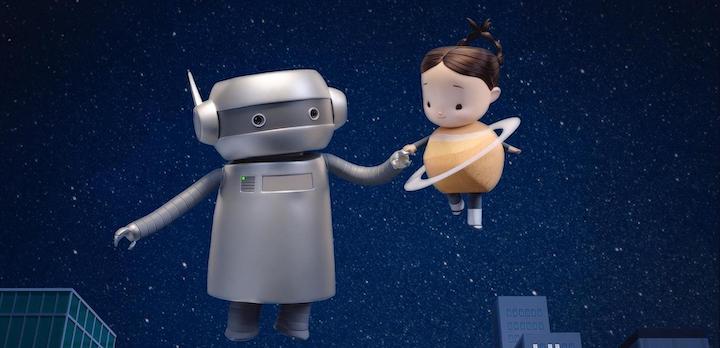
In addition to serving as the head of story, Lillian Chan was also the film’s production designer. Corinne Merrell similarly juggled duties as art director and one of the editors. The team brings a charming storybook look to Space Cadet. While the animation is CG, it has an almost stop-motion feel. There’s a handmade, cardboard-like vibe to this universe, calling games such as LittleBigPlanet and Tearaway to mind. The diorama aesthetic complements the narration, which is simple yet full of depth.
Relying on visual storytelling, we’re introduced to Robot and Celeste, whose mother was lost on a space mission. Robot is left to care for Celeste, often lifting her spirits with games and origami. Before Robot knows it, Celeste is grown up and ready to embark on a space adventure of her own. Once Celeste launches into space, Robot is left without a purpose other than to wait. Robot realizes that he’s obsolete in more ways than one. When Celeste was little, Robot might’ve been cutting edge. Just as the Motorola Razr can now be found in a museum, though, Robot finds himself upstaged by newer models. Robot’s memory bank is almost at maximum capacity, meaning he may soon lose more than his purpose.
Robot’s scenes alone on Earth are the film’s most effective. While Celeste’s intergalactic voyage is interesting enough, it’s strangely not as compelling as the moments back on our world. Celeste’s subplot has some touching twists, but this is where Space Cadet can start to feel padded out. At only 86 minutes, Space Cadet doesn’t overstay its welcome. Had the film been trimmed down to a short subject, though, I sense that the experience might’ve had me in tears. As a feature, Space Cadet is comprised of many poignant moments interspersed with others that go on longer than they need to.
The pacing holds Space Cadet back from reaching the same heights as Robot Dreams. Even so, the film is an undeniable delight. Kid Koala complements the imagery with a heartwarming score, bringing real emotional gravitas. While Space Cadet can appeal to children, it doesn’t talk down to them. For all the cute characters, there’s a sense of loss that looms over the picture. The film doesn’t sugarcoat loss either. When a character is gone, they don’t come back. Space Cadet is nonetheless upbeat and strangely comforting. It leaves you grateful for those who made sacrifices so that you could get to where you are.
Awards Potential:
Best Animated Feature – Independent (Annie Awards)

Nick Spake is the Author of Bright & Shiny: A History of Animation at Award Shows Volumes 1, 2, and 3. Available Now!