A website dedicated to animation, awards, and everything in between.
Because Today Is Saturday Director Alice Eça Guimarães Interview | Oscar-Eligible Animated Short

Credit: Because Today Is Saturday (Animais AVPL, Studio Kimchi)
We all look forward to Saturday. The mother in Alice Eça Guimarães’ animated short is no exception, although she soon finds that just because today is Saturday doesn’t mean she gets a day off from motherhood. Because Today Is Saturday won Best Short Film from a Spanish-Speaking Country at Animayo and PÖFF Shorts: Best Animation Short at Tallinn Black Nights Film Festival, qualifying for Oscar consideration. Cartoon Contender spoke with Guimarães about the real-life inspirations behind her film, telling this story with 2D animation, and more!
Credit: Alice Eça Guimarães
Q: What compelled you to make a film that not only explores motherhood, but also womanhood and gender equality?
AG: I started thinking about this story during COVID, when everything shut down. All of us had to stay at home, and that meant no outside help: no housekeeper, no eating out, no help from the other woman in my life. That was when it became more and more evident the imbalance of my domestic life: unconsciously, I felt strongly that the domestic labor is my responsibility and that I could only ask for “help” from my husband and kids. It’s a feeling that is difficult to shake because it is so embroidered in the way I was brought up.
I remember that I had an argument with my husband, in which I was trying to explain how hard it was to find space in my brain for something more than an endless succession of tasks that I had to perform every day in order for our family life not to collapse. I didn’t get my point across then, and that was when the thought of translating what I was saying into images first came to my mind.
This thought made me look for more information, and I began reading more works written by women and about women's issues. During this time, I joined a feminist book club because I needed some guidance. Much of the ideas that build this short film have a root in a book: talking about the endless nature and the invisibility of domestic labor comes from a quote by Simone de Beauvoir about the relation between the torture of Sisyphus and domestic work.
Few tasks are more like the torture of Sisyphus than housework, with its endless repetition: the clean becomes soiled, the soiled is made clean, over and over, day after day. The housewife wears herself out marking time: she makes nothing, simply perpetuates the present … Eating, sleeping, cleaning – the years no longer rise up towards heaven, they lie spread out ahead, gray and identical. The battle against dust and dirt is never won.”
― Simone de Beauvoir, The Second Sex
The need of a mental space, the garden, is derived from A Room of One's Own by Virginia Woolf. The concept of mental load was explained to me by the French cartoonist Emma “You Should Have Asked,” and the ending scene is heavily inspired by the way Sylvia Plath died and her book, "The Bell Jar."
There are many other references that are reflected in a more subtle way in the film like Invisible Women by Caroline Criado Perez (though I don't agree with her views on transgender people), We Should All Be Feminists from Chimamanda Ngozi Adichie, or The Yellow Wallpaper by Charlotte Gilman... I'm very thankful to have found the work of all these women.
Q: In addition to your own life, you drew from other women like your mother, mother-in-law, and sister. Have they seen the film and, if so, how has it resonated with them?
AG: Yes, they have seen the film. They are all very proud and happy from all the recognition I’ve been having because of the film, but they all have very different reactions. My mom doesn’t talk about it, my sister understands the protagonist’s struggles very well. She sometimes says in conversation, usually about a daily life hustle, “ it’s just like in your movie.” My mother-in-law said very plainly that these are the sacrifices a mother must make and that is how the world is and should be… That made me think about how some beliefs that benefit the status quo pass on from generation to generation, without us questioning it.
Q: After working with techniques like pixilation and stop-motion in past projects, why did you think 2D animation was best suited for this story?
AG: Since the beginning of the project, I wanted to do something in 2D animation, to have the privilege of creating something from a blank page. I was also yearning for the possibility of learning on the go. With stop-motion and pixilation, the workflow is very demanding, time-wise. There is a big and expensive team, with actors, lights, sets, make-up artists… The time is very tight, you are limited by the structure of the puppets/actors and sets, and you have to get the shot on the spot. You can only change a few things in post-production, or else it becomes a nightmare.
I like the freedom of 2D: I can detach completely from reality, and make changes and add details almost infinitely ( though I don't recommend changing a film indefinitely).
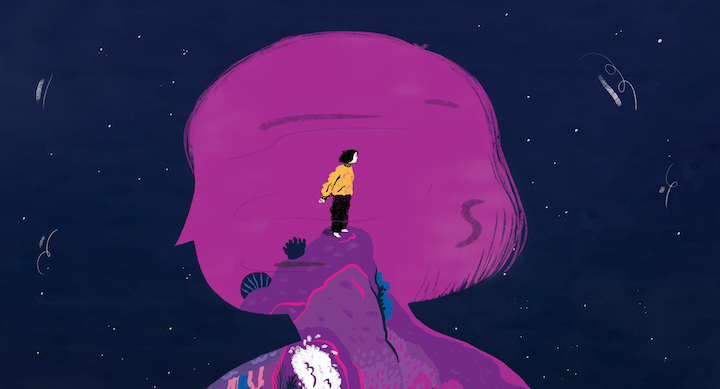
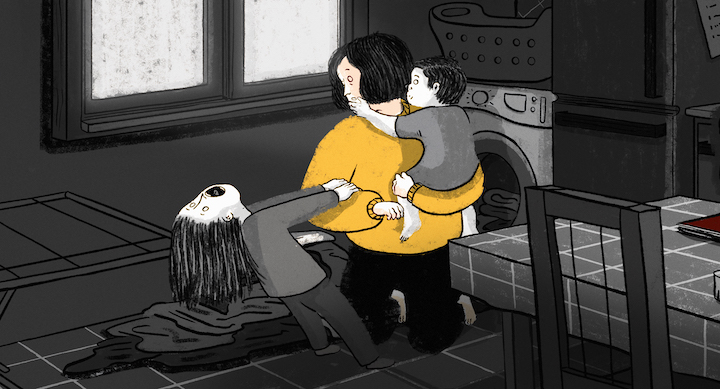
But, most of all, the concept that I wanted to develop, about invisible labor and mental charge, required the flexibility of 2D animation. I wanted the protagonist to interact with her soul (shaped like the silhouette woman) and also to see her thoughts. The house had to become more and more claustrophobic throughout the film and, in the opposite way, I wanted the protagonist's inner world, that comes from her guts, to represent endless creation, and be able to grow infinitely both in size and diversity, and the best way for me to do it would be through 2D animation.
Credit: Because Today Is Saturday (Animais AVPL, Studio Kimchi)
Q: Did you always plan on having the film take place on a Saturday, or was another day of the week considered?
AG: Yes, it was always a Saturday. My protagonist is a working mother, so Saturday is her official "free" day– out-of-work day. But as it happens to most working women that can't afford to pay for someone to do “their" domestic work, Saturday is the day where they do free house labour that they didn't have the time to do during the week. The name, Porque hoje é Sábado is taken from a poem by Vinicius de Moraes - O dia da criação - that talks about Sábado as a religious day, almost like a mantra, a special but also contradictory day, to reach the extraordinary, where routine is suppressed, where god created man. Extraordinary things may happen. Either good or bad. Where you can escape routine, something that my protagonist is searching for.
Also, in the beginning, the project was bigger and wouldn’t evolve in one Saturday, but on an infinite number of Saturdays, until the tension of it all would be unbearable. It included a night sex scene about the fear of getting pregnant. I had to take it out because it was too much new information, it didn't fit the flow of the film.
Q: Throughout the film, the mother keeps pulling objects from her head. What inspired this particular visual?
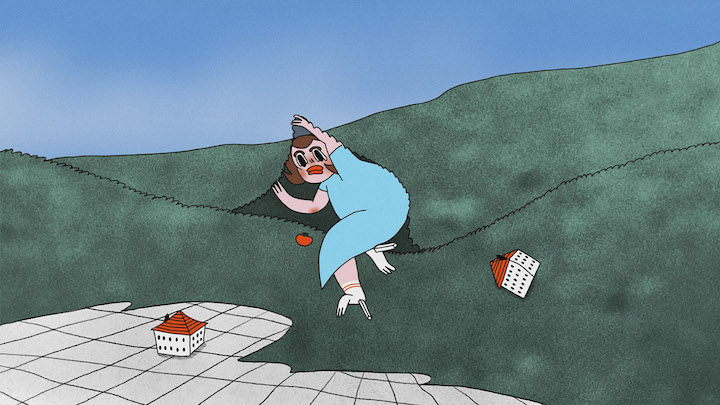
AG: I think I first had the idea when I was window shopping and I saw a vase of a Greek statue head with a hole on the top, where a plant would come out. In my first sketches, the protagonist had the top of her head filled with plants and flowers. Then, it evolved to all the other objects, representing the protagonist's thoughts, overlapping and showing her mental charge. And I really like the idea of a head that works like a Mary Poppins bag, where everything fits inside, even a house or an elephant. Someone told me that it looked like a SIMS character from the game, and that is true! - but I didn’t think about it at the time.
Q: While the central character’s world is mostly black and white, there are a few standout uses of color, most notably orange, yellow, and purple. How do you think those colors reflect the protagonist?
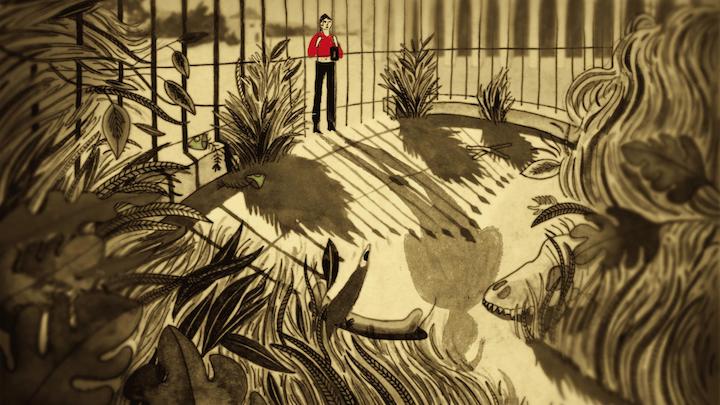
AG: The main protagonist, the woman, had to stand out, so I made her be the only character with color. I find it difficult to make a woman be the center of attention in a film. When a man enters a shot, the audience will immediately assume he is going to take over the action. So everything but her is black and white, the kids and the man almost camouflage into the set.
When she is in the garden, I want her to blend in with the whimsical landscape, hence the use of a color scheme with yellow and green and then purple and pink, which are also colors associated with women's emancipation.
The colors are an aesthetic choice - I really love yellow and orange - but they are also full of symbolism: the orange can be seen like a prisoner's uniform or a working uniform. The purple is usually associated with the women’s fight for gender equality.
Credit: Because Today Is Saturday (Animais AVPL, Studio Kimchi)
Q: The film doesn’t shy away from nudity, but not in a way that feels gratuitous. Rather, it reflects both the mother’s vulnerability and strength. Why was nudity essential to the story?
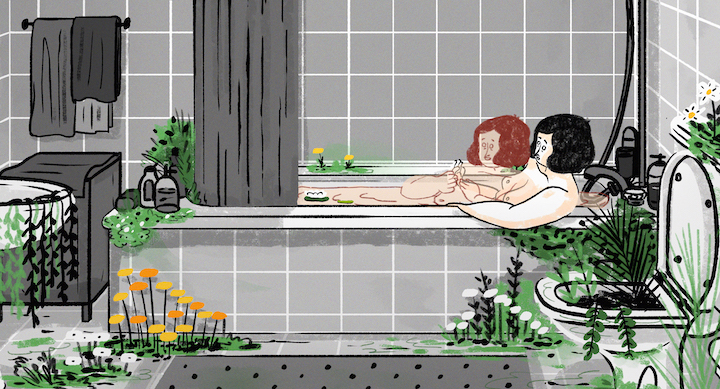
AG: The woman inside the woman - I call her the silhouette woman- was always naked from the beginning of the project. She represents complete freedom, so I never imagined her with clothes on. The woman is only naked in the bathroom, for kind of the same reason. When I created the bathroom scene, I did it because I thought of it like a safe space, where she could feel relaxed. But when she looks in the mirror, she feels old and neglected - beauty standards for women are ridiculously high - she puts clothes on to hide all the beauty objects that come to her mind and hide her body.
Q: Because Today Is Saturday has qualified for Oscar consideration, having won Best Short Film from a Spanish-Speaking Country at Animayo and PÖFF Shorts: Best Animation Short at Tallinn Black Nights Film Festival. What has it been like experiencing the film with festival audiences?
People have been very generous, and there is always someone that comes to me and says nice things about the film. Especially young women that are just becoming mothers or that see their own mothers on the film. I remember when two sisters came to me to talk about the film and how they cried watching it. They said, "that was my mother on the screen…" and talked about some details of the film, I felt so seen!
I also had a very poignant message from a woman working in animation saying she was a young mother and was considering quitting her dream of being a director but, because she watched my film, she felt she had the right to follow her dreams and decided to keep fighting for her space.
Q: Without going too deep into spoilers, the ending involves an oven. How did you decide to end the film on this note?
AG: That scene is heavily inspired by the life of Sylvia Plath and the way that she died. At dawn, she left breakfast for her kids, who were still sleeping in their bedroom. She sealed the door to their bedrooms, went to the kitchen, and put her head on the gas oven, taking her own life.
She has a quote that touched me deeply:
“I saw my life branching out before me like the green fig tree in the story. From the tip of every branch, like a fat purple fig, a wonderful future beckoned and winked. One fig was a husband and a happy home and children, and another fig was a famous poet and another fig was a brilliant professor, and another fig was Ee Gee, the amazing editor, and another fig was Europe and Africa and South America, and another fig was Constantin and Socrates and Attila and a pack of other lovers with queer names and offbeat professions, and another fig was an Olympic lady crew champion, and beyond and above these figs were many more figs I couldn't quite make out. I saw myself sitting in the crotch of this fig tree, starving to death, just because I couldn't make up my mind which of the figs I would choose. I wanted each and every one of them, but choosing one meant losing all the rest, and, as I sat there, unable to decide, the figs began to wrinkle and go black, and, one by one, they plopped to the ground at my feet.”
― Sylvia Plath, The Bell Jar
I wanted this ending to make audiences uncomfortable. I want some real change on this subject. I have a big problem with the way society frames motherhood and women. First, I don't like the idea of the ultimate sacrifice: "A mother must do everything for her children." I think this concept is wrong, both for the mother and for the children. Also, I don’t like the concept that women are inherently multitaskers, super-women that can do it all, that is just a way to justify free labor. It's exhausting, and it takes a big toll on women, it shrinks their world and their capacity to dream, reflect, and create.

Nick Spake is the Author of Bright & Shiny: A History of Animation at Award Shows Volumes 1, 2, and 3. Available Now!