A website dedicated to animation, awards, and everything in between.
South Park Seasons 27 & 28 | Review

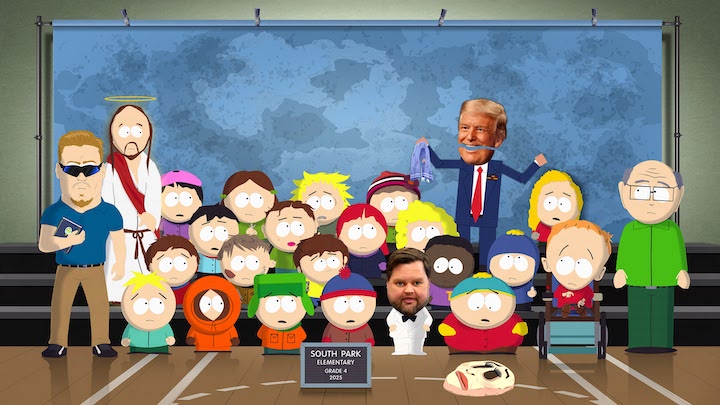
Credit: South Park (Comedy Central, Paramount)
Prologue: South Park Seasons 27 and 28 each have five episodes… but they aired back-to-back with an overarching story. This is one season comprised of ten episodes. Who are you kidding, Paramount and Comedy Central? Just call this Season 27! Now on with the review…
Where most long-running animated shows are content with repeating the same formula that’s worked for years/decades, South Park has opened itself to experimentation. Even before it could be considered a long-running show, South Park took risks, killing off Kenny “for good” in Season 5, replacing him with Butters, then Tweek, then ultimately bringing him back. Since Season 18, though, experimentation has become the norm for South Park, playing around with serialized storytelling. Instead of one episode about the 2016 election, Mr. Garrison running for office (in lieu of Trump) turned into an ongoing arc that lasted longer than Matt Stone and Trey Parker anticipated.
That said, experimentation can be hit and miss with any artist. Parker and Stone are no exception. While Garrison’s presidential ascension started funny enough, it wore out its welcome by “The Pandemic Special”… kind of like Trump. With Trump losing in 2020, Parker and Stone seemingly expressed relief that they could get back to traditional South Park stories. Of course, the streaming war over the rights to South Park limited the number of episodes we’ve gotten over the past four years. By the time the streaming dispute was resolved, Trump was back in office, leading many to believe that Stone and Parker would go back to the well.
While South Park has maintained a massive fan base, those who stopped watching years ago likely weren’t interested in Season 27. Even loyal viewers figured that South Park would just recycle a tired running gag with Garrison returning to office. That’s what the citizens of South Park assume in the season opener, “Sermon on the 'Mount.” They storm Garrison’s house, already feeling buyers’ response to the most recent election. As they learn, Garrison isn’t president again. He’s living a quiet life with his partner Rick, leaving rallying behind. We then cut to the White House where we’re introduced to a cut-out version of Trump, sounding a lot like Saddam Hussein. He’s also entered a sexual relationship with Satan, who sure can pick ‘em.
If you didn’t watch the premiere live, images of Trump in bed with Satan quickly spread throughout the internet. Even if you hadn’t watched or thought about South Park in some time, this was the episode that pulled you back in. This was reflected in the show’s ratings, showing the highest viewership since the late 90s. Canonically, this was Trump’s first South Park appearance since Season 5’s “The Entity,” where he was merely a background character. In 2001, he was better known as “The Apprentice” guy, and the idea of him running for president with Oprah as his running mate seemed like nothing more than a fake news headline. It turned out to be half-right.
Before Season 27, Parker and Stone had expressed a desire to get away from Trump in future South Park episodes. They did a 180 with the season premiere, lampooning Trump harder than ever before. Back when Trump first ran in 2016, you could sense that the South Park creators weren’t especially eager to tackle him. Not because of any political affiliation, but because literally everyone was making fun of Trump. Having Garrison run in his place was South Park’s way of putting a fresh spin on the Trump saga. Trump’s second term has felt different than his first, however. With comedians like Stephen Colbert and Jimmy Kimmel having their platforms jeopardized, it’s been speculated that White House is silencing Trump’s loudest critics. As some have pulled punches out of fear of being sued, South Park went all-in, not only declaring that the emperor isn’t wearing any clothes, but he has a tiny penis, too.
Despite being even more savage than some late-night hosts, the White House’s response to South Park has been fairly muted. Not outright silent, as the Trump administration said South Park “hasn't been relevant for over 20 years” (which clearly isn’t the case). Compared to some other people and organizations that’ve gone after South Park over the years, though, Trump has been fairly restrained. Maybe it’s because Paramount’s leadership is on good terms with the president. Maybe it’s because Trump knows that South Park is a billion-dollar franchise, and capitalism is one ideal he holds sacred. In any case, South Park has not only gone after Trump, but his work family as well.
The season’s second episode, “Got a Nut,” depicted Vice President JD Vance as a Hervé Villechaize-esque sidekick who lives in his boss’ shadow and Kristi Noem as a Botox abuser who shoots every dog she spots. Upon release, those caricatures seemed to overshadow Cartman channeling Charlie Kirk (or perhaps it was Kirk who was channeling Cartman). Kirk himself was a fan of the episode, although that didn’t stop MAGA from trying to pin the blame on South Park after he was assassinated only a few weeks later. Throughout the following weeks, South Park took on more members of Trump’s inner circle, from the accident-prone Brendan Carr, to the brown-nosing Pam Bondi, to the Instagram-loving Pete Hegseth, to antichrist expert Peter Thiel.
Seasons 27 and 28 call to mind another show from Parker and Stone: the short-lived That's My Bush!. Where that show’s version of George W. Bush was a lovable doofus, South Park’s Trump is more like Basil Fawlty, an ass who we nonetheless enjoy watching. Where Basil just ran a hotel, though, Trump is given the keys to the White House, which he runs into the ground in more ways than one. That said, not everything goes Trump’s way. When Satan becomes pregnant with his baby, Trump scrambles to have it taken care of. While this leads to some funny material, it can also meander, leaving the audience to wonder if the season is going to stick the landing.
It echoes something Sharon tells Randy in the episode, "Sickofancy." For all of the time invested in the Tegridy Farms storyline, it never seemed to pay off. South Park finally said goodbye to Tegridy Farms this year, although it came at poor Towelie’s expense. It was an overdue move for Tegridy Farms, but would South Park similarly milk the Trump storyline dry… and then keep trying to milk it regardless? There are moments when it came dangerously close. The first time Trump drops his pants to reveal a micro penis, it’s funny. The second time, still funnier than it has any right to be. The third… honestly, gets a chuckle. The fourth… yeah, it’s starting to get a little old.
Thankfully, Seasons 27 and 28 didn’t exclusively rely on Trump jokes. Sure, it was the main focus, with Stan even saying in one episode that South Park sucks now because it’s gotten too political. South Park has always been political, for the record. While some will argue that the most recent seasons over-relied on political humor, they also found room for commentary on ChatGPT, the Labubu craze, deepfakes, and the 6-7 phenomenon that confused every adult not on TikTok. Even those on TikTok couldn’t explain why 6-7 was supposed to be funny, although that didn’t stop kids like Cartman from laughing until they vomited.
Beyond Trump’s White House, South Park took shots at Israeli Prime Minister Benjamin Netanyahu and Americans (supposedly even Paramount) selling out to Saudi Arabia. The presence of Jesus in public schools also took on a literal meaning, as South Park’s most well-mannered resident tries to figure out where he fits into the modern landscape of Christianity. There’s a difference between Christianity and MAGA Christianity, but what happens with the latter eclipses the former? Although Jesus tries to resist MAGA Christianity, PC Principal pressures him to get with the program. The PC in his name no longer stands for Political Correctness. Now, he’s Power Christian Principal. Despite completely changing political affiliations, the character remains the same, punching people into agreeing with his beliefs. It goes to show how the far-left and far-right are more alike than they care to acknowledge.
While this was the most consistently funny and narratively engaging batch of South Park episodes in several years, an ending can change one’s perspective of an entire season (or seasons in this case). By episode ten, South Park had numerous balls in the air. Would Satan’s baby be born? If so, what would the antichrist look like? Would Trump choose between Satan and JD Vance in their bizarre love triangle? Would Jesus see the light or continue down the MAGA path? Would Stan’s family move out of grandpa’s retirement home? Would Kyle’s cousin Kyle get out of prison? Would Hegseth and Thiel remain locked up? Would Towelie ever escape the White House? What the hell does 6-7 even mean? Will we ever get another “pro-Trump” PSA? We were promised “01 of 50,” although we’ve yet to see another since the Season 27 premiere.
South Park doesn’t have the best track record for wrapping up all loose ends in a tidy package. In the case of this season finale, though, it wasn’t just a tidy package. It was a Christmas package, cleverly tying several plot lines together, while still slyly copping out - or crapping out. It does so by reaching back into the show’s legacy with the long-awaited return of a beloved Christmas staple. Not Mr. Hankey, who’s teased as Stan gazes into a toilet, wishing for a Christmas miracle. With the antichrist story arc climaxing around Christmas, I began to wonder if the woodland critters might pop up. South Park didn’t disappoint, bringing the critters back for a showdown involving Trump, Vance, Jesus, Satan, and Towlie… only to resolve the antichrist arc with an anticlimax so mean-spirited that it’s hard not to laugh. This is South Park, after all.
The season may end with Trump victorious and Satan mourning a baby who chose suicide in the womb over our current existence. Yet, the final scene is one of hope. With Jesus’ faith restored, he pulls A Miracle on 34th Street, getting Stan’s old house back and decking it out for the holidays. The ending serves as a reminder that while things are bleak and won’t be solved overnight, miracles can happen. Whatever awaits, at least we can count on one thing. South Park will be there to make it better.
Nick Spake is the Author of Bright & Shiny: A History of Animation at Award Shows Volumes 1 and 2. Available Now!