A website dedicated to animation, awards, and everything in between.
Legendary Disney Animator Praises Jessie Buckley’s Oscar-Nominated Performance in Hamnet

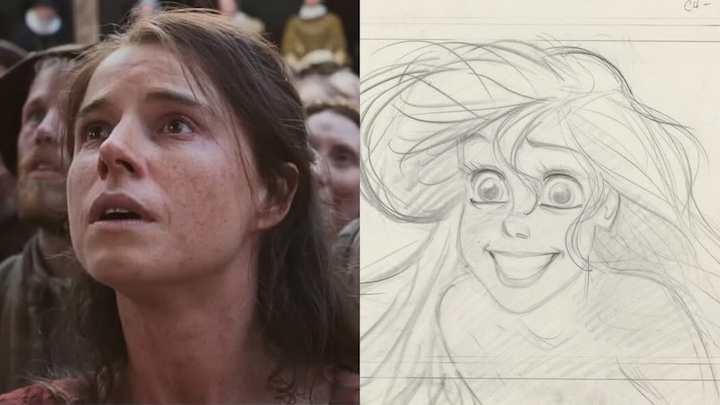
Credit: Hamnet (Focus Features), The Little Mermaid (Walt Disney Feature Animation)
If one acting race is all locked up at this year’s Oscars, it’s Jessie Buckley winning Best Actress for Hamnet. Buckley gave a raw, devastating performance as William Shakespeare’s wife, Agnes Hathaway. (In reality, she was more commonly known as Anne Hathaway, although the filmmakers went with the alternative name from her father’s will for obvious reasons). Buckley has already won the Golden Globe, the Critics’ Choice Award, and more than 30 other accolades. Granted, the BAFTA and Actor Awards could still shake things up heading into the Oscars. Even if Buckley doesn’t sweep throughout the season (which I believe she will), it’s hard to imagine anyone challenging her for the Oscar.
Her strongest competition is Rose Byrne, who also won a Globe for If I Had Legs I'd Kick You. Byrne is her film’s lone nominee, however. So is Kate Hudson for her work in Song Sung Blue. Not since Julianne Moore in Still Alive has anyone won Best Actress without their film being nominated anywhere else. Moore was a sweeper that season, propelled by an overdue career narrative. Emma Stone and Renate Reinsve are also nominated for their work in Bugonia and Sentimental Value, respectively. Neither has won much this season, and in Stone’s case, she’s already a two-time Best Actress nominee. No rush to give her a third.
Buckley is on her second Oscar nomination, previously getting nominated for Best Supporting Actress for The Lost Daughter. Hamnet is a Best Picture nominee that’s unlikely to win the big prize. If voters want to honor Hamnet somewhere, Buckley’s performance is the obvious element to award. As well-crafted as the film’s Oscar-nominated screenplay is, Buckley’s performance elevates every moment, especially the ones without dialogue. The climax at Globe Theatre, in particular, is a testament to the mentality that acting is reacting, with Buckley’s facial expressions alone taking us on an emotional journey.
Buckley’s performance has received widespread praise from many, including legendary Disney animator Tom Sito. Having previously learned under animation director Richard Williams, Sito started his Disney career working on Who Framed Roger Rabbit. He remained at Disney throughout much of their 90s renaissance, with his credits including The Little Mermaid, Beauty and the Beast, Aladdin, and The Lion King. Sito’s career stretched beyond Disney, working on DreamWorks films like The Prince of Egypt and serving as a co-director on the animation segments of Osmosis Jones. From 2017 to 2020, Sito was on the Academy’s Board of Governors for the Short Films and Feature Animation Branch.
On his Facebook page, Sito recommended that young animators watch Hamnet five times to study Buckley’s face. “She says more with a silent expression than most others who can't stop talking,” Sito wrote. “It's not just copying live action, it's about learning how the muscles of the face display emotion. Look how much her eyes are communicating with each other. Learn to articulate the face. Not just rely on cliche masks.” Sito went on to relay a lesson from fellow animation legend Ken Anderson, whose Disney career stretched back to the Silly Symphonies: “When you see a movie that moves you, don't just watch it once and walk away. Watch it again and again and learn WHY it moved you.”
Now more than ever, people are taking notice of the work that goes into voice acting, so much so that some feel it should have a category at the Oscars. Yet, one element of acting in animation that's still overlooked is the performance taking place on the screen. Whether hand-drawn, stop-motion, or CG, the animated character is performing even without their voice. We all know Jodi Benson voiced Ariel in The Little Mermaid, but for a good portion of that movie, Ariel is left speechless. This is where Sherri Stoner’s mannerisms as Ariel’s reference model really shined through.
In addition to reference models, animators will sometimes look in a mirror for inspiration, incorporating their own expressions into the character they’re bringing to life. In that sense, animators are actors, even if that won’t get them a SAG card. The next time you watch a character in an animated film, don’t just analyze the performance in their voice. Analyze the performance in the animation. It might not be eligible for an acting Oscar, but the character animation may contain just as much humanity as Buckley’s Oscar-nominated (probably future Oscar-winning) performance.

Nick Spake is the Author of Bright & Shiny: A History of Animation at Award Shows Volumes 1, 2, and 3. Available Now!