A website dedicated to animation, awards, and everything in between.
Cows | Student Academy Award-Winning Short Directors Interview

Credit: Cows (ESMA)
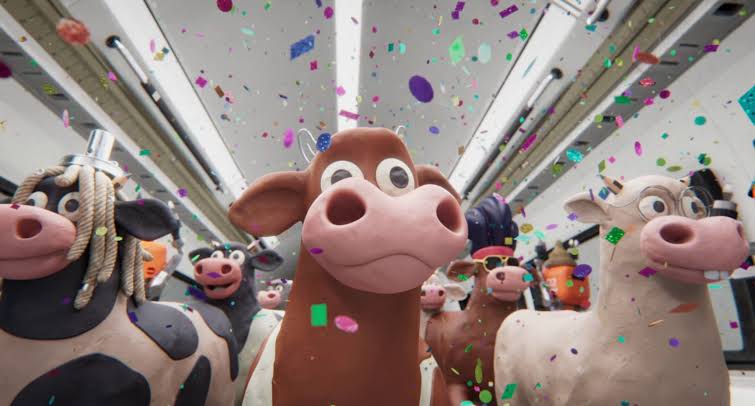
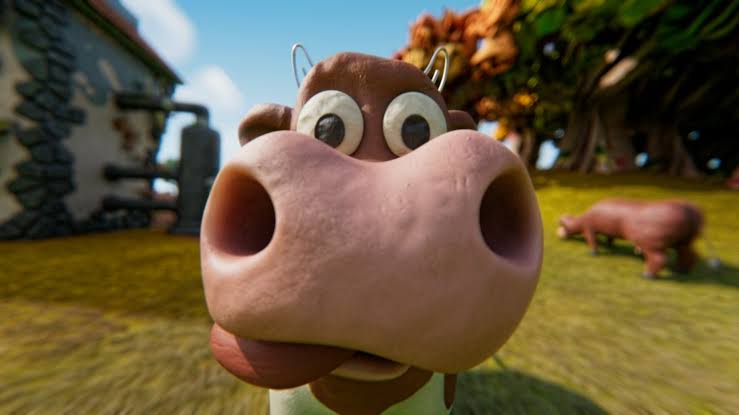
Cows is among this year’s Student Academy Award-winning animated shorts. Although animated with computers, the film has a Claymation aesthetic, channeling the works of Aardman. The story follows Moo Moo, a cow who gets more than she bargains for when she leaves her simple life for the high-tech farm across the way. Cows was a group effort between nine students from the European Securities and Markets Authority (ESMA): Nicolás Acevedo Ferraté, Valentin Brachet, Maxence Corriette, Tanguy Delepine, Eireen Failly, Jonathan Lally, Elio Molinaro, Yulia Nikitina, and Alexandre Vespuce. Cartoon Contender spoke to seven of the Cows’ credited directors about the collaborative process, technical challenges, and what each learned from the experience.
Q: Cows has nine credited directors. How did you all settle on this idea as your graduation film?
Maxence Corriette: It goes back to how graduation films work at ESMA. In our third year, everyone in the class writes a script, and each script already comes with its own visual world, because the writer has been thinking about the look as much as the story. The school then selects a few of them to go into production, and from there each of us gravitated toward the script we most wanted to spend the next year on. The teams formed around those choices.
So nobody sat in a room and invented Cows by committee. Elio Molinaro wrote it, and the nine of us ended up on it because that was the story we wanted to make. What was collective was everything that came after. The film you see is not the script we started with. We had a lot of meetings on it, and there are several major changes between the first version and the final one.
The nine directing credits really reflect how the work was split once we started. We broke the film down by department, script, storyboard, art direction, environment design, and so on, and formed smaller groups inside the group of nine. Each group owned the decisions in its area and brought them back to the whole team. That structure is the only reason a film with nine directors stayed coherent.
Credit: Cows (ESMA)
Q: How did the script evolve from page to screen?
Elio Molinaro: Working in 3D, we have certain limitations that have to be anticipated ahead of time. The main challenge for people in the writing team was writing a story we cared deeply about, while making sure that some sequences could be cut if we ran out of time at the end of production (luckily we were able to create everything in time!). As a writer, every sequence and shot has to be motivated. So writing a script like a sequence could be cut is very paradoxical.
Q: What was the collaborative process like? Was everyone on the same page with the overall vision for the film, or did conflicting visions emerge as production unfolded?
Maxence Corriette: Honestly, no. We had conflicts, like any group of nine people working on the same thing for that long. Pretending otherwise would be a lie. What mattered was what we put in place around them.
I was the production manager on the film, so I ran most of those meetings, and we deliberately split them in two. One was about the production itself, the technical state of the film, what was late, what was blocking. The other was about how people were actually doing. We wanted the human side to have its own space instead of being squeezed in at the end of a technical review, because on a film this long the two feed into each other constantly. A conflict that looks technical is very often someone being exhausted or feeling sidelined. Running those meetings did not make me the one who decided anything. Everyone had a say, and that was the whole point. But someone has to hold the structure, make sure the meeting still happens on the week when everyone is buried in shots, and nobody feels like talking.
The other thing we agreed on early was that we would be as honest and as open as we could about any problem, whether it was technical or personal. And we settled disagreements by a majority vote. The point of voting was not really the outcome. It was that everyone had to put their idea on the table and everyone had to respond to it. Nobody could be quietly overruled. And once the vote was done, it was done, and we moved on instead of relitigating it three weeks later.
Jonathan Lally: It was mostly great! Since it would be pretty hard for all nine of us to work on the script and story simultaneously, we split out into groups. Some of us working on the story (script, storyboard), others on concept art, designs, and some on the 3D pipeline. I worked on the story and regularly consulted with the other teams to keep them updated on where we are at. Obviously, because we were multiple directors, there were some clashes of vision, which is normal, but we always managed to overcome these difficulties by communicating with one another.
Valentin Brachet: The process went surprisingly well. There have, to my knowledge, been no major conflicts. Despite necessarily, as in all teams, a few small ones. The vision was shared. The visions were all divergent. But we try our best to find a balance in all these visions. To make it a film that appeals to the whole team. This was the most important thing for us, even before the recognition, because it remained a student vision.
Eireen Failly: I think the comedy aspects of the movie gave us the most trouble. The movie was actually supposed to be a full-on comedy in an earlier script! But we weren’t quite all finding the story satisfying without its balance of serious moments and funny relief. It gave us grief, but for a good result! Letting go of characters or some storylines we particularly wanted was difficult as well. But overall, we had a similar vision of what we wanted the movie to feel and look like. The miniature look was a given from the very moment we started working on the movie, and we never considered anything else. The rest was just a matter of figuring out the form in which we would make it happen.
Nicolás Acevedo Ferraté: The collaborative process was rather organized. What I mean by this is that we decided to split the team between story and visual development to prevent having to make decisions as nine people. We then asked for feedback from the whole team as the production went by. Of course, there were some disagreements here and there, but the fact that we all wanted to make the best films possible made us decide on what was best for the film and not on personal preference only.
Alexandre Vespuce: The collaborative process was quite challenging at first, as we didn’t always share the same vision, especially after making a drastic change to the film’s visual and animation direction. There were some disagreements, but we ultimately made decisions by majority vote and always tried to make sure everyone felt comfortable and involved in the production.
Elio Molinaro: Everyone seemed to be on the same page at first, but we quickly realized that even though the words we were saying matched, the visual references we had in mind could change drastically from one person to the other. That’s when we learned how good communication is paramount in such a project, we were able to align our visions in the end, and make a movie we’re all very proud of!
Credit: Cows (ESMA)
Q: Although Cows is a 3D-animated short, the earlier scenes call Claymation to mind. It’s especially reminiscent of Wallace and Gromit. It isn’t until Moo Moo arrives at the other farm that the film takes on a more apparent computer-animated aesthetic. What inspired this blending of styles?
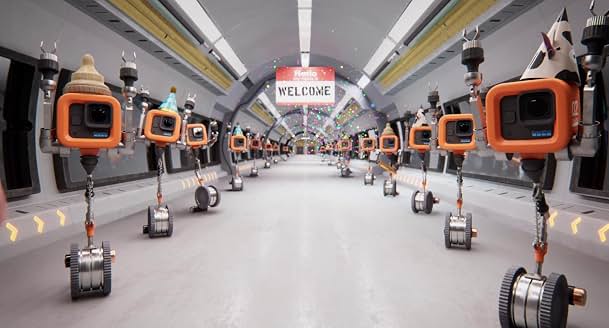
Jonathan Lally: Yes, we wanted to make the old farm different in many ways. The old farm represents a slow life that Moo Moo (the main character) wants to leave behind. The cows move on 2s (12fps), and many even slower when they are in the background of shots. On the other hand, we wanted the new farm to feel high-tech and technologically advanced. Everything in the new farm, from the platforms to the robots, is animated on 1s (24fps), which is why it feels more smooth.
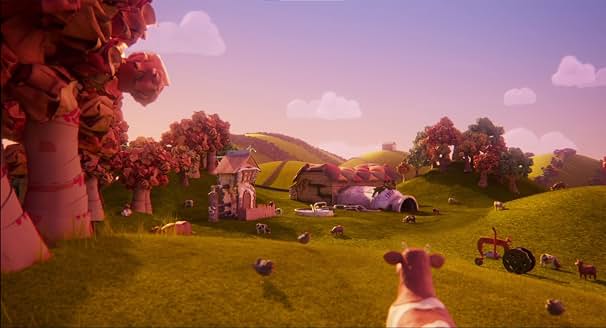
We wanted everything to feel as different as possible between the farms, the music included. We start out with a country song (vocals and guitar) which recounts the feeling of boredom and longing for another place. This music is then contrasted an orchestra upon arriving at the new farm. With a lot more impressive instruments, including a few electric guitars. Aardman Studios were obviously a huge influence on the look of the film as well as the humor. We really wanted to nail the Claymation feel in both the animation and the look of the film. A lot of work and time was spent on texturing the clay cows.
Valentin Brachet: Wallace and Gromit and [their] world obviously inspired our film, but in the end we opted for a general vision: the theme of DIY. All the elements of our film are made by small objects. Screens are mobile phones. The doors of the camera openings. The seals of the corks. Even Moo Moo was made with modeling clay, pins, and a strip of leather. So our main inspirations were the whole world of do-it-yourself. Based on the worlds of Wallace and Gromit and stop-motion in general.
Alexandre Vespuce: Our main inspiration was Claymation, particularly the work of Aardman on Wallace & Gromit or Shaun the Sheep. We wanted to recreate that handmade, slightly jerky, stop-motion feel while working entirely in 3D. The shift toward a more computer-animated aesthetic was intentional, helping us contrast the two farms: Moo Moo’s traditional, handmade environment versus the other farm’s modern, high-tech, machine-made world. We reinforced this contrast through the animation, atmosphere, and textures, while using everyday objects and recycled materials as the basis for many of the set designs.
Nicolás Acevedo Ferraté: We wanted the old farm to feel organic and alive, like stop-motion animation does. This then made the choice for the new farm rather natural, pun intended, as everything is artificial and there's no real life inside of it. However, I wouldn't call it a change of styles but rather a stylistic choice to fit the plot and message we wanted to tell.
Eireen Failly: I think it just came naturally to mind. When I first heard the pitch of the story we were given, I immediately associated Moo Moo with Claymation. Most likely because the setting reminded me of Wallace and Gromit, and I was also very eager at the possibility of making 3D animated Claymation, so maybe I was slightly influenced. I am glad, though, that I was not the only one, and we all naturally came up with that vision. I think the more apparent computer-animated aesthetic is an accident? The farm is supposed to feel different in aspect and colors, but I tried to keep its Claymation aspect when designing the interiors. The animation style itself, I know, is the same. However, as it is naturally more mechanical and sleek, I am not surprised if it feels more computer-animated. It does amplify Moo Moo’s divide from her old life, and the ‘unnatural’ aspect of this new environment. So a pretty happy accident, I think.
Maxence Corriette: Wallace and Gromit was a real reference for us, mainly on the character design, the cows especially. So that read is not an accident. But the shift you are describing is not really a shift in technique. Both farms are built the same way, out of real-world objects. What changes is which objects. The old farm is made of ordinary, everyday things: a crate, a milk carton, trees made out of paper. The new farm is made of electronics. In the room where Moo Moo gets milked, if you look closely, there are phones, a kitchen scale, a Game Boy.
That contrast is the whole point. The first farm stands for nature and simplicity, the second one for technology pushed too far, efficiency pushed too far. We never switched to a different rendering approach to signal that. We changed the vocabulary of the objects the world is built from. If the second half feels more computer animated to you, it is because the world it depicts is colder and more manufactured, not because we rendered it differently.
And it was not a plan we had from day one. We did not set out to build the entire film out of real objects. Someone put the idea on the table in a meeting, and the whole group took it immediately, without hesitation, which was not exactly our habit. It was a real turning point. It gave us a way to keep the handmade quality we loved in Wallace and Gromit without falling into a miniature set pastiche of it. The reference stayed in the characters, and the world became our own.
Q: From a VFX standpoint, what was the biggest challenge in bringing Cows to life?
Alexandre Vespuce: From my perspective, the biggest VFX challenges were mainly related to recreating the Claymation look. I was mostly involved in sculpting, modeling, and animation, but I saw my teammates working hard to reproduce the way clay naturally deforms and changes from frame to frame as the characters move. We couldn’t push that effect as far as we would have liked, but it was definitely one of the hardest aspects of capturing that handmade aesthetic. Crowd animation was another challenge, as some of the character models didn’t always behave as expected with the setups we had prepared in Houdini, especially when we wanted to make the background environments feel more alive. That’s just my perspective, though… my teammates might have a different answer!
Nicolás Acevedo Ferraté: The biggest challenge, without a doubt, in my opinion, was the scale of things we wanted to do and using USD for it. The movie has nine different environments of various levels of detail. So, learning how to use USD was essential to being able to build the sheer size of some of them. Most notably, the one we call "The Silo," which is the one where Moo Moo discovers the true size of the new farm.
Eireen Failly: The milk. Making milk that looks like clay, but not so much that you cannot recognize it, took years off my life. Alright, that is dramatic. It took two months out of my life, but still. The tsunami, which combined both milk and glass, was pretty difficult, obviously, as it was our biggest VFX spread across multiple angles. Interactions, looks, and continuity between scenes - it was all headache-inducing. From a technical viewpoint, it was all a ‘learn as you go’ experience. All VFX after that seemed pretty easy.
Maxence Corriette: For me, the biggest challenge was volume. Cows is long for a student film, eleven sequences and 117 shots. And because the world is built out of real objects, that means an enormous number of individual assets to model, texture, and look dev. Every crate, every phone, every tree is its own asset. Managing that quantity across the team, over a
film that length, was the hard part before anything else. The other half of it was animation time. Getting the entire film animated with our team took a huge amount of it, and that is not something you can optimize your way out of. You just have to plan for it and protect it.
Then there is the rendering. Some of our environments are genuinely large, the silo in the new farm, or the wide-open landscape of the old farm at the start of the film. Those were extremely heavy, and a lot of my work went into optimization so we could get the frames out without the whole thing collapsing. We worked in USD and Solaris, which gave us room to be smart about it. On the crowd shots, for example, instead of building unique assets for everything in frame, I built USD variants on the hero assets and on the environment pieces, the platforms and the floors especially, so we could get real visual variety in a wide shot while reusing the same underlying asset underneath.
Elio Molinaro: From a VFX standpoint, the main challenges were the large silo filled with cows in which she enters after being cleaned up. It was so huge that optimizing for render time on those shots was quite the challenge due to the number of models, textures, lights, etc. The cows crowds were also quite hard to pull off for every department involved, as the team was quite small. This is why student short films (at least in our school) usually try to stick to a few characters to keep a manageable workload, but with a few tricks we managed to pull it off.
Jonathan Lally: There were a lot of sets and assets to create from scratch. The time of the film (Eight minutes) was also incredibly ambitious from the advised guidelines (Five minutes). We felt we could not tell the story we wanted to in so little time. However, the longer the film is, the more complicated it is, with longer render times, longer animation production. Less overall quality than if the film was shorter.
Valentin Brachet: I think one of the most difficult points was finding cows humanized enough to give them emotions without it going into a horrific vision.
Credit: Cows (ESMA)
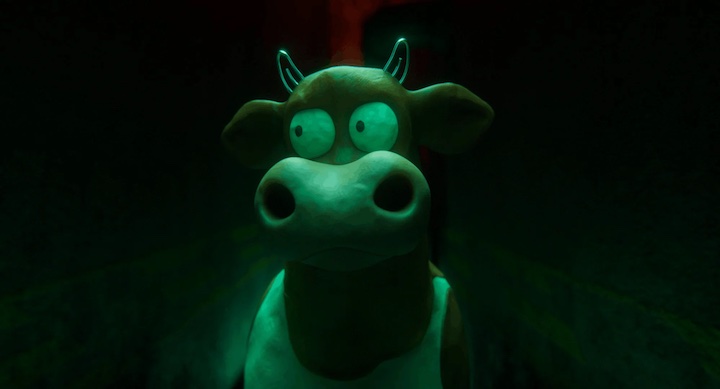
Q: Moo Moo’s horns seem to resemble paperclips. What inspired this small yet distinct design choice?
Nicolás Acevedo Ferraté: They are paperclips indeed, good catch. As we were heavily inspired by Aardman's style, we wanted to emulate the feel yet not copy it entirely, as we did not intend in just making a 3D Aardman movie. So then we asked ourselves, “How would we do these characters if it was in real life?” The style kind of started forming itself then, and that's how we ended up with the world you see.
Maxence Corriette: Honestly, there is no deep design intention behind them. We just thought she looked cute with those little paperclips, and that was enough. They were not the only option, though. We tested a number of other objects for her horns, and the ones that did not end up on Moo Moo were not wasted, we gave them to the other cows. If you look at the moment the herd arrives at the new farm, there is a lot of variety in there, and a good part of it comes from those tests. That is fairly representative of how the art direction worked on this film. We were building everything out of real objects, so a lot of the design came down to trying things and keeping what felt right, rather than justifying a concept afterwards.
Eireen Failly: Moo Moo’s design was what took me the longest. We wanted her to feel unique, without her looking out of place either. I was faced with many restrictions like her body. Because the base of the rig is the same for each cow, I could not give her unique proportions or a unique face. Of course, her coloring is also unique in the movie, but classic for a cow. Instead, we had to make her different in other ways. The paper clips are one of the most distinct things I found. Not only do they resemble horns, but she is also the only one with them, while the other cows have crayons instead. You can see more wild-looking cows in the movie when she first gets to the new farm, but they only work as a contrast to her old boring farm.
Q: The designs are full of other small touches, such as the moon being made of cheese - another Wallace and Gromit callback! What’s your detail hidden in plain sight?
Alexandre Vespuce: The cheese moon was actually my idea, and it made everyone laugh at first, but we eventually thought it was a good fit and decided to include it. My favorite hidden detail, though, is in the milking room, where many of the technological objects are inspired by things we used in our childhood or youth, such as early mobile phones and a Game Boy. There’s actually a Game Boy hidden in the milking room!
Elio Molinaro: My favorite Easter-egg/detail is the robots’ heads being GoPros and the main villain’s head being a security camera. I like the fact that it fits their mean/prison guards character while fitting their character design.
Valentin Brachet: I think this world is generally full of small details. And I think the torture chamber is the one where you can find the most with objects from your childhood.
Jonathan Lally: The artistic direction of the film was largely based off Aardman Studios (Wallace & Gromit, Shaun the Sheep, etc...) However, we still wanted to have our own distinct look. We decided that the film would be essentially "garbage" with props made out of everyday objects. If you look closely, every object and set is full of these real-life props. The trees are Burger King wrappers, the farmer's house is a carton of milk, the barn is a wooden crate, the plane is a mix of cans, the robots are GoPros, the big robot is a kettle, etc...
All these different objects allowed us to be super creative when designing the film and make subtle references such as the cheese moon. It was also a bit of a nightmare from a technical standpoint as the scale of objects became a huge problem. We couldn't have a huge iPhone next to a small Nintendo DS in the same shot as it would look weird. So, had to rework the use of some props in the story.
Eireen Failly: There are so many details I had fun designing for this movie, but my favorites are definitely in the room in which Moo Moo gets milked in the New Farm. We had lots of blank screens to fill, and so I had to make content for them. The best are probably the little animations in the Game Boys that you can see behind Moo Moo in the scene. The first time you see them, they display a ‘select your character’ type animation with pixel versions of us, and the second time we see a Pokémon battle of Moo Moo versus the milking machine. They are by far some of my favorite details in the movie.
Maxence Corriette: I did most of the modelling and the design on the silo in the new
farm, so my two favorites are both in there. The flying platforms you see inside the silo are a pair of headphones. We kept the foam ear cushions, took off the arms, and put a Lego platform on top. Once it is in the shot, nobody reads it as headphones anymore, but that is exactly what it is. And the doors of the cow cells are cameras. As for the moon, that one is exactly what you think it is. It is a straight Wallace and Gromit nod, and it was non-negotiable for us. They were our main inspiration, so it had to be in there somewhere.
Credit: Cows (ESMA)
Q: The film opens with a disclaimer about themes of animal exploitation. I found a more human tale, though, exploring how sometimes it’s better to be content with what you have rather than chase a paradise that’s ultimately a facade. What prompted this “the grass is always greener on the other side” story?
Jonathan Lally: That's right! The main story is that exact logline: to find content in what you have and not always look towards other horizons. Themes of animal exploitation came to the film naturally as we were trying to figure out the main conflict of the film and who the villains would be. The obvious answer to that was a cruel farm that is void of sentiment (hence the robots) and will mercilessly exploit cows by milking them and chopping them up, then package them and sell.
Alexandre Vespuce: The film opens with a disclaimer because some scenes can be quite intense for sensitive viewers, especially the scene where Moo Moo is forcibly milked. We deliberately wanted that moment to feel uncomfortable, although we could have taken it even further if necessary. We felt it was important to warn viewers who might be sensitive to that kind of imagery. And yes, the main message is very much that the grass isn’t always greener on the other side: we wanted to remind people that constantly chasing something bigger, better, or more glamorous doesn’t necessarily lead to what we truly want or need. Sometimes, what we’re looking for elsewhere isn’t actually what’s best for us.
Maxence Corriette: That is exactly the film we wanted to make, and it means a lot to hear it described that way. I should say that the disclaimer was not our choice. The film does show a form of violence towards animals, so we were required to put that message at the start. We did not want it there. It tells the audience what the film is about before they have had the chance to find out for themselves, and what you took from it is much closer to what we were actually after.
The moral came first. The grass is not always greener on the other side is what we set out to tell, right from the beginning. The animal exploitation setting came very quickly after that. It was not a layer we added later. It was the way we found to carry that idea, and it matched it so well that it gave the moral far more impact and far more logic than it would have had on its own. Moo Moo is not chasing an abstract better life. She is chasing a very concrete promise of one, and that lets the film show you exactly what that promise is actually worth.
So yes, the film deals with animal exploitation on the surface, but what we were really after is that very human thing of being unable to be content with what you have, because you are convinced that somewhere else is better.
Eireen Failly: The disclaimer at the beginning was a recommendation by our school's administration, in case some themes may be too graphic for some viewers. However, you are absolutely right. This is the main theme and was always the point of the story. From the moment it was pitched, and through every iteration, it was always about Moo Moo realizing that what was waiting for her in this New Farm was nothing but an illusion. The animal exploitation was really a setup for the story and for Moo Moo’s growth as a character. So she could learn the lesson we wanted to convey through the story and grow to love what she originally had under a new light. As for what prompted the very idea in the first place, as it was always the story, I could not tell you personally since I am not the one who had the initial idea.
Valentin Brachet: I think even though it was not intended at all, we had a bit of a Chicken Run base for some. Then we actually had the vision of a teacher who also saw a slightly more "human" vision and not on animal conditions. And so we also tried a minimum to deepen it without going all the way because we didn't want to get lost in our basic message
Nicolás Acevedo Ferraté: We had a lot of ideas for the story. As you said, one of them is the animal exploitation, but “the grass is always greener on the other side” was the moral we decided, as it is both universally true (it's a saying, so yeah) and that the story kind of demanded it. The initial one had this moral in mind but lacked more elements that leaned into it, so we refined the story to fit it. Personally, I think it was the natural way to go.
Q: Cows has won a Student Academy Award. The ceremony takes place at TIFF this month, where this year’s three winners will be awarded gold, silver, or bronze. Can you take me through the process of making the Academy’s shortlist and ultimately emerging as a finalist?
Jonathan Lally: Yes, and we are all thrilled! I have been spamming every free festival on FilmFreeway and surprisingly got an email that we were semi-finalists for the Student Academy Awards (which I can't even remember applying for). Another email announced us as finalists. Then, the three directors that I had entered into the submission form got an invite to a Zoom meeting where it was announced that we had won and were headed to Toronto. Pretty surreal!
Maxence Corriette: As for finding out, I was at work when it happened. My phone started filling up with messages on the film's Discord, dozens of them, and Jonathan had posted a screenshot telling us we had won an Oscar. I did not really react at the moment, to be honest. It did not land. It was that evening, opening a bottle of champagne with my parents, that it actually became real.
Nicolás Acevedo Ferraté: Making the Academy's shortlist was like blind validation. When Jonathan initially signed us up, and we got semifinalists, we were super happy. Then the finalist shortlist came in, and we were double happy. Finally, when we got announced that we had finished as one of the three winners, it was unreal. We felt like it was the culmination of all the efforts made throughout the year and all that we went through to make the film possible, yet we were not making the film to get an award. So pretty dope in the end.
Eireen Failly: A few of us will be going to Toronto to see Moo Moo be awarded, and we hope to see her continue to travel far and wide!
Q: What is the most important thing you learned throughout the production of Cows?
Nicolás Acevedo Ferraté: I'd say that we all learned something different from the film. So, personally, I learned that there's no shortcuts for hard work. If you want to make something beautiful or meaningful, you have to be at the height of your ambitions. It sounds cheesy and repetitive with the current "I want to become better" mentality in the world, but you know, it's true. I'd also add that as the main person in charge of production, I learned that, as Bruce Lee said, you have to be like water. Adapt to the needs of the production in the most selfless way.
Eireen Failly: How important teamwork is. This would not have been possible individually. I have seen, and keep seeing, how important it is to be able to work together even to bring a vision to completion. Communication is so important, but so is professionalism. I think the production of Cows worked so well because we were all so driven towards making this movie. We were really ambitious about many aspects of it, so we really had to put in the work. I think not letting rising issues, both personal and professional, just sit and fester was a big part of it. And I am glad that I worked with such a good team, with great skills, that I would definitely be happy to work with them again.
Jonathan Lally: I learned how hard it is to make a film and have a newfound respect for directors of feature-length films. For such a short story, I thought my brain was going to explode at times, trying to keep track of the timeline and the different sequences.
Alexandre Vespuce: Personally, I learned a lot from this experience, both in terms of organization and self-confidence. It taught me that I could handle myself in extremely challenging situations. But the most important lesson I learned was that everyone’s voice matters in a production when you are all creating the film together. There were nine of us, and discussions about whether something should be added, changed, or removed could sometimes become quite complicated. At the beginning of the production, I didn’t speak up enough about my own ideas, and eventually that became frustrating because I no longer felt my personal touch in the film. I sometimes felt like I was simply working for other people rather than creating something that was also mine.
At some point, I had to step up for myself and start expressing what I really thought. My teammates were a little surprised because I’m naturally someone who tends to go with the flow, but they were very understanding. The more I spoke up, shared my ideas, and proposed things, the more I felt that I truly had my place in the project. So I think that’s the biggest lesson Cows taught me: when you are part of creating a film, it should feel like your film too. You should feel comfortable expressing your ideas and trying to improve it, while of course respecting everyone else’s vision and working together. We weren’t running a dictatorship, after all!
Maxence Corriette: The people. Honestly, the most important thing I took away from
Cows is not technical; it is human. Knowing how to make 3D images is one thing. Knowing how to make them with nine other people is something else entirely, and that is where I grew the most. You learn to put your ego aside, because a production does not care about who was right. You learn resilience, and it really is something you learn, not something you turn up with. You learn to be consistent, to keep showing up week after week, because on a film this long, being steady matters more than being brilliant in bursts.
That is what Cows gave us in the end. Not just a short film, but the experience of taking a film from A to Z as a group.
Valentin Brachet: I would say that what could have been most rewarding was to see the entire pipeline. Not just a part. And to have deadlines that force us to work at a certain speed. And generally working in a team. Knowing how to find compromises and not just relying on personal preferences. Communication.
Elio Molinaro: Communication is key, especially when working in such a small team. You’d be surprised the amount of information that can be lost even when working in the same room in a team of nine.

Nick Spake is the Author of Bright & Shiny: A History of Animation at Award Shows Volumes 1, 2, and 3. Available Now!