A website dedicated to animation, awards, and everything in between.
What We Leave Behind Directors Jean-Sébastien Hamel & Alexandra Myotte Interview | Oscar-Eligible Animated Short

Credit: What We Leave Behind (Travelling distribution)
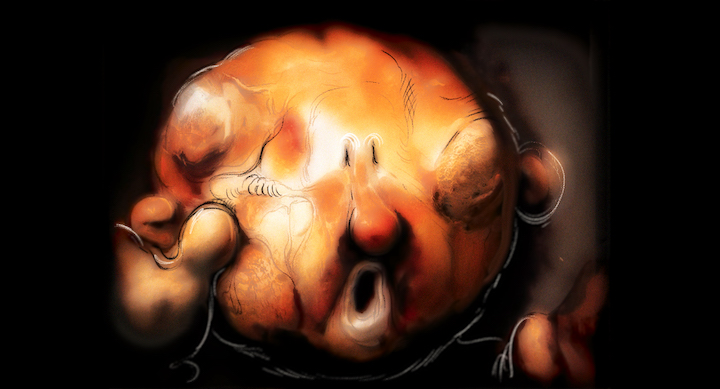
Jean-Sébastien Hamel and Alexandra Myotte are partners behind the scenes in more ways than one. In 2024, the filmmaking couple made the Oscar shortlist with their animated short, A Crab in the Pool. The two may dip their toes into the Oscar pool again with their latest short, What We Leave Behind, which won a qualifying prize at the Kaboom Animation Festival. Protagonist Dan is missing a large chunk of his neck, but something even deeper was taken from him years ago. Returning to a childhood hockey rink, Dan reopens old wounds to confront traumatic memories. Cartoon Contender spoke with Hamel and Myotte about the film’s difficult themes, their collaborative process, and more!

Credit: Jean-Sébastien Hamel and Alexandra Myotte
Q: What compelled you to explore trauma in a film where scars of the past are literal and figurative?
AM: On the most literal level, the missing piece in the protagonist’s neck represents a physical part of himself that he lost during his trauma. But it also affects his vocal cords, so he can’t talk about it or seek help to try to heal. It becomes an invisible vicious circle that prolongs Dan’s ordeal, eaten away by silence. The appeal of animation is precisely that it lets us create a world that brings into the open what is normally hidden deep inside.
Q: The stadium backdrop feels especially timely considering the Hockey Canada sexual assault scandal. Was that controversy on your mind while making this film?
JH: Indeed, the trigger for the script was the rape indictment of several Team Canada junior players. There’s also an NHL player I really liked growing up who was raped by his coach, and it wrecked his life. It’s not an isolated case; it’s a story that keeps repeating itself everywhere. Hockey is a sport I’ve always loved, and having played as a kid, I unfortunately saw with my own eyes a small part of what goes on in that world. Everything becomes relative afterward, and it feels good to try to help by making a movie about it.
Q: The gaping hole in Dan’s neck is a striking image throughout. How did this visual first come to you?
AM: In our previous film, A Crab In the Pool, we revealed the characters’ inner wounds very gradually. In What We Leave Behind, we wanted to capture the audience’s full attention from the very first shot. The hole in the neck came from an intuition: to show a stranger from behind, motionless, who could therefore be anyone and who is possibly mortally wounded. We wanted to create a horror-tinged mystery that we would sink deeper and deeper into. We start from the result and work our way back to the source.

Credit: What We Leave Behind (Travelling distribution)
Q: While the film deals with sexual abuse, it does so with a fair deal of ambiguity. The way one character touches another's shoulder tells us everything we need to know. Did you make a conscious decision from the beginning to rely on the power of suggestion when depicting abuse?
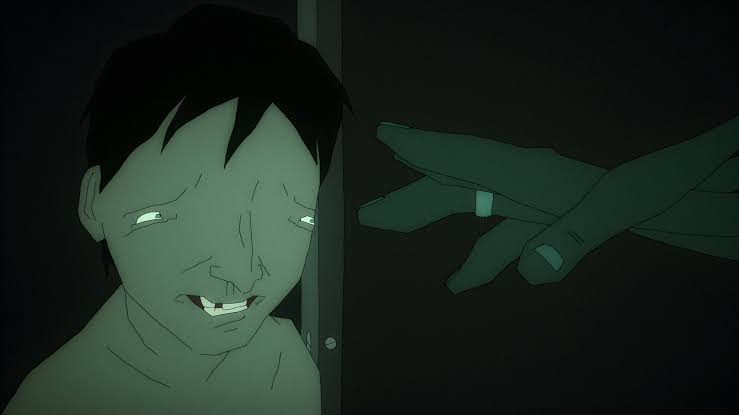
JH: Absolutely! By being suggestive, viewers imagine the worst and become more emotionally open to living the story. Our angle isn’t to only show the physical horror of abuse, but mainly the psychological devastation tied to it. The hand touching the protagonist’s shoulder symbolizes the hold of the evil that dwells within him, and that hand is shown specifically in a photograph because a photo represents a memory, and a memory can devastate us forever.
Q: Did you know from the beginning of the production that Jean-Sébastien would voice Dan?
AM: Yes and no. Jean-Sébastien always does voices in our films, but I wasn’t convinced he could do the voices in this one, and I had planned to hold a casting instead. But when Jean-Sébastien recorded the guide tracks for Dan and the abuser, they were so convincing that we used them as they were.
Q: The color green stands out in the film. Is there a particular reason why you linked this color to memory and trauma?
AM: The film begins in Dan’s secluded apartment, which is purple, a soft color for his safe space. Then we sink deep into the darkness, and all we see there is a vibrant, sickly green. It represents the radioactive essence gnawing at Dan’s repressed subconscious.
Q: You’re partners in life and in filmmaking. When making this film, did your creative visions generally align or do they ever conflict?
JH: Alignment and conflict are both inevitable and essential in our co-directing. Eighteen years ago, we met during the production of an animated music video, and we quickly fell in love and became a couple after realizing how many artistic tastes we shared. But two people also means two different visions, and with each of us holding a creative veto over everything, it could cause a lot of frustration at first. Over time, we’ve learned to give each other more space in order to maximize each person’s main strengths.
Q: What We Leave Behind won an Oscar-qualifying prize at the Kaboom Animation Festival. What has it been like experiencing the film with festival audiences?
JH: I will always remember the film’s premiere at Locarno! We were coming out of the theater and in the line, a woman was crying her eyes out, supported by her loved ones. Suddenly our eyes met, and she ran toward me. She took my arms and said, “Keep doing what you’re doing, it’s so important to talk about this.” I’m still so moved by that encounter…and at many of the festivals we’ve attended, the same thing has happened. I’ve also received a great number of messages containing extremely troubling and touching confidences. Reaching so many people who need it gives us the strength to keep creating.

Credit: What We Leave Behind (Travelling distribution)
Q: You previously made the Oscar shortlist with your film A Crab in the Pool. Both What We Leave Behind and A Crab in the Pool deal with memory and a sense of loss. Did you notice any other parallels while making this film?
JH: In both films, we address in complementary ways how to get back up and rebuild in the face of life’s trials. In A Crab in the Pool, a brother and sister who don’t get along share an unspoken tragedy, and their salvation lies in rediscovering their sibling love. But what happens if you have no one? This is What We Leave Behind explores, through an introspection we call “the deep voice.” This process reveals, layer by layer, the sincere and sometimes dark sources within us, in order to rid ourselves of them, regain our identity, and hopefully live better.

Nick Spake is the Author of Bright & Shiny: A History of Animation at Award Shows Volumes 1, 2, and 3. Available Now!