A website dedicated to animation, awards, and everything in between.
Addicted to It Director Nigel Tierney Interview | Oscar-Eligible Animated Short

Credit: Addicted to It (Have A Sleepover Productions, Tierney Corp Productions)
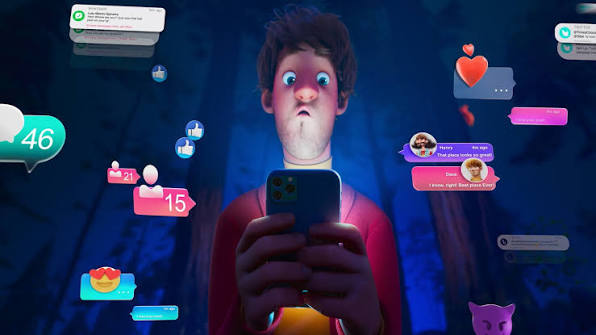
In 1963, Mel Brooks lent his voice to the Oscar-winning animated short, The Critic. Over 60 years later, Brooks provided another voice in an Oscar-qualifying short, Nigel Tierney’s Addicted to It. Brooks voices Phoney Bunny, a smart device who isn’t easily put down. Our protagonist attempts to do so for five minutes in this musical short, complete with an original tune from Tony Award winner Jeff Marx (Avenue Q). Cartoon Contender spoke with Tierney about working with a comedy legend, translating a song to animation, and more!

Credit: Nigel Tierney
Q: How did this project come about? Did Jeff Marx write the song first and decide to make an animated film around it, or did you set out to make an animated short, prompting Jeff to write the song as a result?
NT: The song came first. Jeff had reached out after I released Earth with Lil Dicky in 2019. Ironically, he messaged me on Facebook, and I’d moved over to Instagram, so I didn’t see it until September 2020. About a year and a half later! I apologized for the delay, but I was delighted that the composer of Avenue Q had reached out. I thanked him and said I’d love to work together. The timing actually worked out. With the pandemic shutting down theatre, Jeff had been working on his next musical and suggested taking one of his songs, about phone addiction, and making an animated project. So we got to work with Jeff and his husband and creative partner, Andrew Hawkins. That was the spirit of it: what would happen if you took the musical humour of Avenue Q and mixed it with the animation and visual comedy of Earth?
Q: This isn’t the first time you’ve mixed music and animation, most notably directing the Lil Dicky: Earth music video. How was Addicted to It different from those past projects, and how was it similar?
NT: I got to bring back a lot of the team from Earth, including my co-director, Federico Heller, and producers from 3DAR, the incredible animation studio in Argentina that I’ve partnered with for years. We had the old band back together. Jeff’s musical sensibility is quite different from Lil Dicky’s, though. One thing I learned on Earth was to make sure the visuals supported the music. That became a real exercise on this film. Some early storyboard ideas were funny visually, but they were stealing the joke from the lyrics. We had to keep asking where the audience’s attention needed to be. Working through that with Jeff and Andrew was a dream.
We were also fully remote, whereas on Earth we’d had more people working together in an office. Casting was another difference. Dave had very clear ideas early on for Earth: Bieber would be the baboon, and so on. With Addicted To It, the casting revealed itself much later. We developed the film and then discovered what type of characters we are going to meet and cast against that.

Credit: Addicted to It (Have A Sleepover Productions, Tierney Corp Productions)
Q: Mel Brooks isn’t a stranger to animated shorts. He lent his 2000 Year Old Man voice to the 1963 Oscar-winning animated short The Critic. How did he come on board?
NT: We were thinking about who could play Phoney Bunny, our villain and agent of chaos, and asked ourselves who we’d most love to work with. I’ve loved Mel since I was a wee one. So we chanced our arm. We sent an email explaining the project and asking whether he’d be interested. And he was! Even getting that response was exciting enough. Then suddenly he was coming into the studio, wearing a suit with a pocket square, ready to perform.
What’s funny is that we’d brought in someone with one of the most iconic voices in comedy to play a character who barely says any actual words. Much of the performance is vocalizations and efforts. Together, we developed this almost Minion-esque way of speaking for Phoney Bunny. Mel was so engaged, and we got to discover the character with him. It was an absolute honor. Knowing his history with The Critic, fingers crossed a little of that blessing comes our way.
Q: The animation reflects the hyperactive digital age, but has a clear human touch, as a disclaimer at the end notes. How did you come to define the look of the film?
NT: We wanted it to be visually rich and engaging. We know how much is competing for people’s attention, and the film takes us into gaming, social media, crypto, and all these different digital worlds. Each needed its own visual character. The movement was a big part of it too: lots of squash and stretch, very noodly animation, pushing and breaking the rigs to get the performances we wanted. We were trying to bring the freedom of 2D animation into a 3D world. For a short, we pushed the technology quite far, created 40 original fully rigged CG characters inspired by phone addiction archetypes and spanned over 20 CG environments.
But every choice had to serve something. Was it supporting a lyric? Underscoring a joke? I want someone to be able to pause the film, print a frame, and put it on their wall. That’s the ambition. The end card, “made independently, by human hands and hearts,” recognizes the more than 200 artists, designers, engineers, animators and musicians who worked on this over the years. If we want people to care about what we’ve made, we have to care about how we make it. Every frame involved people making decisions and putting something of themselves into the work.
Q: What were the inspirations behind the main character, Dace?
I honestly don’t remember the name coming from that connection. I think it was a name Jeff liked, we all kept calling him Dace, and it stuck. We spent much more time figuring out who he was. He needed to be charming and relatable without seeming like someone who’d arrived to lecture everyone. We developed a whole backstory and even animated material that didn’t make the final film. His girlfriend had challenged him about spending too much time on his phone, so he went off to a park to disconnect and discovered he couldn’t manage it himself. That mattered to us. He’s singing the song, but he’s caught up in the same problem. He’s addicted too. We didn’t want him standing outside it all, telling everyone else how to live.
Q: Was Phoney Bunny’s design cemented early in production, or did you experiment with a few different animals before settling on a bunny?
NT: We tried several animals. Early on, we had this image of a phone walking a human, as though we were its pet. That led us towards dogs and cats. There was a panda version we liked too. The bunny gave us a few things at once. The ears were great visually and offered plenty to play with in animation. But the rabbit-hole metaphor was what really made it click. The phone pulls you through a portal and into these worlds that consume your time, almost like an Alice in Wonderland journey. A rabbit made sense for that. I do remember seeing the bunny early on and having that reaction: “Oh, that’s it. That’s the one.” We’d explored other possibilities, but once we saw him, we knew.

Credit: Addicted to It (Have A Sleepover Productions, Tierney Corp Productions)
Q: While the film encourages us to put down our phones and appreciate the world around us, it doesn’t demonize technology either. Otherwise, it would’ve ended with Dace throwing out his phone rather than just ignoring it. What do you think is the smartphone’s biggest advantage and most dire attribute?
NT: That’s the complicated part. These devices help us communicate, keep us safe, and make a living. People’s livelihoods depend on them. You can’t dismiss all of that. But even the ability to earn a living through your phone comes with complications. Work becomes gamified. An artist can find themselves spending their time making videos to get their art noticed, rather than making the art itself. For me, the biggest problem is how so many applications and algorithms are designed around taking more of our attention.
Helping someone connect with another person is a useful service. Keeping them engaged for every possible waking minute is a very different ambition. The device gives us extraordinary access to people and opportunities. What bothers me is when that access becomes a way to commodify our time and attention. We wanted the ending to acknowledge that complicated relationship. Dace still has his phone. He’s trying to regain some control over when he gives it his attention.
Q: Addicted to It has qualified for Best Animated Short consideration at the Oscars. I’d say that it should also be a Best Original Song contender, but according to Academy rules, “Short films in any genre are not eligible for music awards.” Would you ever consider doing a musical feature with this team, though?
NT: In a heartbeat. Absolutely. And I appreciate you saying that about the song. Something that sounds simple and repetitive can take an extraordinary amount of work. Watching Jeff write is fascinating. There’s so much thought and detail behind something that feels effortless when you hear it. It reminds me of Dolly Parton’s line "It costs a lot of money to look this cheap". There’s a musical equivalent: it takes a lot of effort to make something sound that simple. Phone addiction is only one of the many existential crises Jeff has conjured up in his brain. I’d love this short to be an amuse-bouche for something bigger with Jeff, Andrew, and the team. We have the ideas, we have the songs, and we have the people. So, studios, let us know. We’re ready!
Q: What would you say to anyone who watches Addicted to It on their phone?
NT: You’ve found it where we knew we’d have to reach you! We’re very aware of the irony. We have to use the same platforms and algorithms that bother us to get the film to people. We can’t go door to door with this thing. The closest analogy I can think of is the warning on a packet of cigarettes. You’re putting the reminder right where the habit happens. If someone’s doomscrolling, catches the song and thinks, “Maybe I should put this down for a bit,” great. We’ve done our job.
And it doesn’t have to happen immediately. That’s why the music matters so much. Hopefully, Jeff and Andrew’s song gets stuck in your head and comes back an hour or two later, when you realize how long you’ve been scrolling. There’s no judgment. We’re dealing with this ourselves. We’d just love ye to take a five-to-ten-minute walk without your phone and re-establish that your mind is still your own.

Nick Spake is the Author of Bright & Shiny: A History of Animation at Award Shows Volumes 1, 2, and 3. Available Now!