A website dedicated to animation, awards, and everything in between.
Toons at the Tonys | BOOP! The Musical


Mickey, Bugs, Snoopy, Garfield. No matter how many decades pass, these characters remain instantly recognizable. The same goes for Betty Boop, despite her relatively thin filmography compared to the aforementioned. Making her debut in 1930, the baby-faced flapper girl became a breakout star for Fleischer Studios. With the rise of the Hays Code, Betty lost much of the pluck that made her earlier toons such fun. Betty’s final theatrical short would be produced in 1939, with Fleischer Studios shutting down three years later. Betty eventually returned to the spotlight, making her way onto a plethora of merchandise. Even with her newfound popularity, Betty’s screen credits remained limited.
Throughout the 80s, Betty starred in two specials: The Romance of Betty Boop, which Bill Melendez and Lee Mendelson of Peanuts produced, and The Betty Boop Movie Mystery, in which she was voiced by Melissa Fahn (Cowboy Bebop, Invader Zim). Her most prominent appearance was a cameo in Who Framed Roger Rabbit, telling Eddie Valiant, “Work's been kinda slow since cartoons went to color.” Mae Questel, widely considered the definitive voice of Betty, reprised her role one last time. Betty remained marketable into the 90s, being featured at Universal Studios where Sandy Fox brought her to life. Her face has been plastered on everything from t-shirts, to lamps, to Harley Davidson jackets, to Hooters pins. On a storytelling level, though, it’s been unclear what to do with Betty.
There’ve been multiple recent attempts to revive the character, including an animated/live-action hybrid movie that Simon Cowell would’ve produced. This is one of the numerous projects that never happened. Although Betty is a great character, she isn’t the easiest to do justice. Where Mickey and Bugs can function in various settings and periods, Betty is ingrained in 1930s urban culture. Betty is a wide-eyed innocent, but her early cartoons had a risqué edge, catering more to adults. Of course, the modern definition of “adult animation” seems to be constant swearing and full-frontal nudity. Despite her bulbous head, Betty would feel out of place in something like Big Mouth. While Betty can appeal to younger viewers, she wasn’t exactly intended for the preschool crowd either. This might explain why Betty’s screen presence has been scarce lately. The character recently made a return on stage, however.
Betty Boop is ripe with musical potential. The character is rooted in Broadway, New York, where brothers Max and Dave Fleischer once set up shop. Max innovated the “bouncing ball” effect, literally getting the ball rolling for the modern sing-along. Music was often a key component of Betty’s cartoons. In her debut, Dizzy Dishes, she’s first seen performing on stage, catching the eye of Bimbo the dog (Betty was initially depicted as a humanoid poodle). The character even had a few albums like Betty Boop's Scandals of 1974. Although BOOP! The Musical is something of a full circle moment, it’s been a long road from the inkwell to the Great Way White.
Plans for a Betty Boop musical trace as far back as the 1980s when Bernadette Peters was eyed for the lead role. Barry Krost (What's Love Got to Do with It) was set to produce with Clark Gesner (You're a Good Man, Charlie Brown) writing the book, lyrics, and music. Peters would play Betty in an SNL sketch around that time, but this version of the stage musical never saw the light of day. In the 90s, Peters was again considered to voice Betty in an animated feature that cartoonist Steve Moore (Open Season) would’ve directed. Singer Cyndi Lauper was also in talks, although the role went to the late voice actress Mary Kay Bergman (South Park). While this animated film ultimately fell through, Bergman would demonstrate her Betty voice in the “Weird Al” Yankovic song, "Pretty Fly For A Rabbi.”
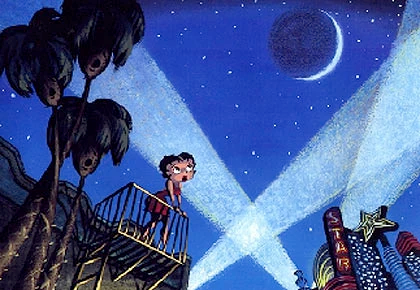
Artwork for Cancelled Betty Boop Animated Feature
The stage production lingered in limbo until the turn of the century, when producer Bill Haber acquired the musical rights. Jason Robert Brown (Parade, The Last Five Years, The Bridges of Madison County) was approached about scribing the songs. David Lindsay-Abaire (Rabbit Hole) was locked in to write the book, having already put together a treatment. Taking place during the Great Depression, the plot would’ve seen Betty run for mayor, echoing the 1932 cartoon Betty Boop for President. Influenced by Duke Ellington and Carl Stalling, Brown wrote a couple of songs, which Nicole van Giesen recorded. Although the producers were enthusiastic about Brown’s songs, he got fired almost as quickly as he was hired for reasons he doesn’t entirely understand. Brown later shared his unused Betty Boop musical demos on his blog.
By 2004, Lindsay-Abaire was still attached to the project, but Andrew Lippa was brought on as the new composer. Lippa started his career playing piano for a production of It's a Bird... It's a Plane... It's Superman. Fittingly, the Fleischers were behind Superman’s Golden Age cartoons. Lippa also contributed new arrangements and songs to the Broadway revival of You're a Good Man, Charlie Brown. This included the song “My New Philosophy,” which many credit for securing Kristin Chenoweth’s Tony victory. Going from Sally Brown to Betty Boop sounded like a natural progression. There were even reports that Chenoweth was in the running to play Betty. By 2008, though, Lippa was no longer attached to the project.
Lindsay-Abaire had also left, but he wrote the lyrics and book for another musical based on an animated property: Shrek the Musical, which received eight Tony nominations. Meanwhile, the Betty musical found another composer in Grammy winner David Foster, whose collaborations range from Whitney Houston, to Barbra Streisand, to Celine Dion. It’s a group Betty would fit right into! With Sally Robinson and Oscar Williams working on the book, the musical aimed to premiere at the Nederlander Theatre on Broadway by the 2010-11 season. It’d miss that release window by about 15 years, eventually being titled BOOP! The Musical.
While Foster remained with the musical throughout, Tony nominee Susan Birkenhead (Working, Jelly's Last Jam) came on as a lyricist. To direct and choreograph, the producers tapped Tony winner Jerry Mitchell (Kinky Boots, La Cage aux Folles). Book writing duties shifted to Bob Martin, who co-wrote the musical version of Elf. Just as Buddy travels from the North Pole to the Big Apple, Martin’s book would see Betty venture from the black-and-white ToonTown to colorful, modern-day New York. By the time BOOP! premiered at Chicago’s CIBC Theatre, the similarly themed Barbie had already broken box office records. Both BOOP! and Barbie drew parallels to Enchanted, which also saw a cartoon character get a reality check in New York. Predating them all was Pleasantville, in which colorization symbolizes the liberation of a black-and-white sitcom. Although some found Martin’s story too familiar, critics universally praised at least three elements: the bouncy songs, Mitchell’s toe-tapping choreography, and Jasmine Amy Rogers’ breakthrough performance as Betty.
“Betty Boop isn’t Black!” She is now 💋❤️ pic.twitter.com/sS4AG2jklT
— Jasmine Amy Rogers (@jasmineamyr) November 23, 2024
Born in Boston and raised in Texas, Rogers lived and breathed musical theatre from a young age. For her performance as the Witch in a high school production of Into the Woods, she won a Tommy Tune, a Houston-based award. This earned Rogers an opportunity to perform at the Jimmy Awards, “the Tonys for teenagers.” Rogers was a finalist at the Jimmys, scoring a $2,500 scholarship. Following a two-year stint at the Manhattan School of Music, Rogers landed her first major gig as Frances Bassey / Donna Summer in the Atlanta production of Becoming Nancy. Serendipitously, that musical’s director was Jerry Mitchell.
Mitchell kept Rogers in mind years later as the BOOP! team searched for their Betty. Rogers had more professional experience under her belt, playing Gretchen Wieners in the U.S. national tour for Mean Girls. The first dance call for BOOP! was a misstep for Rogers, however. Although she had been tap dancing since childhood, learning from her grandmother, this audition didn’t bring out her A-game. It didn’t come as a surprise when Rogers heard the team was going in another direction. That didn’t make the news any less devastating.
Word started circulating that the role had gone to Jessica Vosk, a former Elphaba. Yet, the team was still on the lookout for their perfect Betty, giving Rogers another shot. At a workshop entitled Betty's Day Off, Kim Exum portrayed in titular character. Rogers continued to channel her inner Betty, though, taking extra dance classes and running her lines with bestie/roommate Morgan Ashley Bryant, the understudy turned replacement for Karen Smith in the touring production of Mean Girls. In the end, the BOOP! crew felt Rogers had the spunk, heart, and boop-oop-a-doop required to bring Betty to life.
Although everyone agreed that Rogers was born to play Betty, being African-American would reopen the conversation about “color-blind casting.” While Betty Boop has often been portrayed as white in media, the character possesses several important ties to Black culture. Betty remains a symbol of the Jazz Age, which African-American musicians pioneered. Her cartoons thus provided a platform for Black artists such as Cab Calloway and Louis Armstrong. Betty hasn’t been exclusively depicted as white either. In 1933’s Popeye the Sailor, the titular character’s animated debut, a hula-dancing Betty is seen with darker skin. Then there’s the inspiration behind Betty’s creation.
While various artists evolved Betty as she went from a dog to a human, Max Fleischer and animator Grim Natwick are generally credited as her creators. It’s said that Natwick was tasked with drawing a caricature of actress Helen Kane, which ultimately became Betty. Mae Questel had won multiple Helen Kane impression contests, helping her land the role. As Betty’s popularity took off, Kane pursued legal action against Fleischer and Paramount. Kane lost this lawsuit, as the judge found that she didn’t invent her signature “boop-oop-a-doop” style that Betty further popularized. It dates back to African-American child actress “Baby Esther” Jones, who in turn drew inspiration from African-American cabaret performer Florence Mills.
It’d be unfair to cite Betty Boop as an example of cultural appropriation. While Helen Kane served as one of Betty’s inspirations, there’s no evidence that Fleischer or Natwick had Ether Jones in mind when the character was put from ink to paper. Even if Jones had been considered, she wasn’t Betty’s sole inspiration. Still, Jones maintains an important place in Betty’s legacy, which more people seem to be recognizing. Many have come to view Betty as a Black icon, with Taraji P. Henson dressing as her while hosting the 2021 BET Awards. Jasmine Amy Rogers’ performance has been praised for not only honoring Betty’s past, but also creating a Betty that’s all her own.
This past year saw another character that Natwick had a hand in designing, Disney’s Snow White, at the center of the color-blind casting discussion. In the live-action Snow White remake’s case, it was more of an online screaming match. Although critics generally saw Rachel Zegler’s performance as one of the film’s redeeming qualities, racist and toxic trolls made the lead-up to Snow White feel like slowly tearing off a Band-Aid. Racism wasn’t the only controversy Snow White had to weather through. To some, there was a perceived lack of respect for the 1937 animated classic among the people behind the remake. BOOP! The Musical managed to avoid a similar backlash.
With virtually every interview, the cast and crew have praised what Fleischer Studios created. Rogers, in particular, expressed a deep fondness for the character ever since receiving a Betty Boop doll as a child. The team understands that Betty Boop isn’t - and never has been - a ditz. The only bimbo in the Fleischer’s inkwell was… well, Bimbo. Betty was arguably animation’s first feminist, embracing her body, yet slapping back against unwanted advances. Booming with a colorful personality even in black and white, she’s a boundless source of wit, energy, and versatility. Going back to the Barbie comparison, Betty is everything: performer, princess, presidential candidate, poodle.
Above all else, Betty is equal parts sex symbol and sex-positive icon. BOOP! doesn’t do away with Betty’s sexuality, although the term “family-friendly” would frequently be used to describe the musical. There’s even a kids’ program that can be downloaded on the musical’s website. To some Fleischer purists, that might seem like a betrayal given the suggestive undertones and overtones of Betty’s original cartoons. That said, Betty hasn’t seen a star vehicle in decades. For a production such as BOOP! to turn a profit, the producers can’t solely target nostalgic adults. They need to appeal to their kids, grandkids, and great-grandkids as well, introducing Betty to a new generation.
While Betty’s early cartoons were aimed more at older audiences, kids still saw and enjoyed them. It’s not as if Betty were Fritz the Cat or Eric Cartman, who have always been for adults only. Even if this Betty is more family-friendly, the show doesn’t give her the Hays Code treatment per se. This is reflected in the Act One finale, “Where I Wanna Be,” in which Betty sheds her conservative black and white ensemble, revealing a red minidress with a garter wrapped around her leg. Full disclosure, I haven’t had a chance to see BOOP! The Musical on stage as of writing, currently lacking the funds to fly from Phoenix to New York. However, the singles have become regular residents of my playlist. The minute I heard “Where I Wanna Be,” I was compelled to learn more (hence this deep dive).
After the successful Chicago previews, BOOP! headed to Broadway over a year later. The musical opened at the Broadhurst Theatre, a roughly seven-minute walk from where Fleischer Studios used to be. The Chicago ensemble would accompany Jasmine Amy Rogers to NYC. The cast of characters includes a few familiar faces from Betty’s cartoons like Grampy (Stephen DeRosa) and her dog Pudgy (Puppeteer Phillip Huber). The lineup also included new characters like a jazz musician named Dwayne, Betty’s love interest. In the cartoons, Betty was given a human boyfriend named Freddy, although fans generally consider him a shark-jumping moment.
BOOP! arrived on Broadway amid a crowded season of Tony Award hopefuls. Among the buzziest titles were Death Becomes Her, based on the 1992 cult classic film, and Maybe Happy Ending, which started as a one-act musical from South Korea. David Foster shared a loose connection to another musical that opened that season: Smash. Foster is married to Katharine McPhee, who played Karen Cartwright on the NBC series that served as the stage musical’s basis. When Foster was previewing songs from BOOP!, McPhee performed “Something to Shout About,” Betty’s 11 o'clock number.
In another Smash connection, McPhee’s former co-star, Megan Hilty, stars as Madeline Ashton in Death Becomes Her. In the Smash TV series, McPhee and Hilty played rivals vying for the role of Marilyn Monroe. Although Betty’s time in the spotlight predated Monroe’s, they have a fair deal in common. Both were smarter than they were often given credit, both had baby-esque voices, and both have been immortalized as cinematic symbols. Even if you’ve never seen a Marilyn Monroe picture, everybody recognizes the image of her in a white dress on the subway grating. Even if you’ve never seen a Betty cartoon, you’ve surely seen her on a slot machine or tattoo with one leg raised.
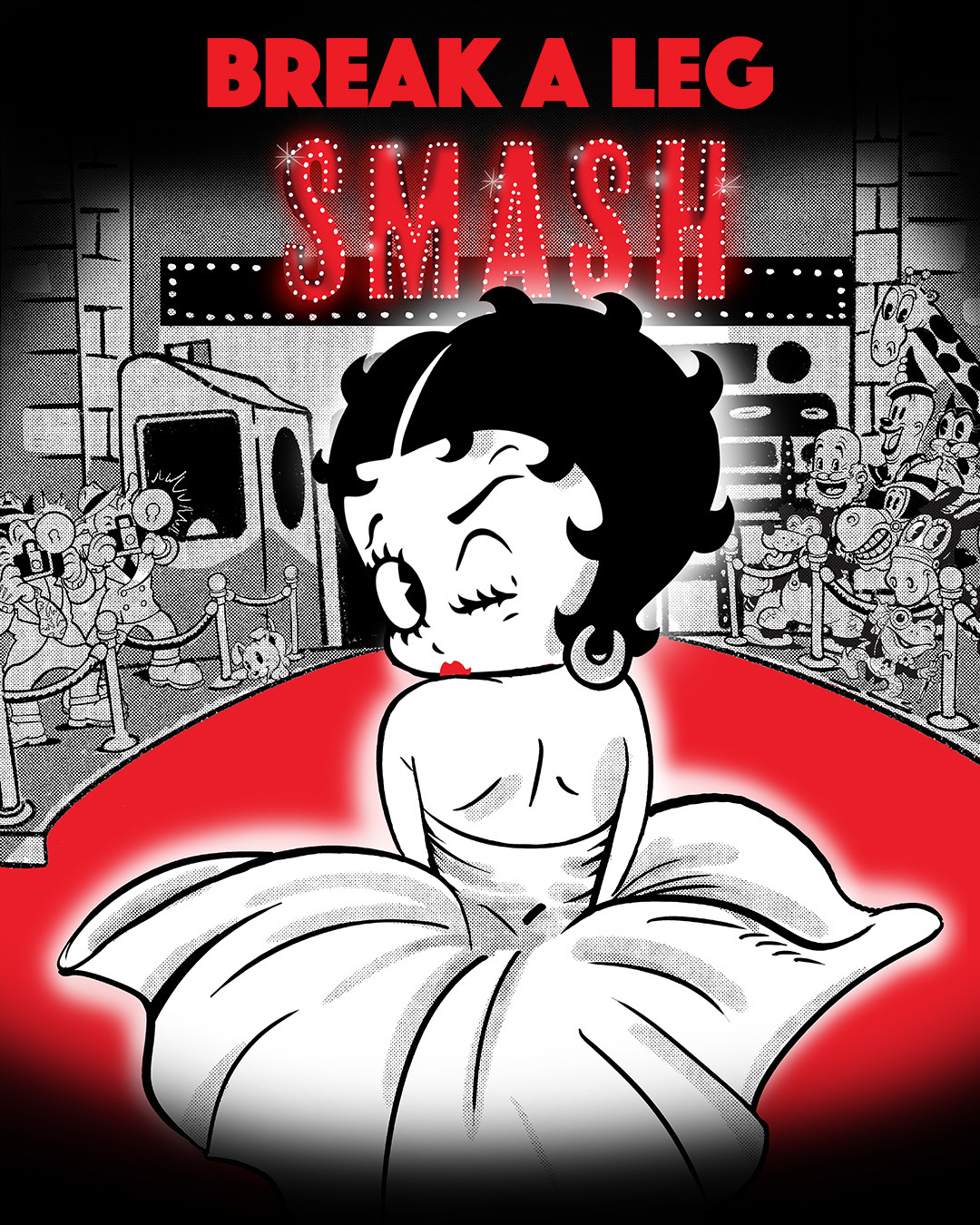
Boop! The Musical
With other original musicals like Buena Vista Social Club, Dead Outlaw, and Operation Mincemeat also in the running for Tony consideration, BOOP! ran the risk of getting lost in the shuffle. While reviews were solid, the box office left something to be desired. According to BroadwayWorld, the March total gross for BOOP! was $933,733, with the outlet calling it, “a much weaker position than any other new musical this spring.” For context, Death Becomes Her’s total gross for that month was $4,440,291, Maybe Happy Ending’s was $3,365,809, and Smash’s was $1,576,629.
BOOP! showed more promising numbers at the precursor awards ahead of the Tonys. At the Outer Critics Circle Awards, BOOP! received eight nominations, the third most of any show that year. BOOP! was the leading nominee at the Drama Desk Awards, scoring eleven notices. It wasn’t the first time Drama Desk went all in on a musical based on an animated character, previously awarding Best Musical to SpongeBob SquarePants. It’s worth noting that some of the shows in the running at the Tonys like Dead Outlaw and Buena Vista Social Club weren’t eligible at this year’s Outer Circle Critics or Drama Desk Awards. Regardless, BOOP! seemed like it might do better than expected on Tony nominations morning.
Ultimately, BOOP! would miss out on Tony nominations for Best Musical, Foster’s score, and several other categories. It garnered three nominations overall for Best Choreography (Jerry Mitchell), Best Costume Design of a Musical (Gregg Barnes), and Best Performance by a Leading Actress in a Musical (Jasmine Amy Rogers). While not the huge showing the musical could’ve used to boost box office, Mitchell still celebrated at that day’s curtain call. Carrying a bag of Tonys, Mitchell sang praises to Rogers and Barnes. Rogers’ nomination, in particular, felt like her coronation into the Broadway elite.
Although some awards prognosticators saw Rogers’ nomination as a foregone conclusion, nothing is guaranteed in showbiz. Rogers got in over musical legends like Idina Menzel for Redwood, as well as other up-and-comers who appeared to be sure things, like Helen J. Shen for Maybe Happy Ending. Rogers’ nod is even more impressive considering who she’s going up against. On GoldDerby, Audra McDonald is the predicted frontrunner for her performance as Mama Rose in the rival of Gypsy. McDonald holds the record for the most acting Tony nominations (11) and wins (6). Gypsy could be her seventh, following in the footsteps of Angela Lansbury, Tyne Daly, and Patti LuPone, who previously won for playing Rose.
In second place on GoldDerby is Nicole Scherzinger for her performance in the revival of Sunset Boulevard as Norma Desmond, a role that previously brought Glenn Close a Tony. Scherzinger already won a Laurence Olivier Award for performance on the West End. The former Pussycat Dolls member has a career narrative that somewhat mirrors Norma Desmond’s, although Scherzinger’s return to the limelight is going much better than Norma’s. Rogers’ odds put her in third place ahead of Megan Hilty and her Death Becomes Her co-star Jennifer Simard. While Hilty and Simard are expected to split votes, Death Becomes Her is the only show represented in this category with a Best Musical nomination.
Other than Hilty, each actress is nominated at the Drama Desk and OCC Awards. While this leaves the Tony race open, most agree this seems like McDonald’s to lose. If voters decide McDonald has enough Tonys already, Scherzinger may be the alternative. There was speculation that Scherzinger’s comment on a pro-Donald Trump post in November 2024 might hurt her campaign, but that feels like a distant memory. However, if this comes back to bite Scherzinger and the Death Becomes Her ladies cancel each other out, is there a case for Rogers?
Rogers is this year’s ingénue, being the youngest nominee and a newcomer to Broadway. She’ll surely have a long career on stage, which could compel voters to hold off on awarding her. Then again, age wasn’t a factor last year when Maleah Joi Moon won for her Broadway debut in Hell's Kitchen. Moon was even younger than Rogers, although Hell’s Kitchen also had the benefit of being a Best Musical nominee. Rogers may have more in common with Stephanie J. Block, who won in 2019 for The Cher Show. Like BOOP!, Cher only had three nominations, none of which were for Best Musical. Beyond the Best Actress category, MJ’s Myles Frost won Best Actor in a Musical in 2022, beating seasoned vets like Billy Crystal, Hugh Jackman, and Rob McClure.
In BOOP!’s two other categories, Jerry Mitchell has a good track record in Best Choreography, having won twice. Patricia Delgado and Justin Peck may be his stiffest competition for Buena Vista Social Club. Gregg Barnes stands a reasonable shot at winning a fourth Tony for his vibrant costumes, although Paul Tazewell’s dresses in Death Becomes Her are to die for. If BOOP! doesn’t win either of these categories, Rogers beating out McDonald and Scherzinger would likely be the night’s biggest shocker. Surprises do happen, however. Notably, McDonald, Scherzinger, and Rogers are all people of color playing characters who weren’t necessarily created with POC in mind.
Whether or not Rogers can overcome the odds, getting nominated for your Broadway debut at age 26 is a triumph in its own right. If this is Rogers’ breakout role, hopefully it’s only the beginning of Betty’s comeback. None of Betty’s Golden Age cartoons received Oscar nominations. Granted, some of her cartoons predated the Best Animated Short category. Even after the category’s creation, Betty’s black-and-white cartoons were passed over as Walt Disney’s colorful Silly Symphonies dominated. Of her theatrical series, Betty’s only color cartoon was 1934’s Poor Cinderella. While she went overlooked at the Academy, the Tony nomination is providing a Cinderella moment for Betty and Rogers. Whatever is around the corner, it’s something to shout about.