A website dedicated to animation, awards, and everything in between.
Scarlet | Review

Credit: Scarlet (Sony Pictures Classics)
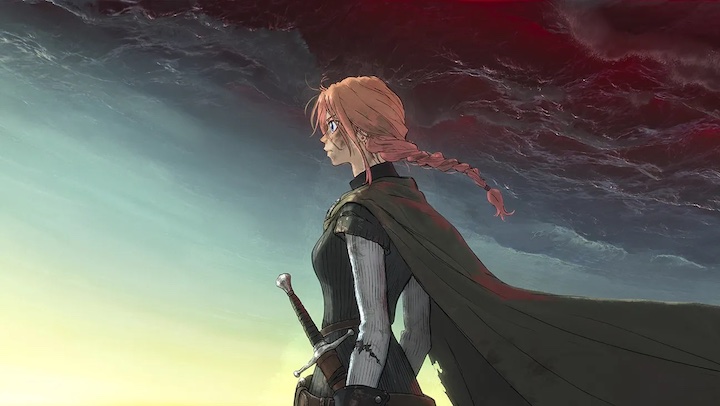
When the first images of Scarlet surfaced, I thought Mamoru Hosoda might’ve crafted his masterpiece. To extent, one could argue that he has. This could be Hosoda‘s best-looking film, which is saying something considering that this is the same guy who made The Girl Who Leapt Through Time, Summer Wars, Wolf Children, The Boy and the Beast, Mirai, and Belle. The story of Scarlet lacks the heart of Hosoda‘s previous films, however. It’s also not as focused, straying so far from its inspiration - Hamlet - that you often forget about its Shakespearean roots. It’s worth experiencing on a pure spectacle level, but as far as this year’s loose Hamlet adaptations go, Chloé Zhao clearly made the superior one.
Where Zhao’s Hamnet provided a fictional account of why Shakespeare wrote Hamlet, Hosoda starts with a gender swap, substituting Hamlet for the eponymous Scarlet. While Scarlet makes for a compelling heroine, Hosoda could’ve gone further with the gender swap angle. Most of the supporting characters remain largely male, as Scarlet seeks to avenge her father, whose blood is on the hands of her Uncle Claudius. The female perspective isn’t the only way that Scarlet deviates from its source material. Scarlet’s father is publicly executed rather than poisoned. Where Hamlet dies at the end of the play, Scarlet meets her end at the beginning.
Following a failed attempt to even the score with Claudius, Scarlet finds herself in the Land of the Dead. Whether this is Heaven, Hell, or somewhere in between, Scarlet isn’t giving up on her revenge quest yet. She’s determined to find Claudius, traversing this strange wasteland that’s not only beyond Scarlet’s physical realm, but her time as well. The medieval Scarlet encounters Hijiri, a modern-day medical worker who may or may not be in denial of being dead. He’s from another time, and often feels like someone from another movie. Where Hijiri dedicated his life to saving people, Scarlet lived for vengeance. The two nonetheless form a bond as Hijiri gives Scarlet a new reason to live, assuming that’s even on the table.
While Hamlet wasn’t without supernatural elements regarding the living and dead, Hosoda certainly takes Scarlet in his own direction. That said, Scarlet is in the vein of Hosoda’s past work. From The Girl Who Leapt Through Time to Mirai, Hosoda is known for time-bending stories. Hosoda’s protagonists often find themselves navigating unusual environments, be it a digital realm or a kingdom of beasts. Changing the source material isn’t unwelcome, as some of the best contemporary versions of Hamlet only vaguely resemble Shakespeare (The Lion King, Black Panther). What separates Scarlet from those films is its character dynamics, which don’t connect as much as one would hope.
The chemistry between Scarlet and Hijiri can occasionally feel flat. So, when Scarlet has to make an impossible choice during the final act, it doesn’t exactly rip our hearts out as intended. Scarlet’s rivalry with Claudius is underdeveloped as well. We understand Scarlet’s motivations, but these two spend so little screen time that it’s hard to get that emotionally invested when they inevitably face off. The film’s theme of vengeance vs. forgiveness can also get lost in a meandering plot that doesn’t entirely know what it wants to say in the end.
For all of its narrative shortcomings, there’s no denying that Hosoda is a master of craftsmanship. The backgrounds are breathtaking, the scale is epic, and the titular character’s striking design makes her an instant icon. Between its awe-inspiring animation and thrilling battle sequences, Scarlet lives up to the high bar that Hosoda has set for himself. One might even say he exceeds that bar in terms of style. It’s the substance department where Hosoda falls short of his other works. Scarlet is far from Hosoda’s best film, although it isn’t his weakest either. He was technically a co-director on Digimon: The Movie, after all. (With apologies to Digimon stans).
Nick Spake is the Author of Bright & Shiny: A History of Animation at Award Shows Volumes 1 and 2. Available Now!