A website dedicated to animation, awards, and everything in between.
The Panic Inside | Student Academy Award-Winning Short Director Interview

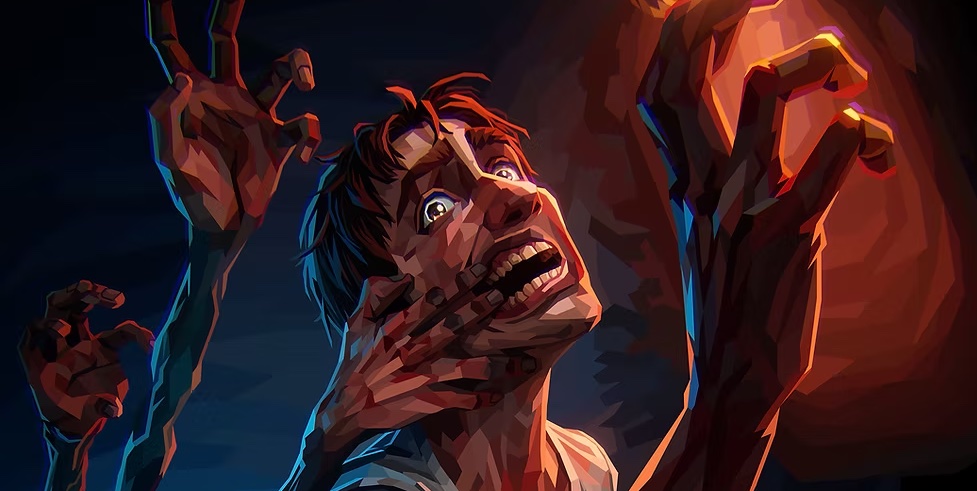
Credit: The Panic Inside (Filmakademie Baden-Württemberg)
Matthias Strasser is among this year’s Student Academy Award winners for his animated short, The Panic Inside. A graduation project at the Animationinstitut of the Filmakademie Baden-Württemberg, the story centers on Jacob, a chronic people pleaser about to crack under pressure. Jacob is forced to confront his festering anxiety, which materializes in the form of a character named Theo. Strasser spoke with Cartoon Contender about the skin-crawling animation style, the film’s deeper themes, and scoring an Oscar-qualifying prize.
Q: When people hear “student film,” they expect certain limitations. Observing the animation in The Panic Inside, though, it felt as if I was watching an episode of Arcane or a Spider-Verse movie. You spent two years on the project, which definitely shows in the execution. What was the biggest challenge in achieving this level of quality?
A: First of all, thank you for the compliment! It means a lot to hear our film compared to shows and films like Arcane and Spider-Verse.
I think the biggest challenge was definitely communication. We were a team of around thirty people, with around twenty people working on the visuals, so it was really important that everyone had a clear understanding of what we were trying to achieve. We tried to overcommunicate as much as possible, explaining what each scene was about, what the character was feeling, what the final image should look like, what the mood should be, and so on. Even when it was just a small drawing or a mood image, we found that giving people as much visual and contextual information as possible really helped us stay on the same page.
Another big challenge was figuring out how to visualize what the main character Jacob was feeling and bring his inner world to the outside. We did a lot of research and eventually found that Cubism and Surrealism reflected the emotions we wanted to portray particularly well. From there, we tried to translate some of these ideas into 3D.
To make that possible, we had to develop a lot of our own tools and techniques. We were inspired by the films and shows you mentioned, as well as Puss in Boots: The Last Wish, The Wild Robot, and Teenage Mutant Ninja Turtles: Mutant Mayhem. We developed, among other things, a tool that allowed us to paint brushstrokes directly in 3D, another that broke up the perfectly clean edges of CGI to give them a more painted feel, and tools that disrupted the smooth gradients of CGI to create a more Cubist look.
So a lot of the two years went into not only making the film itself, but also figuring out how to build the tools and pipeline that would allow us to achieve the visual language we had in mind.
Q: People-pleasing is the root of Jacob’s panic. Yet, I feel like the imagery can be applied to just about anyone who struggles with mental health and substance use. Was the intention to tell a universal story?
A: Yes, although it wasn’t something we consciously set out to do. Quite early in the story process and look development, we noticed that a lot of people connected with the film, not only people who struggle with people-pleasing, but also people dealing with very different things. I think it became universal because, as the story developed, it went in many different directions, but at its core it was always about mental health.
Interestingly, Jacob originally came from an animation series script I wrote the year before. In that story, he struggles with heavy substance abuse, so there was already this idea of him dealing with different forms of self-destructive behavior. That probably influenced the film more than I initially realized. If you look closely, there’s even a shot of his bedside table where you can see sleeping pills and ADHD medication.
Q: The inability to say no is an issue we rarely see talked about, but it’s one that many of us can relate to. How do you identify with Jacob?
A: I’m a big people-pleaser myself, so I identify with Jacob quite a lot. In a way, making this film was also a bit healing for me, because the production forced me to get better at saying no and setting boundaries. I’m still very much a people-pleaser, though, which is probably why I’m doing this interview. I also come from a family of people-pleasers, and at some point it became quite serious and even dangerous. That’s a big part of why this story felt so personal to me.
I also think people-pleasing is particularly relevant in the film and animation industry. We rely so heavily on collaboration, and especially when you’re just starting out, there can be this feeling that you always have to say yes, because you want to get your foot in the door and meet new people. It can be really difficult to recognize when saying yes is actually coming at the expense of yourself.
Q: I mentioned Arcane and Spider-Verse already, but were there any other productions that inspired your film’s mix of 2D and 3D, which reflects a painting coming to life?
A: Oops, I got a little ahead of myself, but the ones mentioned earlier were all big inspirations for us.
We were also heavily inspired by anime, especially the rough, gritty animation you see in shows like Chainsaw Man and Jujutsu Kaisen. We were particularly drawn to the work of Olivier Lescot and Masanobu Hiraoka, who combine that rough, expressive feeling with fluid animation and morphing forms.
Q: For its first half, The Panic Inside is almost devoid of spoken dialogue until Jacob begins an internal dialogue with Theo. Did you ever consider telling the story exclusively through visuals, or did you always feel this exchange was essential to the story?
A: It was always our goal for the film to feel like a wake-up call, almost like a punch. With the film, we wanted to reach people who struggle with people-pleasing to an unhealthy extent and maybe warn them about where that behavior can lead. Obviously, what happens to Jacob is fantastical, but the consequences of constantly ignoring your own needs can be very real and equally dangerous.
To get that message across, I felt that dialogue was necessary. It allowed us to dive into some deeper ideas that would have been difficult to communicate purely through visuals. In particular, I wanted to make the conflict between Jacob and Theo verbal. Theo represents the part of Jacob that is constantly repairing the damage caused by his stress, so their conversation allowed us to externalize this internal conflict and have Jacob actually confront the consequences of his behavior.
I think the contrast also worked well for us: the first half is very visual, and then suddenly we enter this completely different world where Jacob has to actually listen to someone and ultimately to himself.
Q: I noticed a few sneaky details in the background, including sketches of Pikachu and Handsome Squidward. Are there any other Easter eggs viewers should keep an eye out for?
A: Haha, yes! We tried to make Jacob’s world as relatable and lived-in as possible, so there are a lot of little details hidden throughout the film. Apart from the medications and the Easter eggs you already mentioned, there are quite a few things that hint at Jacob being an aspiring filmmaker. You can spot film equipment on his bookshelf, some filmmaking books you might recognize, and his movie collection.
The Polaroids capture little moments from his relationship, and during the time-lapse, you can actually see him working on his new film. There are probably a few more details we’ve forgotten about by now.
Q: The Panic Inside has won a Student Academy Award. The ceremony takes place at TIFF next month, where this year’s three winners will be awarded gold, silver, or bronze. Can you take me through the process of making the Academy’s shortlist and ultimately emerging as a finalist?
A: It was the very first festival or awards competition we submitted the film to, so we really didn’t expect it at all. The week leading up to the deadline was pretty stressful because we were still working hard to finish the film in time.
Then, together with my good friend David, who is also a Student Academy Award finalist this year with his film Send Nudes, we went to an escape room. As soon as we got out, we checked our emails and were completely blindsided by a message saying that both of our films had been selected as semifinalists. It was such a surreal moment, we were standing there outside the escape room, staring at our phones, trying to process what had just happened.
Q: What is the most important thing you learned throughout the production of The Panic Inside?
A: Like I mentioned before, probably learning to say no and learning how important clear communication is. With a team of more than 30 people, everyone works differently, and I learned how important it is to adapt to each person’s needs and communication style.
We had so many incredibly talented people working on the film, and I think one of the most important things as a director is making sure that everyone feels appreciated and that you respect their time.

Nick Spake is the Author of Bright & Shiny: A History of Animation at Award Shows Volumes 1, 2, and 3. Available Now!