A website dedicated to animation, awards, and everything in between.
Memory Hotel Review | Portland Festival of Cinema, Animation & Technology

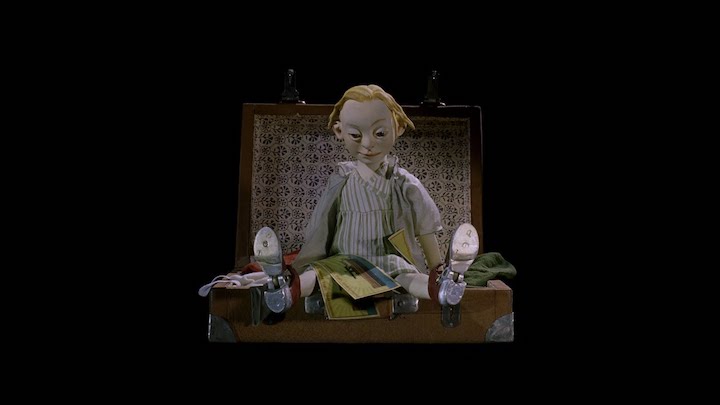
Credit: Memory Hotel (Heinrich Sabl Filmproduktion, Michael Schmetz Mediaconsult)
German director Heinrich Sabl wrote the screenplay for Memory Hotel back in 1995, while production commenced in 1999. Reportedly, this stop-motion film took 23 years to complete and 25 years to be released. Had Sabl just spent a few more years on his labor of love, he could’ve beaten Richard Williams’ record with The Thief and the Cobbler. Even so, you can see the time and dedication behind Sabl’s craft, which he produced with a small “community of solidarity.” While the film’s narrative might not be as gripping as its technical merits, there is a personal story within.
We open in 1945. With World War II winding down, young Sophie and her family have aspirations to immigrate to America. The family stops at a hotel, which becomes a purgatory for Sophie as the Red Army invades Germany. When her parents are killed in a standoff, Sophie finds herself trapped in the hotel with a Nazi, a Hitler Youth, and a Soviet soldier who pulls rank. Sophie doesn’t just lose her parents. Her memories are lost as well, growing up in the hotel, which is equal parts prison, labyrinth, and demented dollhouse, with the four forming a dysfunctional sitcom family of sorts.
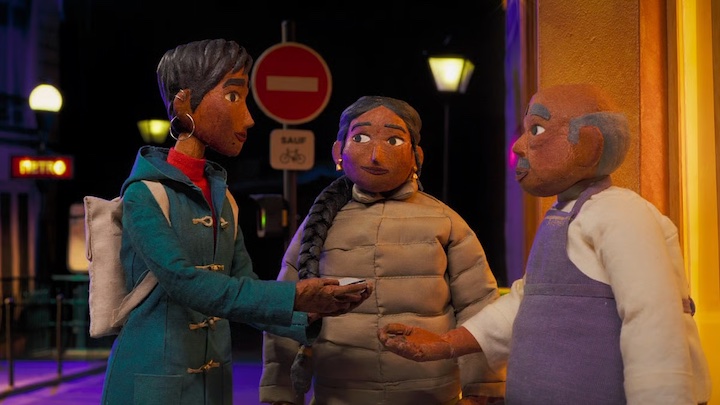
The characters somewhat resemble the puppets from the Oscar-winning The Girl Who Cried Pearls. They might not be as technically advanced as the puppets you’d find in a Laika production, yet manage to have a fair deal of personality nonetheless. In a way, it’s fitting that the characters would have limited facial expressions, as they’re all frozen in time like forgotten porcelain dolls from a bygone era. Conversely, the hotel constantly seems to be in motion, with elevators, a conveyor belt, and pieces you might find in a Rube Goldberg device. The hotel is essentially a fifth character, being both the bleakest and most over-the-top presence.
It’s easy to get lost in the hotel. The same can be said about the plot, which is something of a maze to trek through. Just as Sophie struggles to remember her past, the audience often has to remind themselves why the characters are making certain choices and what their motivations are. Maybe that’s appropriate for a film that deals with memories, which can be fragmented. As a film, though, Memory Hotel is easier to admire than it is to love. That said, there is a lot to appreciate in Memory Hotel, from its production values to its timely themes.
Interestingly, Sabl grew up behind the Iron Curtain, which had fallen by the time he started production on Memory Hotel. When Sabl finally completed his film, Russia was engaged in another conflict with Ukraine. It’s a reflection of how much changed during that time, and yet how little. Sabl has lived between two disasters, much like how Sophie can’t seem to break free from the cycle of oppression. Sabl couldn’t have planned for his film’s completion to coincide with history repeating itself. In an eerie twist, though, Sabl’s memory now mirrors the present, with progress moving like his stop-motion figures.

Nick Spake is the Author of Bright & Shiny: A History of Animation at Award Shows Volumes 1, 2, and 3. Available Now!