A website dedicated to animation, awards, and everything in between.
Have a Trophy | A Homestar Runner Retrospective


This is the greatest cartoon in the whole world. Have a trophy!
In 2010, the 2nd Streamy Awards took place at the Orpheum Theatre. As the Best Animated Web Series category was presented, a Cuddles the rabbit mascot stood in the wings, suggesting Happy Tree Friends might be the frontrunner. The Streamy went to How It Should Have Ended, leaving Cuddles literally crushed. Co-creators Daniel Baxter and Tina Alexander accepted the Streamy for HISHE, which was just starting to gain a following. Fifteen years later, HISHE is still delivering hilarious parodies, but there was another nominee that paved the way for almost every animated web series that followed. Sorry, Cuddles, but I’m not talking about Happy Tree Friends.
In the early 2000s, you didn’t go to YouTube for a daily dose of irreverent humor that only the internet can provide. You went to Homestarrunner.com. Homestar’s mix of offbeat comedy and retro references not only set a tone for the YouTube Generation, but the Golden Age of Flash Cartoons. As Homestar entered the internet zeitgeist, programmer Tom Fulp gained traction with Newgrounds.com, one of the first sites where creators could share Flash content. Homestar’s influence was evident among some of Newgrounds’ most prominent creators. Joseph Blanchette, aka LegendaryFrog, snuck chalkboard sketches of Homestar and Strong Bad into his toon, Kerri's Big Invention. In his eponymous Flash series, Bryan Waterman regularly featured a Strong Bad popsicle on the side of an ice cream truck. Even with this surge of Flash artists, there was only one Homestar, one Strong Bad, and one Poopsmith.
Around the same time as the 2010 Streamys, Homestar Runner disappeared… well, not entirely. Homestar, Strong Bad, and the rest of Free Country, USA have sporadically popped up over the past 15 years, sometimes for an April Fools' toon, sometimes on Halloween, and occasionally to announce new merch like the Trogdor board game. Despite the death of Adobe Flash, sites like Homestar Runner and Newgrounds are hanging in there. Both have inevitably adapted to the changing internet landscape, though, launching YouTube channels. While not as active as it was in the early 2000s, Homestar’s impact is felt today, and not just online.
Homestar’s unconventional wordplay, surreal yet simple scenarios, and fondness for nostalgia call to mind modern TV programs like Adventure Time, Regular Show, and Gravity Falls, the latter of which Homestar co-creator Matt Chapman worked on. While those shows are marketed to kids, they have just as many adult fans, if not more. Homestar was far from the first animated production that appealed to kids and adults, but it was among the earliest to find an unlikely middle ground between little kids and college kids. Mike Chapman, Matt’s brother and Homestar’s co-creator, summed up the website’s target demographic in a 2001 interview. “It is aimed at twenty-somethings and college-type kids, but can be enjoyed by little tykes as well.”
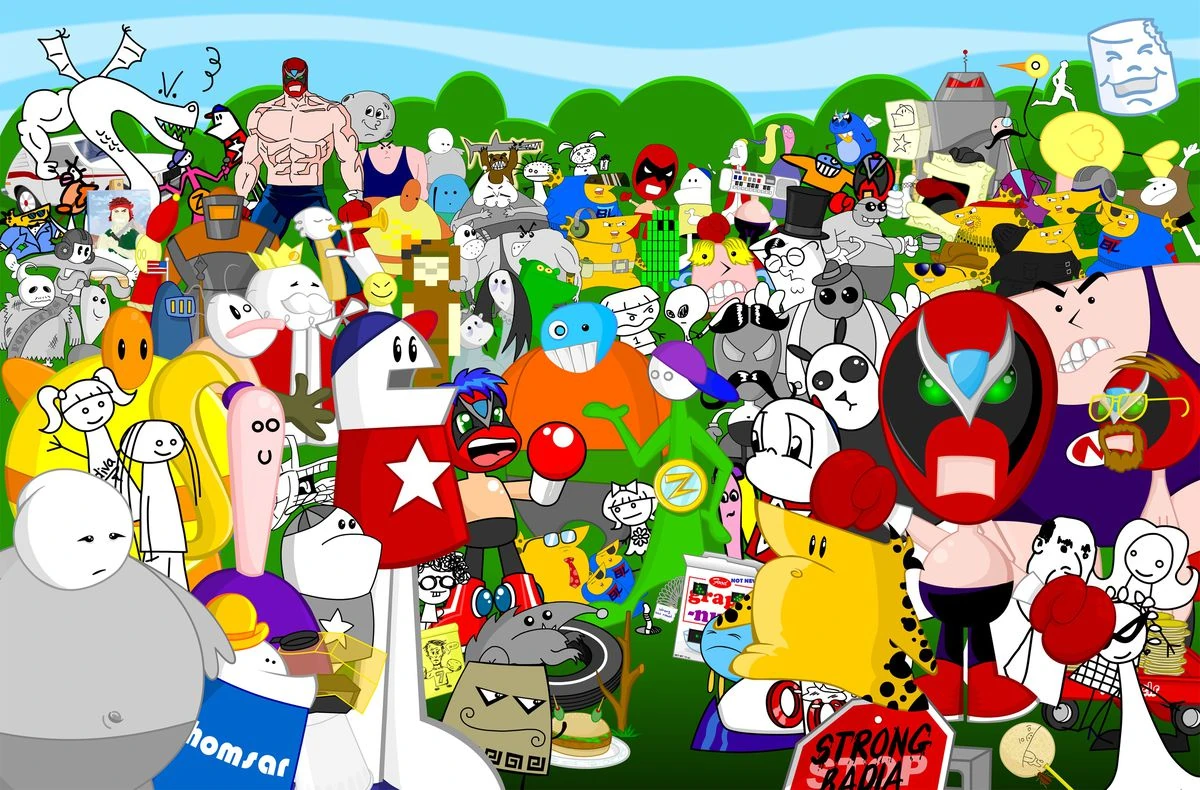
When people think of college humor, their minds go to raunchy, R-rated comedies like Animal House and Porky’s. Being an internet series, nothing was stopping the Brothers Chaps from incorporating profanity, sex, nudity, or graphic violence into their work. All of the above were commonplace in various Newgrounds cartoons, with nobody worrying about demonetization. Homestar also came out on the heels of several '90s shows known for pushing the envelope. Ren & Stimpy was an adult cartoon cheekily disguised as a children’s cartoon, becoming a college campus staple. After being let go from Ren & Stimpy, John Kricfalusi used Adobe Flash to create The Goddamn George Liquor Program, which has been credited as the first animated series exclusive to the internet. Matt Stone and Trey Parker found greater success with two shorts that went viral, paving the way for South Park.
Like South Park, Homestar Runner became known for its quick turnaround, limited animation, and infamous creators. The two were on polar ends of the shock comedy spectrum, however. South Park took bad taste further than any animated show had gone at the time, but there were some things even that game-changer couldn’t do on TV. With no walls of censorship to tear down, Flash series like Happy Tree Friends and R******* Animal Babies treated the World Wide Web like the Wild West. When the entire internet is pushing naughty humor to the limit, the novelty of seeing cute cartoon characters swear and die excruciating deaths can get old quickly.
“In terms of the wholesomeness of it all, at the time we started, everything on the web was South Park rip-offs and gross-out shock humor,” Matt said in a 2003 interview. Wanting to be different, the Brothers Chaps’ work never ventured beyond what you’d see in an 80s PG movie. Even by that standard, most 80s PG movies were allowed one f-bomb, something Homestar never took advantage of. “It's really just more of our style, too,” said Mike. “It wasn't a super hard decision to make. We probably would have been doing it like this anyway. We've always leaned toward the more subtle type of humor, as opposed to over-the-top.”
The most prominent examples of cursing included “helluva,” “screw all y'all,” “sucks,” “freaking,” and, of course, “crap.” Strong Bad would turn “holy crap” into his catchphrase, suggesting that religion exists in the Homestar universe, as does casual blasphemy. Conservative parents and teachers might frown upon such language, but it’s nothing compared to the inventive obscenities the Angry Video Game Nerd and Nostalgia Critic instinctively drop. Strong Bad is like a little kid who hasn’t learned all of the swear words, but he’ll abuse the ones he does know to the moon. “From the get-go, folks seemed to like Strong Bad the best,” Matt said in 2003. “He's the most accessible across the board, I think. Maybe cause he's the character that comes the closest to cussing. Everybody loves a cusser.”
As far as innuendos go, the most suggestive running gag found Homestar without his shirt on, requiring his body to be blurred. Homestar has no arms, and based on his pixelated body, there’s little between his chest and legs. Homestar’s girlfriend Marzipan has an equally baffling anatomy with no arms, no midriff, and the figure of a broom. Strong Bad almost always went topless, but he never had to be censored. I guess you can call that a double standard.
Even the violence was fairly tame, although occasionally a drop of blood would work its way into a toon. As the gang brainstorms ways to capture the titular hot bird from In Search of the Yello Dello, Pom Pom whips out a handgun. “I kind of wanted to take him alive, Pom Pom,” Homestar says. If Homestar aired on Cartoon Network, censors surely would’ve flagged this scene. Back in the day, kid-oriented networks had no issues airing classic cartoons where Elmer Fudd shoots Daffy Duck in the face. In a post-Columbine world, merely mimicking a gun with your fingers can get a student suspended. Yello Dello is an otherwise lighthearted toon, making the sudden presence of a firearm all the more jarring.
Moments like this epitomize Homestar’s tone. It wasn’t shocking, but it was just edgy enough to make kids feel like they were watching something more adult. Meanwhile, college kids were taken back to a simpler time when the nonsensical sounded natural. The Brothers Chaps have compared the series’ brand of humor to the in-jokes that families develop on road trips. In fact, the name Homestar Runner started as an in-joke between the Chaps and their childhood friend, James Huggins. Growing up in Georgia, the Atlanta Braves were advertised everywhere, including the local grocery store, Winn-Dixie. A particular ad mentioned “Mark Lemke: All Star Second Baseman for the Braves.” Knowing nothing about sports, Huggins said, "Mark Lemke: Homestar Runner for the Braves!"
The name stuck with Mike Chapman and another friend, Craig Zobel, who noticed the low quality of modern children’s literature while browsing at a bookstore. This inspired Mike and Zobel to scribe their own children’s book, The Homestar Runner Enters the Strongest Man in the World Contest. Along with the titular no-armed character, the book introduced his best friend Pom Pom, his tiny-handed enemy turned frenemy Strong Bad, and the latter’s loyal lackey, the Cheat. Also featured were several characters who’d be more scarcely seen in future years like Mr. Bland, the Robot, Señor, the Grape Fairie, and his Fat Bee. The story culminates in Homestar exposing Strong Bad’s cheating ways during the Strongest Man in the World Contest. Pom Pom emerges victorious, sharing the trophy with Homestar.
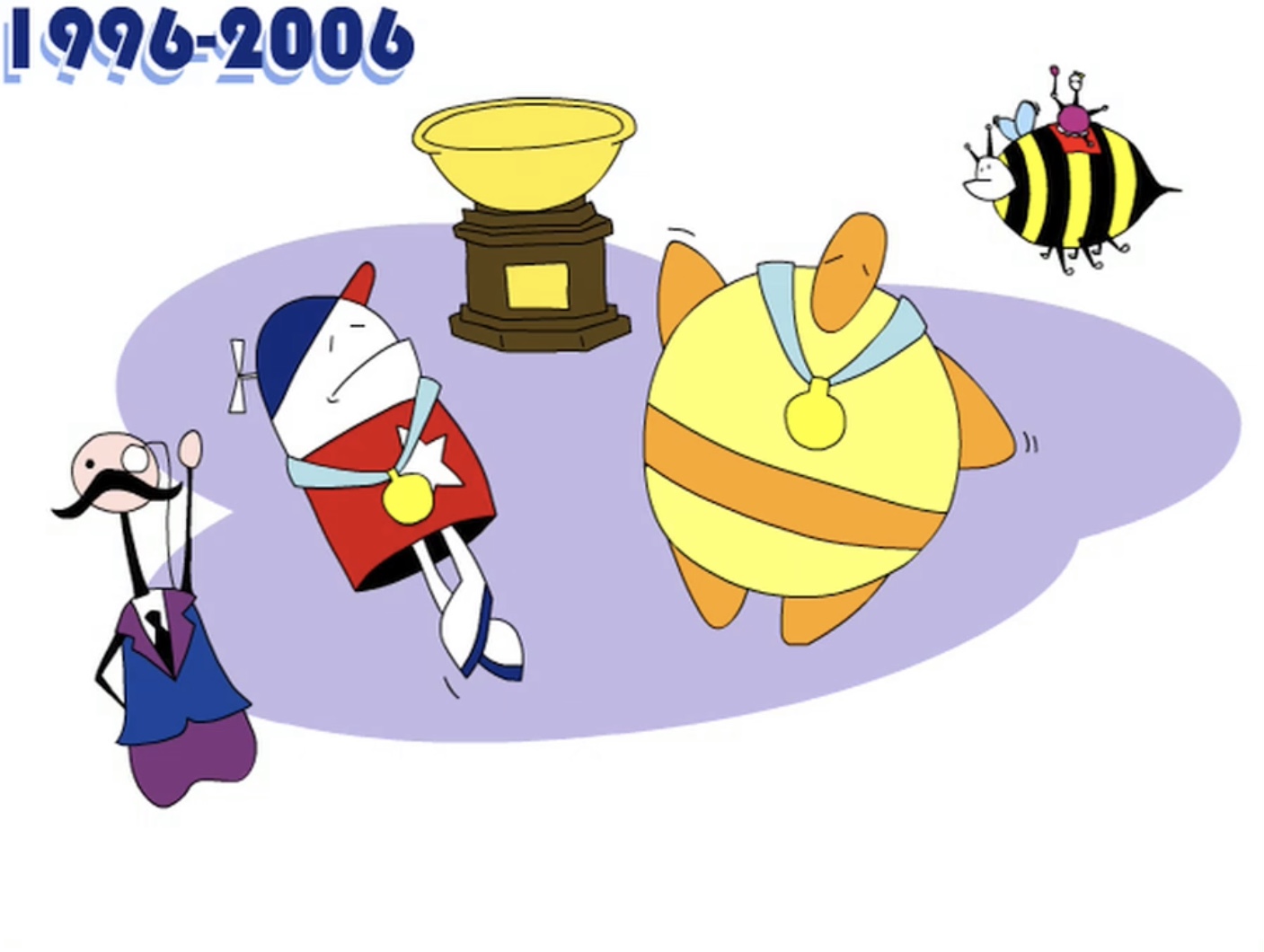
Just as the name Homestar Runner was an in-joke, this seemingly nonsensical book was never meant to spread beyond friends and family. Little did Chapman know that his father sent copies to dozens of publishers, but the most they received were rejection letters. That didn’t discourage Matt and Zobel, who began work on a sequel book, Homestar Runner Goes for the Gold, which went unfinished. Another book entitled Where My Hat Is At? was eventually completed, but animation is the medium that would define Homestar.
Although Matt Chapman wasn’t involved in the original children’s book, he collaborated with his brother and Zobel on the first Homestar Runner cartoon. The toon was made using the SNES game Mario Paint as a Christmas present for the Chapmans’ oldest brother Donnie, who they credit for their sense of humor. While the Mario Paint toon was notable for officially debuting Strong Bad’s brothers Strong Mad and Strong Sad, it essentially played like the rough animation for a TV show’s theme song. The toon was still lovingly made despite the limitations of Mario Paint.
In 1998, Matt graduated from Florida State University. Achieving a BA in Fine Arts, Matt’s thesis project was a 15-minute short film entitled Perchance, telling the story of a boy named Toby, his Uncle Frank’s dog Marmalade, and a quest to get his father out of their trailer. Moving back home to Atlanta, Matt made icons and banner ads for MindSpring, which later merged with EarthLink. Mike, meanwhile, had recently dropped out of Louisiana State University’s postgraduate photography program. Living under the same roof again, the Brothers Chaps taught themselves how to use a relatively new animation software called Flash. The brothers drew inspiration from characters they were already well-acquainted with, registering Homestarrunner.com.
Mike would primarily animate the cartoons while Matt provided the voices of almost every character, which included concession stand proprietor Bubs, the food-obsessed King of Town, and the sketchy Coach Z, whose name would be a nod to Craig Zobel. Marzipan, the cast’s only female regular, would be voiced by Mike’s then-girlfriend and later wife, Missy Palmer. Even when Matt temporarily moved to New York in 2001, he continued to record dialogue and email the files back to Mike. In addition to toons, the website included games and a store, the latter providing a revenue stream that allowed Mike to quit his job in August 2002. Matt left his job the following year, making Homestar Runner a full-time gig for both brothers. Ironically, Matt got jury duty on the first day of self-employment.
While t-shirts and other merch kept a roof over the brothers’ heads, the toons kept users coming back. Taking a page from the original book, early toons typically centered on sports and competitions. The toons soon expanded beyond this with toons like “A Jorb Well Done,” in which Coach Z overcomes his struggle to say the word “job.” The site also launched ongoing series like Marzipan’s Answering Machine and Powered by the Cheat. By far the most popular was Strong Bad Email, debuting its first episode, “some kinda robot,” on August 22, 2001.
The brothers insist that every email Strong Bad ever answered came from real people. This was evident in the grammatical and spelling errors that often littered emails. For example, in the second episode, a fan suggests that Strong Bad kill “Homsar,” an obvious failed attempt at spelling “Homestar.” This inspired the brothers to create a pointless new character named Homsar, whom Strong Bad drops a ton on. Despite starting as a throwaway joke, Homsar became a recurring character, showing how fans were influencing the creators. Getting your email answered boiled down to pure luck. At one point, Strong Bad got a few hundred emails daily. By 2003, it was over 4,000 daily, according to Matt. Many concerned how Strong Bad types with boxing gloves on.
Along with Homsar, the emails paved the other for other mainstays like the Japanese cartoon Stinkoman, the crazy cartoon Sweet Cuppin Cakes, and the comic strip Teen Girl Squad. For many (including yours truly), their introduction to Strong Bad would be in the episode “Dragon.” Showcasing his skills as an artist, Strong Bad draws a “wing-a-ling” dragon comprised of consummate V's, spinities, and a beefy arm protruding out of its neck. Dubbing his creation “Trogdor the Burninator,” an internet icon was born. Equally iconic was Trogdor’s theme song, which later inspired a heavy metal version that would be featured on the album Strong Bad Sings (and Other Type Hits), as well as Guitar Hero II. Believe it or not, the song was a last-minute addition that the brothers wrote, recorded, and drew on the fly.
Just as Strong Bad surpassed Homestar’s popularity, Trogdor arguably overshadowed Strong Bad. This was evidenced in the series finale of Buffy the Vampire Slayer, which aired about five months after Trogdor’s debut. Playing Dungeons & Dragons, a character says, “You go through the door and are confronted by Trogdor the Burninator.” Homestar Running had officially crossed over to the mainstream. Having started as an in-joke, Homestar’s humor shouldn’t have appealed to anyone beyond the Chapmans’ inner circle. Weirdly enough, though, fans felt like they were in on the joke as well. Homestar Runner became the biggest inside joke in early internet history before anyone even knew what a meme was. Certain lines and mispronunciations still live in the heads of longtime viewers rent-free, working their way into everyday conversation and even TV shows.
In addition to writers like Joss Whedon, the Chapmans attracted the attention of alternative rock duo They Might Be Giants, collaborating on a music video for the 2004 single, “Experimental Film.” The Chapmans hadn’t bothered keeping track of the site’s traffic. When the outlet Cold Hard Flash did an Alexa Internet search in 2005, though, they found Homestarrunner.com was attracting more visitors than Pixar.com, TheSimpsons.com, SouthParkStudios.com, and StarWars.com. While many considered this the peak of Homestar Runner, a vocal minority argued that the show had “jumped the shark.” When Mike read this on a message board, he stated in a Pulse interview, “It's me and my brother making cartoons for the internet in our apartment. We haven't ‘jumped the shark.’ That just doesn't even apply. When Marzipan and Homestar have a baby, then we've definitely ‘jumped the shark.’”
Homestar and Marzipan never procreated, but Mike and Missy Palmer welcomed a daughter in 2006. Matt and his wife, Jackie Chapman, became parents. Despite their newfound responsibilities, the brothers not only found time to regularly update the site, but also found time for side projects. 2008 saw the release of Strong Bad's Cool Game for Attractive People. Developed with Telltale Games, this five-episode saga saw Strong Bad sabotage Homestar Runner, go to war with the King of Town, host the Battle Royale of the Bands, don his Dangeresque shades for an overdue threequel, and even face Trogdor. Strong Bad taking center stage was something of a full-circle moment, seeing how the NES game Tag Team Wrestling inspired the character. That same year saw Strong Bad answer his 200th email with John Linnell of They Might Be Giants lending his voice to the Poopsmith, breaking his vow of silence for the occasion.
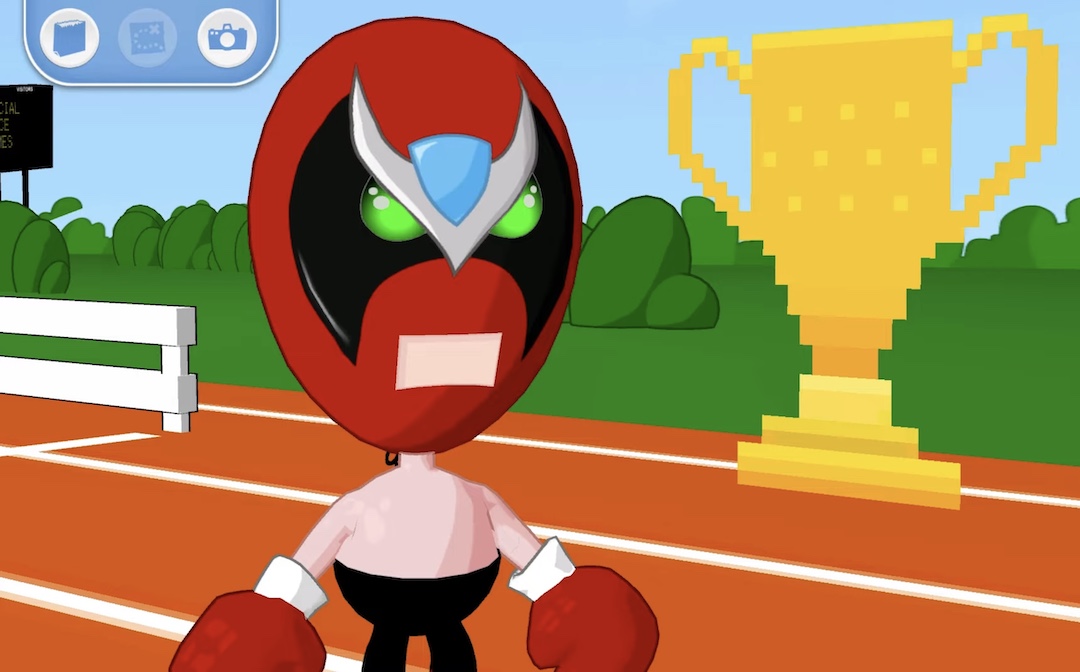
Strong Bad's Cool Game for Attractive People
With Matt’s second child being born the following year, 2009 seemed like an appropriate time to take a break. Putting out content almost every week for a decade, creative burnout was settling in. With their families growing, the brothers also needed to consider other career opportunities. Their temporary hiatus turned into an indefinite one. Since losing the Streamy Award in 2010, Homestar Runner has sporadically popped up. In 2011, @StrongBadActual was registered on Twitter (X). On April Fool’s Day 2014, Homestar and Strong Bad starred in their first toon in over three years. The gang has since appeared in a handful of new toons, including a 20th-anniversary special that resurrected Homestar Runner Goes for the Gold. Every time Homestar resurfaces, though, he quickly retreats back into hibernation.
Just yesterday, Homestar celebrated its 25th year online with a new toon, “Back to a Website.” Homestar longs for the good old days when there were more than four domineering websites, all of which we access through smartphone apps. Losing www. is one thing, but when was the last time anyone had the pleasure of typing .com, .net, or .egg? Homestar and Strong Bad engage in a catchy duet, reminiscing about the experiences that only a traditional website can offer. Ironically, the toon is also available on YouTube. For anyone thinking this might mark the return of weekly Homestar updates, Strong Bad quickly shoots the idea down. Hopefully, we’ll see them again by Halloween.
Looking back, Homestar is like a time capsule of what the internet was during the 21st century’s first decade. Homestar spoke a language only those between grade school and college seemed to understand. Those grade school kids are now out of grad school, and those college students are forty-somethings with desk jobs where they spend all day scrolling through Instagram. Instead of gathering around a bulky computer monitor to watch the latest Strong Bad Email, kids casually watch TikTok videos on their phones. Not much has changed in Homestar’s neck of the woods since then, except Strong Bad has upgraded his computer to the Lappier while the website runs on the Flash emulator Ruffle. Yet, Strong Sad is still sad, Strong Mad is still mad, and Homestar is stupider than ever.
Like the Looney Tunes, Muppets, Peanuts, or Simpsons, the Brothers Chaps tapped into something timeless and revolutionary. Homestar isn’t as well-known as the aforementioned names, but that’s part of what makes the series stand out. Even at its most popular, Homestar was like a secret that only the cool kids were in on. When you ran into the only other person in the tri-state area wearing a Senor Cardgage Halloween costume, it was like finding a kindred spirit. If you mentioned Trogdor the Burninator at a party, chances are most people asked, “Trog-what?” If one person understood the reference, though, you’d spend the rest of the night talking to them about the Cheat Commandos and Biscuitdoughhandsman. More people would be familiar with Homestar if it had been produced through Disney, Nickelodeon, or any TV network. This would’ve sucked out what made it unique, however.
During the site’s infancy (about two or three months in), the Brothers Chaps actually pitched Homestar to Cartoon Network. Homestar fit the mold of Dexter’s Lab and Powerpuff Girls, which appealed to kids and older audiences. Nevertheless, Cartoon Network rejected Homestar, as they weren’t looking for “character-based humor,” as Mike put it. This turned out to be a blessing in disguise. As a TV series, Homestar could’ve been a hit. As an internet series, it was and still is one of a kind. Upon stepping away from the site, the Brothers Chaps got involved in several TV shows, some of which even brought them awards attention.
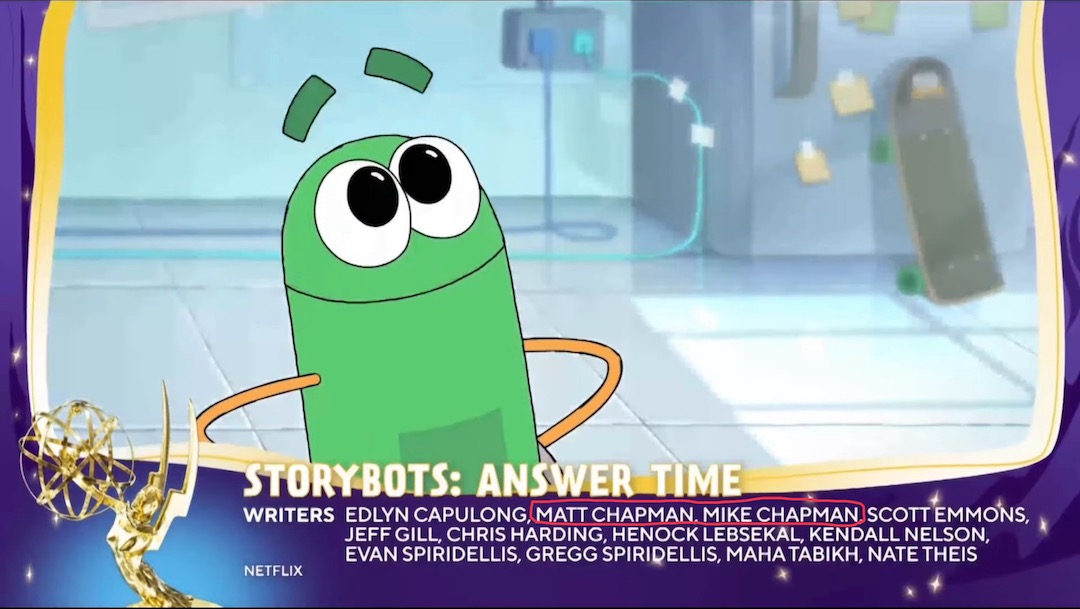
In 2016, Mike and Matt were nominated at the Daytime Emmys as part of the directing team for the Nick Jr. series Yo Gabba Gabba!. Among Matt’s contributions to Gravity Falls was a co-writing credit on the fan-favorite episode “Not What He Seems,” earning him and his collaborators an Annie nomination. In 2023, Mike and Matt shared in a Children’s & Family Emmy victory with the rest of the StoryBots: Answer Time writing team. Others affiliated with Homestar Runner have also branched beyond web animation.
Missy Palmer received nominations at the Gotham and Film Independent Spirit Awards for Great World of Sound, which she produced with director Craig Zobel. In addition to directing other features like Compliance and The Hunt, Zobel garnered two Primetime Emmy nominations for his work on Mare of Easttown. Zobel may have another Emmy contender this year, directing three episodes of The Penguin and also being an executive producer. It might not be a Streamy, but a trophy is a trophy.
The Brothers Chaps have worked on other shows like Wander Over Yonder, while Matt has lent his voice to Amphibia, The Owl House, and Teen Titans Go!, among others. They also created Two More Eggs, which bridged the gap between TV and web animation, being distributed through YouTube and Disney XD. Although the Brothers Chaps have gone on to find work in mainstream television, they’ve managed to keep Homestar shielded from corporations. There’s a pureness to Homestar that we haven’t seen since Calvin and Hobbes. Just as Bill Watterson contained his creation to the newspaper comics, Homestar hasn’t strayed far from its internet roots, a few tie-in games and merchandise aside. This has preserved what made Homestar special to begin with.
Homestar, Strong Bad, and the Brothers Chaps might not be household names, although for a generation raised online, you’ll recognize the brand of humor they helped shape. As influential as Homestar proved, it’s never quite been replicated. The site, in particular, offers an experience that YouTube can never compete with. Visiting other sites that launched in the '90s and 2000s, it’s like uncovering a relic from a forgotten time. Falling down the rabbit hole of toons, games, and Easter eggs hidden throughout Homestarrunner.com, you’re not just browsing a site. You’re transported to another world comprised of suburban houses, a race track, a concessions stand, a vacant field called Strong Badia, and the Stick. That might not sound especially exciting, but in the realm of Homestar and Strong Bad, a simple email is a gateway to endless possibilities.
I’d say that the Streamys owe the Brothers Chaps a lifetime achievement award. Of course, the Streamys skipped 2024, and the organization hasn’t updated any of their socials since 2023, calling the award’s future into question. There are other internet-based awards, however. Webby Awards, considered by some as the Oscars of the Internet, will hold their 29th ceremony on May 12, 2025. Wouldn’t it be fitting if the Webbys presented the Brothers Chaps with a lifetime achievement award at the 30th ceremony? 2026 would also mark the 30th anniversary of the first Homestar Runner book. If not a Webby, the Brothers Chaps at least deserve a pizza… maybe even a pizza trophy. If you understood that in-joke, consider yourself a member of the Homestarmy.