A website dedicated to animation, awards, and everything in between.
Batman: Knightfall – Part 1 Review | How to Break a Bat

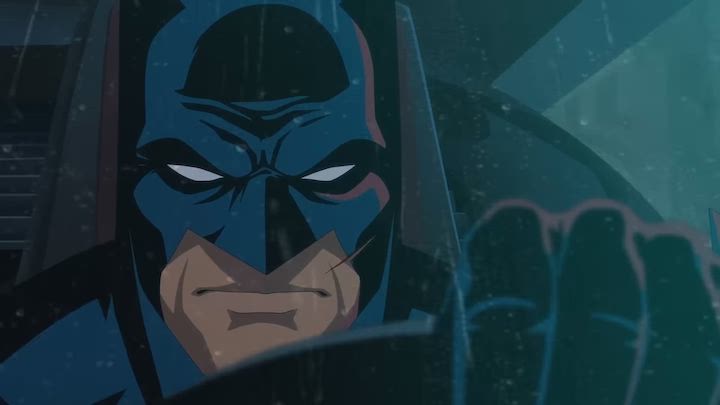
Credit: Batman: Knightfall – Part 1: Knightfall (Warner Bros. Home Entertainment)
There’s an issue with modern action stars. Many refuse to show any weakness, so much so that some have contracts stipulating how many times they can be punched. The novelty of watching a one-man army take on a parade of goons gets old quickly. Part of what makes Batman (arguably) the most fascinating superhero is that he isn’t made of steel. He’s flesh and blood. Still mightier than most mortals, surviving everything from bomb explosions to shark attacks. As Bane demonstrates in Knightfall, though, everyone has a breaking point. Even Batman.
Knightfall – Part 1 draws from one of the best Batman comic book arcs, as well as the definitive Bane storyline. While Batman’s origin story has been done to death, this film’s first third is largely dedicated to Bane’s. Like the best heroes and villains, Batman and Bane are opposites in many respects, but where they intersect is where things get interesting. Despite his childhood tragedy, Bruce Wayne otherwise grew up surrounded by luxury. Bane was raised in prison, literally fighting every day to stay alive. What doesn’t kill you makes you stronger and, in Bane’s case, more lethal. The Venom-enhanced Bane becomes an inspiration to his fellow prisoners. Where some similarly view Batman as a symbol, Bane sees him as a crutch who’s allowed Gotham to grow weak.
Releasing the inmates from Arkham, Bane sends Batman on a marathon run of boss fights, from a Bob Hoskins-esque Mad Hatter to a jacked-up Riddler. Batman has backup in Tim Drake’s Robin, but after what happened to Jason Todd, he’s hellbent on flying solo. The villains of Gotham chip away at a sleep-deprived Batman one at a time. Where Bane seeks to destroy him physically, Batman’s more concerned about his mental state, fearing that he’ll get sloppy enough to break his own rule. Batman would still rather cross that line than hold the corpse of another dead Robin.
With Studio Mir providing the animation, director Jeff Wamester delivers one of the sharpest-looking DC projects in a while. At times, the pursuit of an R rating can get a little gratuitous, but the violence doesn’t overshadow the dynamic that drives the plot. Despite not meeting face to face until the pulse-pounding climax, you feel the rivalry building as Bane pulls the strings, with Batman falling right into his carefully orchestrated trap. In a film full of solid voice work, Michael Mando is the standout as Bane. Although Tom Hardy’s closed-captions-required take on the character worked against all the odds, his Bane has been a caricature since Harley Quinn. Mando returns Bane to his roots, striking a balance between calculating intellectual and hulking fiend who can kill Batman with his bare hands.
As is the case with the source material, Batman and Bane are at the core of what makes Knightfall an essential Dark Knight tale. There’s a third wheel in this story, however. Jean-Paul Valley, aka Azrael, has always felt awkwardly inserted into this arc, especially during the first part. Of course, Jean-Paul plays a more prominent role as the Knightfall trilogy progresses. For my money, though, the story begins to lose what made the first part so engaging when Jean-Paul takes center stage. To me, Knightfall as a whole is like The Death of Superman storyline, which opened with the emotional gut-punch of Doomsday but became progressively messier on its way to Reign of the Supermen.
This isn’t to say I’m not looking forward to Parts 2 and 3 of this Knightfall adaptation, which will come out over the next year. Having read the source material, though, I can’t help but suspect that the filmmakers might’ve peaked with this first entry. That said, the film more than lives up to the comic’s promise. It’s one of the best animated DC projects of recent memory. As far as animated Batman movies go, it may not reach the gold standard of Mask of the Phantasm, but it sits comfortably alongside 2010’s Under the Red Hood. Of this year’s two adult-oriented animated Batman projects, I’d take this one over Caped Crusader Season 2.

Nick Spake is the Author of Bright & Shiny: A History of Animation at Award Shows Volumes 1, 2, and 3. Available Now!