A website dedicated to animation, awards, and everything in between.
2026 Oscar-Eligible Animated Short Scars We Love Director Raphael Jouzeau Interview


Credit: Scars We Love (Raphael Jouzeau)
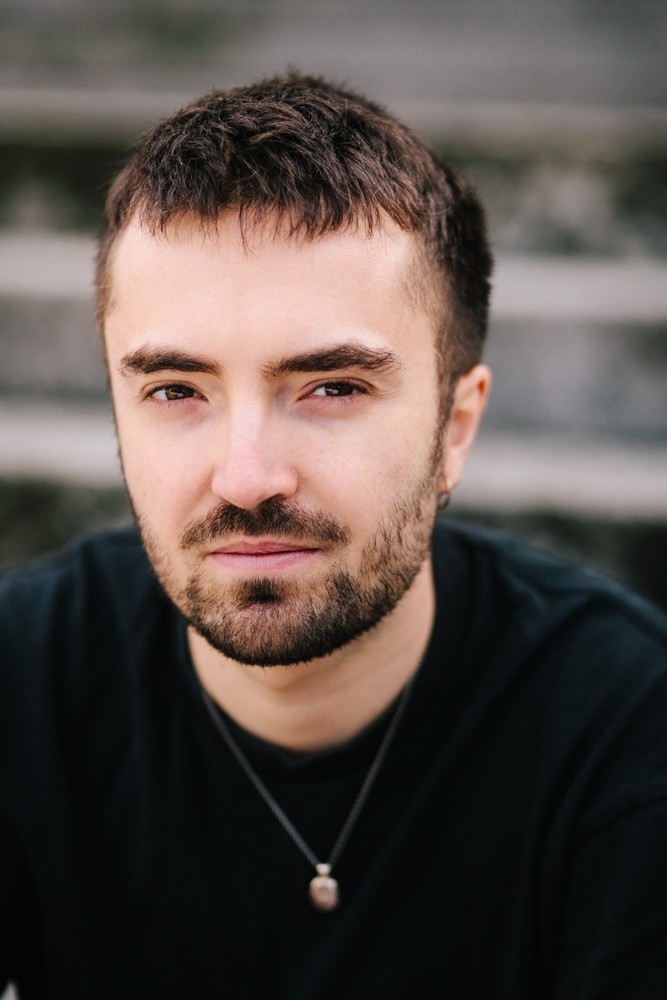
Some scars we learn to live with. Then there are the ones we learn to love, even if they still hurt. This theme is at the center of Raphael Jouzeau’s short Scars We Love, which explores what went wrong between former lovers Gaspard and Leïla. She’s moved on. He hasn’t, but a trip down memory lane may put the past and future into perspective. Winning Best Short Film win at the Kaboom Animation Festival, Scars We Love has qualified for consideration at the 98th Academy Awards. Cartoon Contender spoke with Jouzeau about drawing from real-life scars, artistic inspirations, and the short’s surprise breakthrough on TikTok.
Credit: Raphael Jouzeau
Q: Is the story, which you wrote with Pierre Le Gall, at all autobiographical?
A: Obviously, I was inspired by my first breakup, which affected me a lot at that time. I think with this film, I wanted to try to understand what happened. It was also an opportunity to feel what she had felt at that time, too. It was like therapy, but I wanted to share this, did a sort of big group therapy, ahah. I wanted [as] many people as possible to identify with it and also heal their own scars. For that, it was really important for me and my co-writer, Pierre Le Gall, to make this film really sincerely, with no shame about our most intimate emotions. Also, I didn't want it to be a stupid war between two ex-lovers. It was very, really important for me that the two characters were equal and nuanced. There is no winner or loser in this story, just two [people who don’t] understand each other.
Q: Quentin Dolmaire voices Gaspard in the film, while Fanny Sidney voices Leïla. Was it a long search for the right actors for these parts?
A: It was pretty quick. I didn't really know any professional actors, so I asked my producers to suggest some names of people we could approach. Quentin Dolmaire has a fragile voice, which suits Gaspard well, and I have to say that his voice is also similar to mine, ahah. So, I don't think it's a coincidence that my producers suggested him. For Fanny, we were looking for a more sunny, confident voice, but one that could break when emotions overflow. And she does it beautifully. I was very lucky to meet them.
Q: Did Dolmaire and Sidney record their lines together or separately?
A: They were together in the studio. We first did a training session where we filmed them to get some acting references for the animators later on. Then we spent a day recording the final voices. Most of the time, they were together. Then, during the sound editing, we took quite a long time and [it] was difficult to choose the right takes… because the voices in the film play a big part. Some sentences are combinations of several rushes from the same dialogue. Other times, an entire rush works very well, like Leïla's monologue at the end on the beach. During this one, Fanny made us all cry in the record studio.
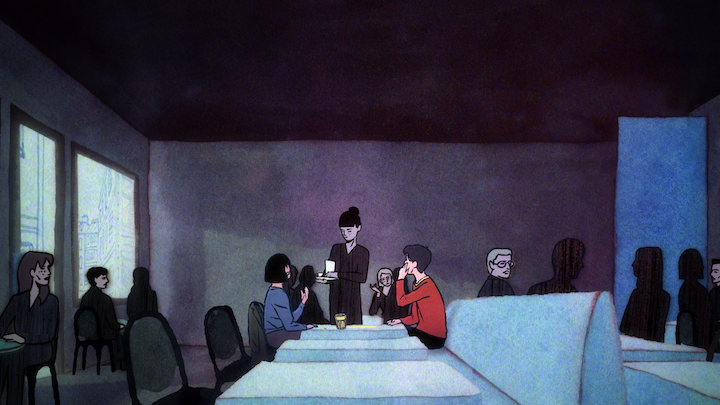
Q: The backgrounds leapt out at me. What were the inspirations behind the film’s visual aesthetic?
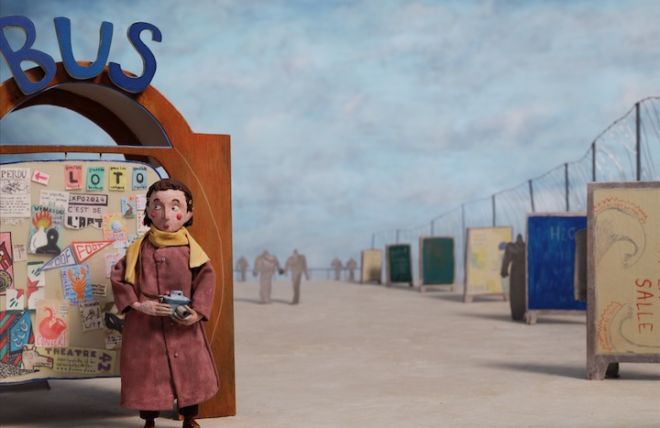
A: The backgrounds were created by André Derainne, a friend I met during my studies. I've always loved his watercolors, and I tried to copy his technique, but I never got it right, ahah. So, I just asked him if he'd be interested in making the backgrounds for the film himself. He said yes right away. It was his first time working in film, he loves cinema, he was very excited about it. We were inspired from the desert in Spike Jonze's adaptation of Where the Wild Things Are, and by Gerry by Gus Van Sant. I wanted a desert because it's a virgin place where you can make anything appear behind a dune, like a memory, for example. I wanted two very different settings: the bar, cold, full of people watching us, which we want to leave at all costs, and the beach, with its sunset colors, where we are finally alone and can finally say everything to each other. Saying very difficult things to each other while we are in a very sweet place. I think it is the kind of contrast that can touch people.
Q: Scars We Love is eligible for Oscar consideration through its Best Short Film win at the Kaboom Animation Festival. What have been some other standout moments from its festival run?
A: We were very happy to receive both the audience award and the jury prize for Kaboom. This day I was in Vienna for another festival, and it was my birthday, like the member of Kaboom’s festival who told me, haha! It was a wonderful gift.
Q: Scars We Love has also gained a significant amount of attention on social media. What has the digital response been like?
A: The film was released last September in France. A week later, the views on YouTube exploded. We didn't understand what was going on. My little sister told me the film was buzzing on TikTok. I don't have TikTok, no one in the team have it too, so we were a little bit lost. We discovered a lot of people were repeating Leila's monologue in the bar, lip-syncing or like acting performances. It was a little bit crazy for a short film. In general, we don't have a lot of visibility. Short films [are] still in the sphere of cinema lovers and film festivals. The film [found] a very wide audience. This is what makes me happiest.
Q: Why do you think the short is resonating with Gen Zers in particular?
A: From what I've read in the comments and what I've been told, a recurring theme is the fact that the characters talk to each other and communicate. The film also talks about alcohol, and how when you're young and partying a lot, it can be an easy way to be yourself, to say what you feel to others, because you're no longer affected by the opinions of those around you. And the fact that you put yourself in the other person's shoes and see that there are no good guys or bad guys. It's a different perspective from the highly polarized, even extreme, discourse that young people see on TikTok and other social media platforms. It can be reassuring to see that there is still a place for nuance, for listening to others and being heard and understood without preconceived judgments.
Credit: Scars We Love (Raphael Jouzeau)
Q: Is there a scar/souvenir that you love?
A: In the film or in my life? In the film, my favorite moment is during the party, when the two characters walk around the city as ghosts. It's a scene that I completely rethought at a time when I was told it didn't work, and I'm very happy that I listened to that comment and questioned myself, because it's the scene I'm most proud of now.
In real life, I had a very powerful moment with my friend who did the backgrounds for the film. We spent a week at the Cannes Film Festival for the film's premiere, and at the end of the week, there was a screening of short films. At the end, we found ourselves outside with the whole film crew, and I saw my friend wearing his sunglasses. I approached him and realized he was crying. He's a very secretive friend who doesn't show his emotions much, and seeing him like that, seeing that I had broken through his shell, made me burst into tears too, haha. We hugged like we had never hugged before, with lots of tears, and I think it did us a lot of good, haha. I'll never forget that beautiful moment.
Nick Spake is the Author of Bright & Shiny: A History of Animation at Award Shows Volumes 1 and 2. Available Now!