A website dedicated to animation, awards, and everything in between.
2026 Oscar-Eligible Animated Short Hunting Director Lea Favre Interview


Credit: Hunting, Qui part à la chasse (Lea Favre)
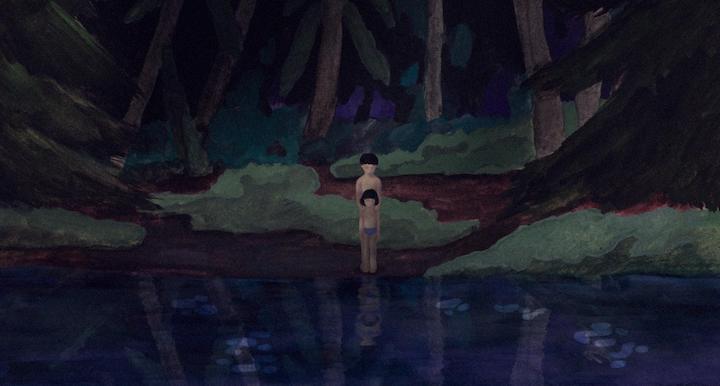
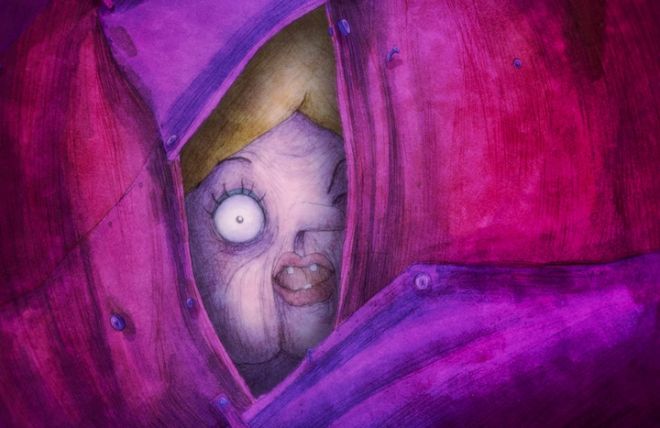
In the stop-motion short Hunting (Qui part à la chasse), aspiring documentary filmmaker Lea turns her attention to an old man as her subject. Lea wields her camera like a rifle, but once the old man starts talking, the hunter becomes the hunted. This is an autobiographical story from director Lea Favre, who incorporated an actual recording from an all-too-real experience. Hunting won Favre the Silver Dragon for animation at the Krakow Film Festival, qualifying the film for consideration at the 98th Academy Awards. Cartoon Contender spoke with Favre about telling her story through stop-motion, the significance of costuming, and the film’s haunting tonal shift.

Credit: Lea Favre
Q: Can you tell me about your background in animation and what inspired you to tell this story in stop-motion?
A: Animation, especially stop-motion, has always moved me deeply, without really knowing why. I started making my own animated films quite late (around seventeen), alone in my bedroom. And then I decided to attend a live-action film school, directing track (ECAL in Switzerland), telling myself that maybe I’d specialize in animation later on. Between my second and last year of studies, I paused my curriculum to do a one-year internship on Claude Barras’s second feature film, Sauvages, which allowed me to understand how a professional animated film is made (and quite a film — I’m a huge fan of Claude’s work!!). Then I went back to school and made Qui part à la chasse during my graduation year. It was on Sauvages that I met the main members of my film crew: Constantin Rytz (puppets and lead animation), Diane de Ribaupierre (sets), Aurélie Sprenger (cinematography), Clémence Pun (production), … To tell this story, I deliberately chose stop motion over any other technique (and over live action). The goal was to create a childlike world — a familiar, controlled space where the viewer, like the film’s protagonist, feels safe. At first, at least…
Q: The main character’s name is also Lea. Is she based on yourself, and is the film at all autobiographical?
A: Yes! Lea is me, and the story of the film happened to me about three years ago (give or take a few details). From my point of view, it’s therefore a totally autobiographical film. Also, the Lea in the film looks physically like I did on that day: little hair clips, often-red cheeks, camera always ready, and a long pink coat covering me head to toe.
Q: Where most of the characters are white, shadowy extras who blend in with one another, the two central marionettes stand out. How did you conceive the look of these marionettes?
A: I wanted it to be instantly clear why the two main characters are drawn to each other — that mutual lightning strike: they belong to the same visual universe, they’re colorful, in volume, alive! They exist in the same dimension. The other characters, however, are almost 2D. At first, they’re like shadows: flat and dull; then, when the situation shifts, like ghosts — there without being there, mute, blind, deaf while the horror unfolds...
Q: You also made the costumes for Hunting. The clothing ultimately plays an important role in the film. The star on the back of the old man’s jacket is seemingly what catches the young documentarian’s eye. When he starts harassing Lea, her coat suddenly disappears, revealing a marionette's body. In what other ways do you think the costumes are integral to the story?
A: Good eye — I love costumes, clothes in general, and sewing! Clothes are meant to protect us from the outside world, but they often also serve to attract us toward each other (at least for me), and I love that duality. Regarding the old man’s costume, I imagined it entirely so that its owner would immediately appear brilliant and magnetic (because that’s exactly how Lea sees him). Regarding Lea’s coat, I invented nothing: it’s a replica of a beautiful pink coat I own. When I met this man, everything was fine, and then suddenly, out of nowhere, he said: “It’s a shame, your coat is too long, it hides your body.” And then it began — he started getting worked up, imagining what body might be underneath. So I wanted to symbolize what it feels like to be undressed by someone’s gaze. And from another angle, that coat was my protection. I remember thinking that as long as I kept it firmly closed, nothing could happen to me: it was my shield against the aggressor.
Q: The film takes a sharp turn about halfway in. It starts so charming, but once the old man shows his true colors, we’re unsettled throughout the rest of the film. When you show Hunting at festivals, can you sense tonal shifts in the audience?
A: Absolutely! Since I know my film by heart, I love being in the theater when it’s screened and listening to people’s reactions, trying to rediscover it through their fresh eyes. At the beginning, people smile, sometimes laugh quite loudly (which is the most beautiful reward for a director, in my opinion), and then all of a sudden it stops. Everything freezes. Not a breath. And finally, the film ends and the applause is very, very, very loud - I’m exaggerating a little to make you want to watch the film ;).

Credit: Hunting, Qui part à la chasse (Lea Favre)
Q: For much of the film’s second half, the main character closes her eyes. The screen goes black, but there’s still a record signal in the upper right-hand corner, emphasizing how this horrifying experience will stick with the main character. What inspired this creative choice?
A: For this scene, I wanted the focus to be entirely on the sound, so I decided there would be no more image. I wanted the viewer to be at the same level as Lea: stuck, trapped, not knowing for how long, not knowing what will happen next. Suddenly, it’s no longer Lea’s voice that expresses itself and leads the way — it’s a man’s voice. A real everyday villain… Indeed, the audio recording heard in that part is real. I recorded that man out of pure survival instinct. I thought: if he kills me, at least the police will have proof of what happened. At the time, making a film was absolutely not on my mind!!!
Q: Hunting has qualified for Oscar consideration by winning the Silver Dragon for animation at the Krakow Film Festival. What have been some other highlights of the film’s festival run?
A: Everything happening around this film feels completely surreal to me… It’s traveling all over the world, with selections in around forty festivals, eleven awards, including the Silver Dragon in Krakow, but also Best Film at Fantoche (which actually makes it doubly eligible for the Academy Awards). I’m realizing that this story, so personal to me, is actually entirely universal, and that sometimes overwhelms me. I’ll never forget the discussions after screenings, the thanks, the steady gazes filled with tears or anger. I’m fortunate to accompany the film to most festivals where it’s selected, and to discover incredible films and filmmakers.
Q: What do you hope aspiring young artists take away from your film, be they animators, documentary filmmakers, or both?
A: I hope it inspires people to tell their own stories. Even if it’s sometimes difficult to dig deep, that’s where you find what others haven’t done! And the great thing is that as filmmakers, we get the final say on what happens in the film — unlike in real life. So let’s take advantage of that, twist things our way, it’s our weapon!
Nick Spake is the Author of Bright & Shiny: A History of Animation at Award Shows Volumes 1 and 2. Available Now!