A website dedicated to animation, awards, and everything in between.
2026 Oscar-Eligible Animated Short No Vacancy Director Miguel Rodrick Interview


Credit: No Vacancy (Miguel Rodrick)
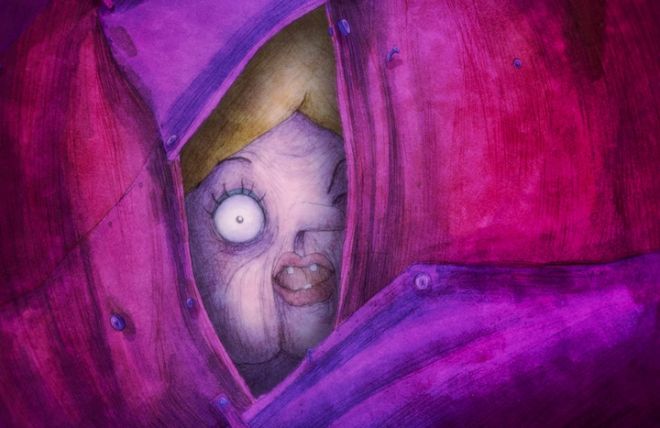
The animated short No Vacancy not only takes us inside a motel, but also the headspace of protagonist Jack. The film is just as much an exploration into the psyche of director Miguel Rodrick, who based this story on his own memories… as he remembers them. No Vacancy won Best U.S. Latino Animated Short Award at the Los Angeles Latino International Film Festival, making it eligible for the 98th Academy Awards. Cartoon Contender spoke with Rodrick about visualizing his mind, the film’s neon-draped style, and what a particular scene means.

Credit: Miguel Rodrick
Q: No Vacancy is based on true stories as you remember them, according to the opening text. When did you decide to put your stories from pen to paper… and from paper to the digital realm?
A: My intention was to create a visual representation of the inner workings of the mind, not so much about opinions or preferences, but about the complexity of thought itself, how the mind moves from one idea to another. Since my own mind is the only mind I’ve had access to, it only made sense to tell the story from my own experiences.
Q: I love the visual aesthetic of your film, which feels both retro and cutting-edge. What were your creative influences in crafting the visual language?
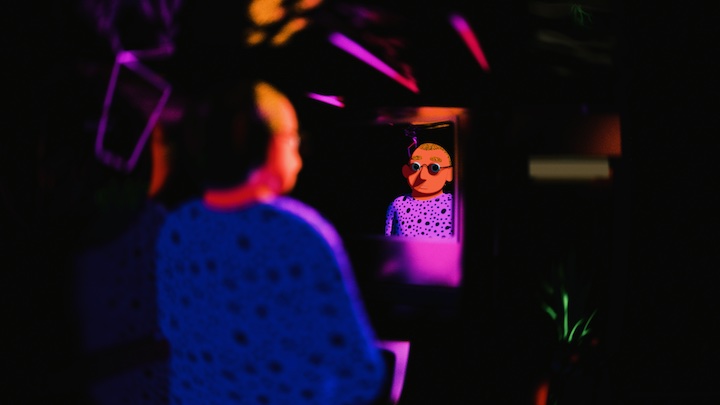
A: I took some inspiration from light painting, like the psychedelic work of Dean Chamberlain, and from poster and album cover design done in the ’70s. You can see design parallels between my film and the cover of the album The Jimi Hendrix Experience – Are You Experienced, done by Karl Ferris, which also led to me wanting to do the soundtrack mostly with electric guitar sound effects. I grabbed this visual starting point, and then added glass and metal materials to reflect the 2D colors, which I believe creates a look that feels modern.
Q: The neon colors and narration also give it a film noir quality. Was there a specific film noir that inspired the film?
A: When it comes to inspiration for the narration, it actually came mostly from my love of short stories. Donald Barthelme for form and structure, especially modular, collage-style storytelling, and Denis Johnson and Raymond Carver for their minimalist portraits of life’s beautiful chaos.
Q: The transitions also stood out to me, making it feel as if we were going from one thought to another in the protagonist’s mind. Was that the intent?
A: That is exactly right. I wanted to represent, as best I could, what it “looks like” to think, how the mind flows from one idea to another in a seemingly seamless way, while certain motifs keep repeating throughout.
Q: You animated the film with Esteban Peña. What was that collaboration like?
A: It was an interesting dynamic because I never showed him (or anyone else) a full rough animatic of the film. I would just send him little snippets with directions for him to execute, which I believe he executed brilliantly, given how little information I was giving him. I’m not exactly sure why I did it this way; I think it was mostly because it wasn’t until the very end that I was able to find the story I really wanted to tell, and I didn’t want to pile other people’s doubts about the film on top of my own.
Q: Wilver Rivera also worked on the character 3D modeling for the film. Did Rivera’s designs match what you had in your head when this project started?
A: With Wilver, the dynamic is very simple. I usually send him a collage design of a character, he models it, and then sends it back to me so I can pass it on to Esteban for rigging and animation.
Credit: No Vacancy (Miguel Rodrick)
Q: Eli Levine voices the film’s protagonist. Did you ever consider voicing Jack yourself?
A: The way the voice-over came about was a bit of a mess. I first sent a callout to a few voice-over sites and got back thousands of submissions of all kinds and levels; some didn’t even remotely match the description of a thirty–forty-year-old male. It became overwhelming to sort through them all. So, I sent the first full rough cut to Eli, who is also a director/VFX artist, to get his feedback. This first full cut had subtitles instead of any voice-over because listening to my own voice was too distracting. I hate my voice, as I think most people do, and I couldn’t see past that. Eli offered to do a voice-over pass until I could find someone else, and from the moment I dropped it into the edit, I realized he had the existential dread I was looking for. Some people ask why, if I’m from Colombia, the film is in English and not Spanish. The answer is simply practical: I wanted to do it in both languages, but it took a long time and a lot of luck to find the right English voice-over. After more than four years working on the film, I didn’t have it in me to go through the same process again to find a Spanish voice-over.
Q: No Vacancy has qualified for Oscar consideration with its win for Best U.S. Latino Animated Short Award at the Los Angeles Latino International Film Festival. What have been some standout memories from the festival circuit?
A: As I mentioned, I made this film without showing it to anyone until it was mostly completed. When it was finished, my wife asked what I hoped would happen with the film. I told her I just wanted one Oscar-qualifying festival to select it. To me, that would mean that someone, somewhere, with no reason to be nice to me, had liked the film. Anifilm was my first Oscar-qualifying festival, and if that was as far as I’d get, I was happy with that outcome, so to now be Oscar-qualified feels far beyond my original expectations.
Q: My last question is one that only those who’ve seen No Vacancy will understand: Why do you think he kept going?
A: I love this question. We will never know for sure. Some people think that maybe he was an illegal immigrant, and since there was a police siren in the background, he was better off just keeping going. The explanation I like the most is that maybe they were looking for him because he stole the bike. I love storytelling where two down-on-their-luck characters crash into each other, either literally or figuratively—in this case, literally.
Nick Spake is the Author of Bright & Shiny: A History of Animation at Award Shows Volumes 1 and 2. Available Now!