A website dedicated to animation, awards, and everything in between.
2026 Oscar-Eligible Animated Short Humantis | Interview Paris Baillie

Credit: Humantis (Paris Baillie)
In 2024, Paris Baillie won Best Animated Short at AFI Fest for her stop-motion film, Humantis. This win qualified Humantis for consideration in the Best Animated Short category at the upcoming 98th Academy Awards. Humantis centers on plantlike creatures who blend into their environments. When one begins to stand out, it attempts to cover up its physical transformation. As the changes become more evident, though, the Humantis is forced to adapt. Humantis was Baillie’s thesis film at CalArts, where she received an MFA in Experimental Animation in 2023. Cartoon Contender recently spoke to Baillie about her unique designs, real-life inspirations, and navigating the awards circuit.
Credit: Humantis (Paris Baillie)
Q: There are some parallels between Humantis and your first year CalArts short, Tulpa, especially in the character designs. There are also several differences. Humantis has no dialogue, while Tulpa features recorded conversations with your family. How did Tulpa prepare you to make Humantis, and what new challenges did your thesis film bring?
A: My first year at CalArts was actually during COVID. So, I was completely remote. I made Tulpa at home in one room on my desk. That was the first big short I ever made by myself, and I think it was right for the time, because I like learning on my own and challenging myself… It was a very intimate, closed-off experience, but then when I came on campus for my last two years at CalArts, I was so excited by the amount of equipment I had access to, and learning how to use a motion control rig for the moving camera shots… I knew I wanted to challenge myself with Humantis… Like, learning how to make a film that didn't have any dialogue... My characters don't have mouths… I'm really interested in body language and communicating things universally in a way that doesn't feel closed off. Anyone in the world can watch it, and they can interpret it in their own way. There's not gonna be a language barrier, necessarily. I definitely wanted to continue exploring that with Humantis, whereas with Tulpa, I went into CalArts with these characters already. People were like, “What's up with these things that you're animating and you're playing around with?” I wanted to make a film where it was just me explaining what these characters were, but then also, it felt weird to do it just me. I wanted to have my family be involved, too, and also make characters for them, showing how my brain worked. Developing characters, in general, even their characters don't have mouths, except for my dad's Tulpa. It's more like a kangaroo sack mouth. It just didn't talk… I hope to continue to make films that don't have dialogue. I think it is a fun and exciting challenge.
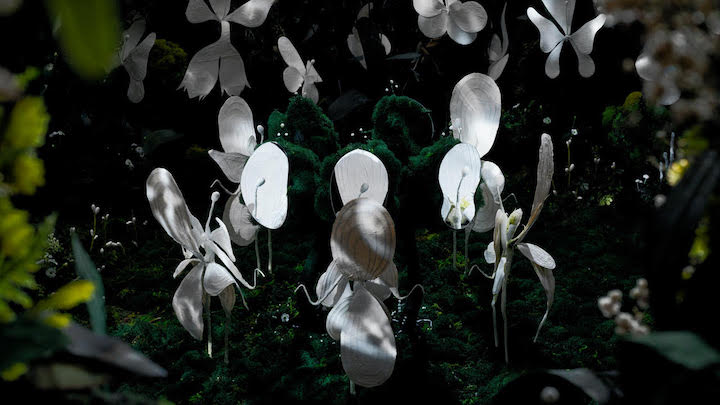
Q: The Humantis puppets were made with materials like latex and Kleenex tissues. What was the inspiration behind their mantis-like designs, and how did you choose the materials to bring them to life?
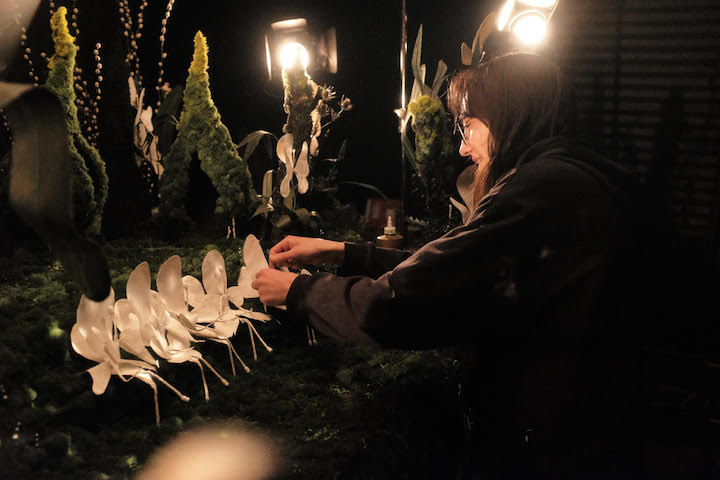
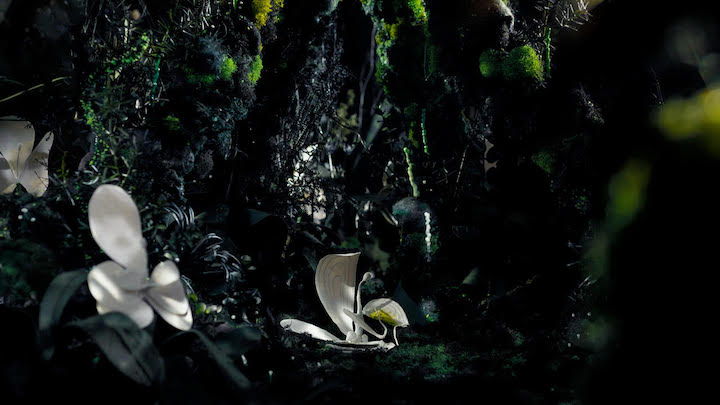
A: I became obsessed with the orchid praying mantis and was interested in the reform of camouflage, which is called aggressive mimicry. That essentially means that they perfectly mimic flowers in order to capture their prey. Developing these Humantis characters, I knew I wanted the main ones to be mainly inspired by the orchid praying mantis. In terms of the design, how could I make petals that looked like they could be animatable or could be still at the same time? It was a lot of practice. I made so many different test puppets. Just tiny scale, figuring out how to animate the petals. My dad just happened to have a 6-inch-wide masking tape roll, and I realized, masking tape, it's a very forgiving, but strong material that can still be flexible in some way. The petals are lined with wire in the inside, and then it's masking tape on top. I wanted them to have an interesting texture. I realized Kleenex was the thinnest kind of material that I could use. The actual stuff I use is called Pros-Aide No-Tack and then latex, just very thin layers to add the Kleenex on top of the tape. The puppets themselves are made out of very cheap materials, and it's aluminum wire. I would even say a lot of the set pieces were done in a minimal way, where their Humantis homes are papier-mâché, where I just build on top of a balloon like we used to do in elementary school. Then I popped the balloon afterwards.
Q: The Humantises lack faces, but they get so much across with body language alone. What do you think is the key to creating an expressive character without a face?
A: I was watching a lot of Buster Keaton clips or other older, silent films, seeing how those kinds of stories were told… It was an interesting challenge in terms of thinking about emotions in general. How do you communicate that through movement, especially with puppets that look like sculptures or don't have facial expressions, too? It's just down to what they're physically doing. I've been told that they actually move like me, which makes sense, because I'm animating them and doing it based off my own body movements... Having a background in dance, I feel, helped a lot, too.
Credit: Humantis (Paris Baillie)
Q: You not only directed and animated Humantis, but also served as the production designer. How many sets were built, and which was the most complicated to construct?
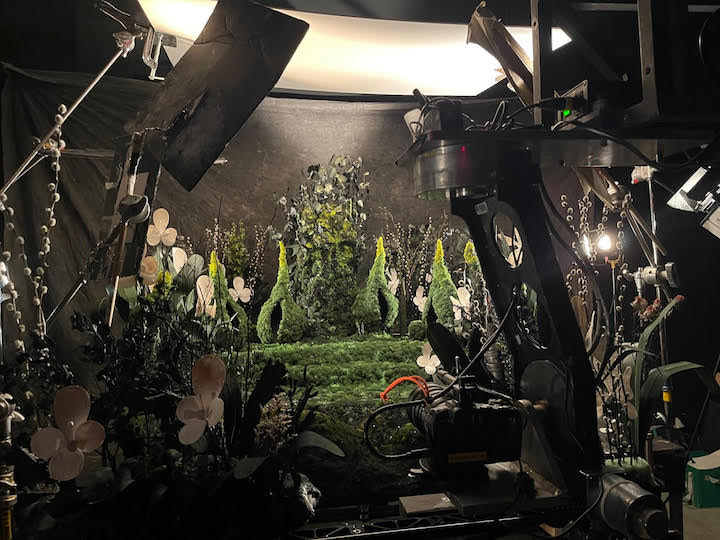
There’s, I think, four bases, main set floors, and then I had a lot of the additional set pieces on top. They're removable, so I would move them around. A lot of them were just me repurposing different floor bases that I originally made… The most difficult set to figure out, I'll say two of them. The first one, the flower Humantis set, the main one that the title opens on, the one with the little huts, and the flower Humantises dance… I wanted it to look like a conversational pit made out of moss, so there is this weird step in the couch that they're all sitting on at one point. Figuring out how to animate on top of it was definitely something. I hadn’t done anything at that scale before… It was a deep set, and I didn't think about cutting it in half. I had to reach my arm really far to screw them into the middle of the set… Funny things like that, I should have thought about at the beginning, but it all works out fine. It looks cool.
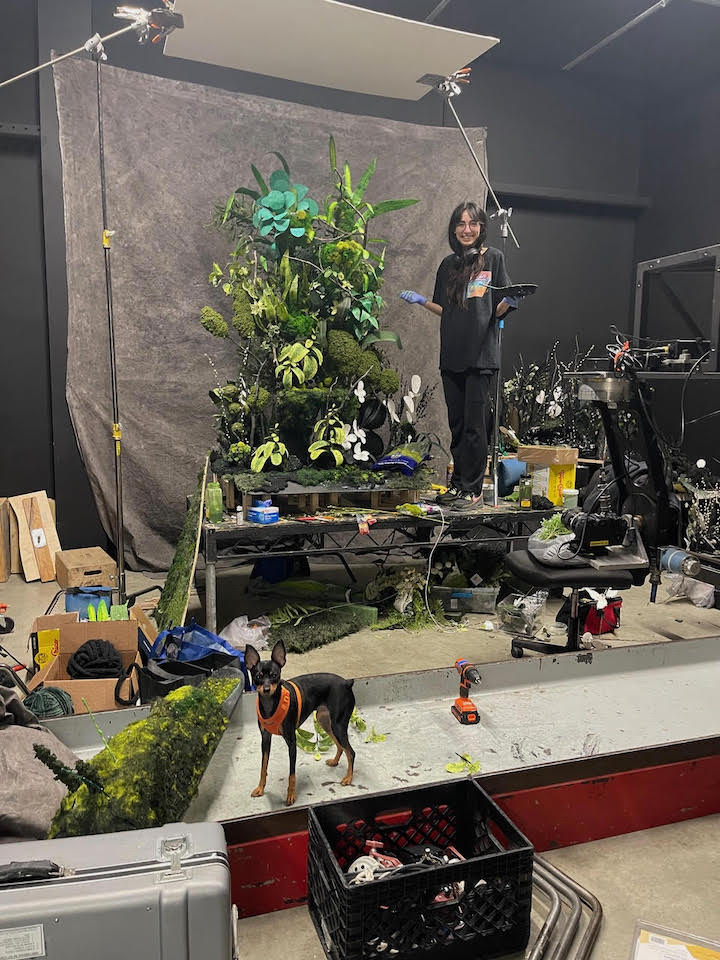
The second set, that was a lot of work, was the final leaf Humantis set. The tall one where the camera pans up. That one was really tall. I definitely thought through that one a lot better… It came apart in different pieces, so the back of it kind of looked like a ladder. I just attach different pieces of plants and stuff on top of that. But that one was difficult in terms of lighting, because again, I hadn't ever made anything at this scale before. I thought it would be great to light a disco ball to light the final set, just to have that speckled light everywhere. But it's impossible to keep a disco ball entirely still, even if you glue it to the ground, which is what we did at one point... In some shots, you can see the light slowly changing, but that meant I had to animate at a certain speed because of light continuity. With stop-motion, you're supposed to have light be set completely, unless it's supposed to change for the shot. For that set, because I decided to use a disco ball, I kept trying to figure out how to make it work, instead of doing something else. I figured it out in the end just to get that kind of lighting effect... That was the only shot that I actually had to mask two different shots together, because when I was animating it, climbing up, I left for a little bit to get dinner. Then I came back, and the lights were completely different. I had to finish animating it, but then just masked in the puppet after I reshot it. You can see the light slightly change, but it ended up being fine.
Q: You were responsible for the sound design as well. How did you go about creating the sounds?
A: I love all aspects of stop-motion… I could have worked with a lot of other people, but they never really crossed my mind. I was so excited to take on everything, and it felt like such a clear vision in my brain. I had never done sounds before for a film, but when I was at CalArts, I took every sound class I possibly could. I got inspired and excited by that. I took an amazing class taught by Andrew Kim where we learned how to build a synth from scratch. Then we're just experimenting with a lot of different synth machines and making our own kinds of machines, and learning things like VCV Rack. There's this other class that he taught called Bad Sounds, where we just try to make crazy, weird sounds using different kinds of materials. Through those classes alone, I felt inspired to experiment with this synthesizer that we built. Most of the sounds are from that synth that we actually built, and then I also did a lot of stuff in post on my own, using things like VCV Rack. Because the characters were kind of otherworldly and experimental, I wanted to make it a very experimental score as well.
Q: Change and adaptation are among the film’s key themes. Was there a particular change in your life that inspired this direction?
A: Totally, yeah. I had a lot of crazy life changes around COVID. I think going through that stuff made me actually become more of an empathetic and open person. People may not know that I'm having a hard day right now, but then, talking to other people, I'm like, “Well, they could be having the same day as me…” Sometimes the details aren't really important. It’s how we process things and move on, deal with it. Then that made me think about camouflage in general, and studying these mantises, it all just came together in this beautiful way… Thinking about camouflage, what we choose to hide and show… Now that it's out, I realized that it doesn't even feel like it's my own story anymore… I love when people come up to me and tell me, “Oh my god, this film reminds me of my own experience, or when I was going through this or through that”… This is what I wanted, people to interpret it in their own ways… After one of the festival screenings I went to, I think it was at AFI, this young girl came up to me, and she said that the film made her think about who she wanted to be as an adult as she gets older… It was really sweet to hear those different kinds of interpretations about change, going through that, but told through this universal story.
Credit: Humantis (Paris Baillie)
Q: Humantis won Best Animated Short at AFI Fest in 2024, which qualified it for the Oscars this year. Can you walk me through your memory of winning this award?
A: I saw the animations in that section, and it was such an amazing curated section. I was just excited to be there. To get that award was obviously an amazing feeling. I wasn't expecting it. I did leave after my screening and before the final award party. My sister and I laughed, and we got tacos and some drinks. I was just hanging out at that point. Then, when I got there, it was like, “Oh my god, I need to go back again!”… It was a fun evening, and it meant a lot that my sister was there because she lives in New York. So, we got to celebrate, which was really great... The other film that won, Two People Exchanging Saliva, it's cool to see that they're doing a For Your Consideration campaign now also… I made this film because I felt like I needed to make it, and then now navigating the festival circuit's been fun. The response was beyond my wildest dreams.
Q: The Oscar shortlist for Best Animated Short will be announced in December. Have you been hitting the campaign trail?
A: I did submit. This is my first time doing anything like this. So, I'm curious to see how this goes. The festival circuit's been really fun. To have my film premiere at Annecy was so cool… I had never been before, and meeting so many different animation heroes was just a really cool experience. My parents came with me, and that was even more special. I think they had the best time out of anybody there. They loved it so much. I feel like it's been special to share this with my parents. They actually are accredited in my credits. They made a lot of the leaves for my set pieces, too.
Q: Who are some of the stop-motion animators who’ve inspired you the most?
A: Allison Schulnik is a big one. I was introduced to her work when I first started animating. I feel like she inspired me to challenge my character design. My favorite thing about stop-motion is playing God, and I don't really want to make things that look like it already exists. I think that's also why I want to make these different kinds of characters where they look like moving sculptures. They look like things that wouldn't be alive in everyday life… Kangmin Kim, he's a really amazing Korean stop-motion animator… He’s one of the reasons why I wanted to go to CalArts for grad school. Then it just felt kind of kismet when I started there, he actually started teaching... He actually was my thesis professor and my mentor during Humantis.
Q: The film leaves us on a note of acceptance, but also one of loss as the protagonist finds that there’s no going back. Do you think it’s a happy ending or a sad one?
Somewhere in between… Based on my own experiences of dealing with change or a lot of big life stuff, you can miss a certain time before when things happen. Then afterwards, we're like, well, that was for the best... I miss when things weren't so complicated, but now I'm so thankful this is how things worked out. I feel more independent and on my own. It’s this in-between, a place where every day, I feel like I like myself so much more now. But then I do miss being naive. I know, being young, or when things used to feel so much easier… I wanted to feel like a very human and realistic ending, where the Humantis, once it's in its final leaf form, it’s hugging this petal, and you're not quite sure if it's missing being a flower, or if it's okay with it, because the last time I interacted with the flower, it completely tore it up a part out of anger. But instead, in the end, its final thing with the flower is hugging it. It's this emotional moment, just kind of like how life can be.
Credit: Humantis (Paris Baillie)
Be sure to follow Paris Baillie on her website and on Instagram.
Nick Spake is the Author of Bright & Shiny: A History of Animation at Award Shows Volumes 1 and 2. Available Now!