A website dedicated to animation, awards, and everything in between.
The Violinist Review | Playing All the Right Notes

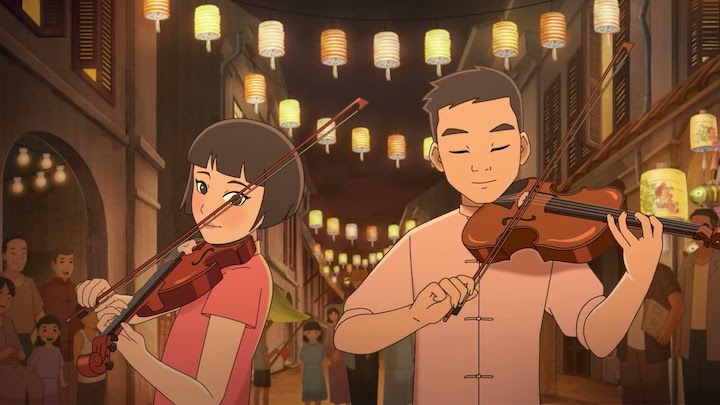
Credit: The Violinist (Robot Playground Media, TV ON Producciones, Altri Occhi)
The Violinist tells a grounded story spanning eight decades, exploring love, war, and music. On paper, the material could’ve worked as a live-action film, but then The Violinist would’ve fallen short of its full potential. Whether the characters are dodging enemy fire or sharing an intimate moment, animation brings new dimensions to humanity, striking a chord live-action can’t. Directors Raúl García and Ervin Han have made a sweeping epic, in which a performance at a concert hall is just as exhilarating as watching someone ride a bicycle amid aerial bombings. The scale may be vast, but a simple romance keeps the film’s heartbeat in tempo.
García, whose credits include several Disney Renaissance features, is originally from Spain, while Han co-founded the Singapore-based Robot Playground Media. Their backgrounds are reflected in the film’s opening, as a journalist from Valencia tracks down Fei, a legendary violinist who grew up in British-colonial Singapore. Although Fei has become an icon, the same can’t be said about a young boy standing next to her in a childhood photo. This is Kai, the adopted son of a servant who worked for Fei’s wealthy family. While young Fei has spent practically her whole life studying the violin, Kai masters the instrument simply by watching and listening to her play.
There’s a hint of rivalry at first, but this isn’t Amadeus. It isn’t long until Fei and Kai are playing together, forming a friendship that sings more like a love song. It’s a tender romance, although class isn’t the only thing separating Fei and Kai. With the rise of World War II, the Japanese come to occupy Singapore. Kai joins the resistance, but promises he’ll one day return to Fei and finish a sonata they’ve been working on. The hope of once again making beautiful music together keeps them going, although Fei fears that Kai may already be dead.
Fei’s circumstances are just as dire. Once surrounded by luxury, Fei now fends for herself amid the rubble. Even then, Fei isn’t selfish, taking a couple of orphaned children under her wing. She also develops a somewhat friendly yet uneasy dynamic with a Japanese soldier, who shows Fei and the children empathy. He doesn’t want this war any more than Fei does, wishing to see his own family again. At the same time, he’s a soldier with a duty to his country. This puts Fei in a compromising position. She comes to see the soldier as a person, but to ensure her survival, Fei must play him like, well, a violin.
Kai must similarly put up a facade as he goes undercover with his fellow resistance members. Kai’s story doesn’t feel as fleshed out as Fei’s, which perhaps could’ve been rectified if The Violinist were fifteen minutes longer. Regardless, the overarching question of whether these two will reunite keeps us invested with every emotional beat. As war and the passage of time separate them, music provides an unbreakable bond. While the film’s hand-drawn animation and CGI backgrounds go together in harmony, the music is just as much the life force behind The Violinist. Composers Ricky Ho and Isabel Latorre helped secure The Violinist’s soundtrack a special prize at Annecy, but the real surprise was when it won the Cristal for Best Film.
While its production stretched to Spain and Italy, The Violinist stands out as Singapore’s first animated feature in nearly a decade and a half. It’s reminiscent of Pakistan’s first hand-drawn animated feature, The Glassworker, which also told a love story against a wartime setting. Both films also have violinists in common, with art keeping the spark between lovers alive. For all the press The Glassworker attracted, it sadly didn’t get much attention on the awards trail. The Violinist might, or at least it’s worthy of such recognition. Even if the film might’ve been a little stronger if Kai received more attention in the final act, the experience as a whole hits few false notes.
Awards Potential:
Best Animated Feature (Oscar, Golden Globes, BAFTA)
Best Original Score (Oscar, Golden Globes, BAFTA)

Nick Spake is the Author of Bright & Shiny: A History of Animation at Award Shows Volumes 1, 2, and 3. Available Now!