A website dedicated to animation, awards, and everything in between.
The Scarlet Tamagochi Director Francisco Visceral Rivera Interview | Oscar-Eligible Animated Short

Credit: The Scarlet Tamagochi (Pista B)
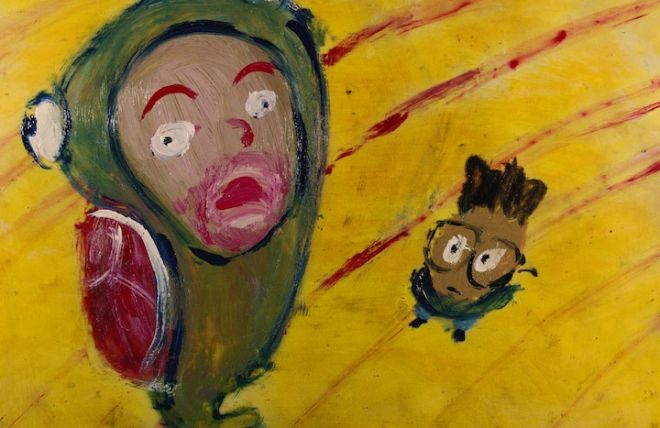
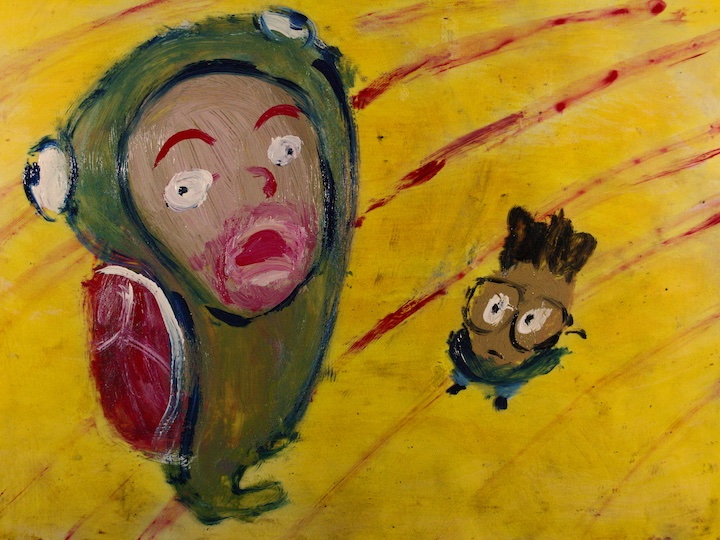
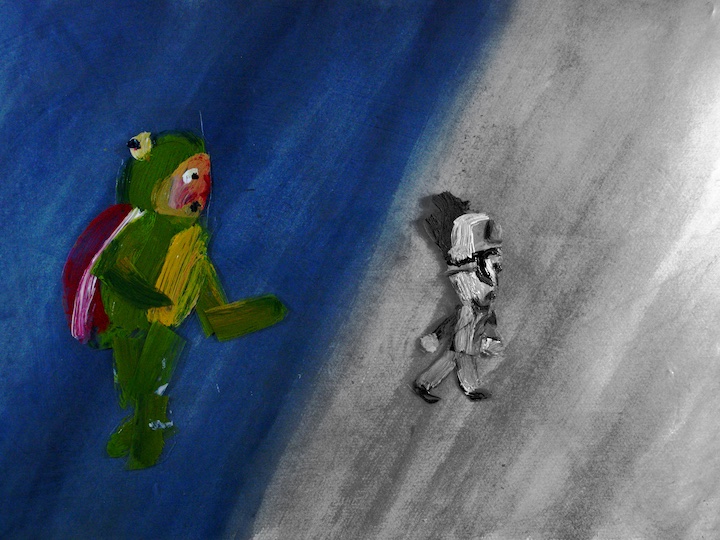
Imagine a film noir brought to life through finger painting. You’d get something along the lines of The Scarlet Tamagochi (El Tamagochi Escarlata). Director Francisco Visceral Rivera’s vivid film follows little gumshoe Iñaki and his turtle pal Cecilio as they set out to find a missing classroom toy. While the detective story draws from the hard-boiled 40s, The Scarlet Tamagochi is grounded in 90s culture, even taking a few cues from Nickelodeon. It’s no mystery why The Scarlet Tamagochi is eligible for Oscar consideration, having won the Latin American Animated Short Film Competition at the Chilemonos International Animation Festival. Cartoon Contender spoke with Rivera about blending noir with the 90s, and more!
Credit: Francisco Visceral Rivera
Q: The aesthetic captures the spirit of a children’s art project, although the film was clearly made by people who’ve spent years studying their craft. How did you strike this balance?
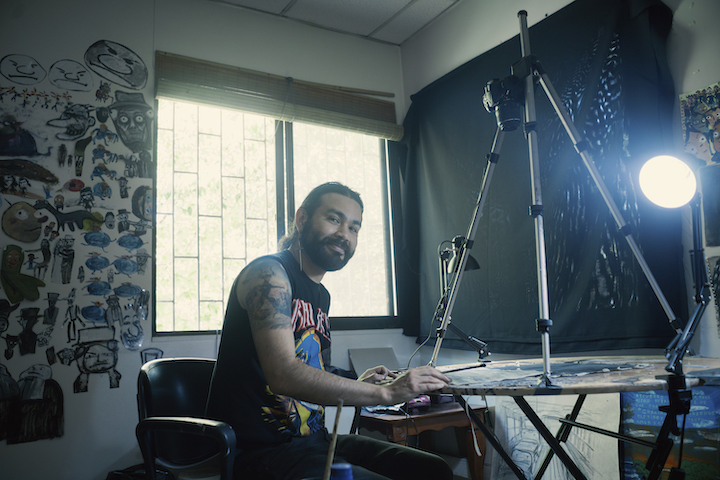
VR: Thank you very much for your observations. It’s true that the animation team, which consisted of my friend Matías López and me, has a good amount of experience in animation, but I think that deep down, we have a very childish attitude. We’re children playing at being adults. And the truth is that the whole process was so much fun, and so honest to who we are, that we didn’t find it difficult to strike a balance between professionalism and that childlike spirit.
We knew we had to present our film as if it had been made by children, but we never forgot that we had to deliver good work. At no point did we stop being animators or forget that we were making a film with a whole lot of people putting their trust in us, myself included. I’m my own worst boss. I think that, in the end, we were simply professional kids at work.
Q: The film uses a mix of techniques, such as hand-painted animation and cutout animation. What was the biggest challenge in bringing these paintings to life?
VR: Economics, as always, was the biggest challenge. Our film was shaped by three main factors. First, it had to look like it was been made by a child. Second, it had to reflect a Chilean creative identity, inspired by iconic films that are honest about their materiality, such as La Casa Lobo and Bestia. And third, we had to work within our resources. This meant that creativity went hand in hand with finding practical, economical solutions that we also found fun. So, whenever we had to solve a problem, we focused on making sure the result looked good according to these three principles, remained coherent, and saved us a lot of trouble.
I think the animation style simply came from a very natural need to finish the film within our means and to be honest about our reality. We had limited resources, as is often the case, but we even reached the point of using scraps or garbage lying next to my desk because it was the most immediate solution. Instead of waiting to secure funding or putting my producer in a difficult position by asking for what I needed, I simply took whatever was within reach, made it work, and hoped people would trust the look of the final project. In the end, they trusted me, and what's most important, it worked.
Q: It feels like this story could’ve centered on any missing toy, though the Tamagochi gives the film a distinctly 90s feel. Why was a sarlet Tamagochi chosen as the film’s Maltese Falcon?
VR: We wanted it to be a Tamagotchi because we wanted it to reflect the childhood experience of growing up between the ’90s and the 2000s, which is when most of us grew up. Tamagotchis were very popular toys in Chile during that period, partly because they were hard to get for a while. I still got my Tamagochi that my older brother brought me from a trip he did when I was a kid and I was obsessed with it. It was an "alternative" version, of course, so it died every day no matter what I did, and that made me crazy. There is something tender and dark about it.
Credit: The Scarlet Tamagochi (Pista B)
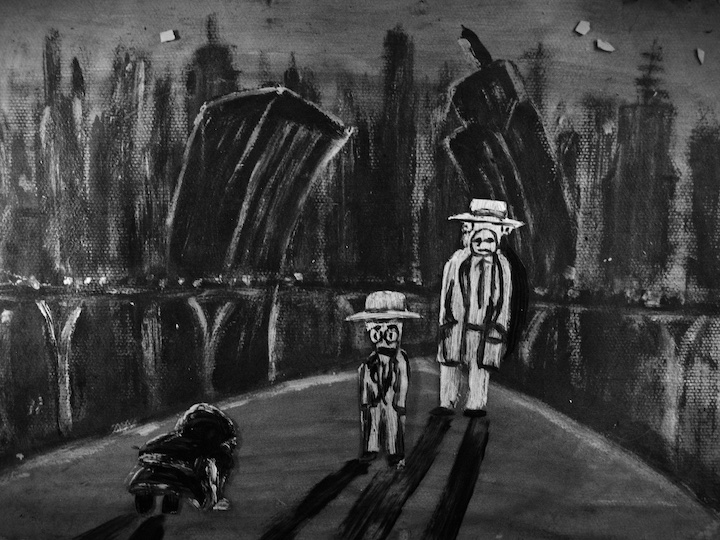
Q: The short has a clear film noir influence with several black-and-white sequences. Was there a particular film noir that influenced you?
VR: Honestly, besides The Maltese Falcon and Chinatown, we were inspired by other films that weren’t exactly part of the genre, such as Casablanca, the Batman animated series, Dick Tracy, the film Cool World, and Blade Runner. In fact, there's a whole scene that pays homage to this film. The truth is that all these sequences and shot compositions came very naturally to us as we were putting them together. They have much more to do with my personal imagination and the influences that have shaped me throughout my life than with film noir itself.
Q: Comedian Ignacio Socías wrote the script. How did you two come to collaborate with each other?
VR: This was a really crazy idea that nobody could have ever imagined, dreamed up by our friend Lucas Engel, producer at Pista B. He came up with the bold and risky idea of bringing together comedian Ignacio Socías, a mainstream comedian with a wide reach in Chile, and me, an underground artist with a dark aesthetic, violent strokes, and a subversive imagination.
He thought that bringing together two creative minds with such a huge contrast between them could lead to something really interesting. Personally, my friend Lucas gave me a great push to dare to take on a project of this caliber. Iñaki and Cecilio were originally conceived as characters for a live-action web series. The project was also envisioned as a book, a comic, and so on. But thanks to Lucas’s intuition, we managed to turn it into this short film.
Q: This is a spoiler-free zone, but without giving anything away, did you and Socías always know who the culprit would be, or did you consider different possible endings à la Clue?
VR: Rather than having different endings, there were different developments and pieces of the puzzle that led us to the final one. Initially, we thought the outcome we had built was too obvious, so our goal wasn’t to create a dangerously surprising twist. We weren’t interested in being too mysterious about the solution to the case, but rather about how to arrive at that solution. And we went around in circles a thousand times. There was even a musical scene in the middle. We cut a lot of material. It’s worth remembering that the original animation for this short film was itself a two-to-three-month job. But then we spent at least another two months creating new scenes and improving others to achieve a better result, even recreating some of them. The director’s cut of this short would be much longer. Hahaha.
Credit: The Scarlet Tamagochi (Pista B)
Q: Did any of the art you did as a child at all inspire you while making this film?
VR: When I was a kid, I loved drawing comics and sharing them with my brothers, and there’s a lot of that humor in El Tamagochi Escarlata. But I think it was more about the things I consumed at that age. For example, when I was a kid, I loved those weird MTV spots from the ’90s. I liked adult fantasy and science fiction comics filled with really terrifying drawings. I loved forbidden animation for adults. I liked Ren & Stimpy. I liked the strange, experimental ideas in a show called KaBlam! that aired on Nickelodeon. I was really into weird animated films that were scary. And somehow, El Tamagochi Escarlata has a lot of that kind of animation that could make a child feel both scared and curious at the same time.
Q: The Scarlet Tamagochi has qualified for Oscar consideration by winning the Latin American Animated Short Film Competition at the Chilemonos International Animation Festival. What has it been like taking the film on the festival circuit?
VR: It’s been surprising, mind-blowing, absolutely insane. It’s also been a tremendous amount of work. Honestly, I’m exhausted, but very excited. The only thing that worries me is that the amount of information coming my way and the number of people interested in working with us are overwhelming, and sometimes I can’t manage to respond properly to everyone. That stresses me out a little because I don’t want to be rude to people who are interested in our project.
On the other hand, we’re in a position we never thought possible. It’s crazy to think that a project made with so few resources, but with so much determination to see it through, built around spending time with friends and working with friends, could receive this level of attention and have a real chance of being nominated for an Oscar. All we can do now is keep working, keep making this possible, and enjoy all the gifts this incredible experience with El Tamagochi Escarlata has brought us. I’m very grateful to Iñaki and Cecilio.
Q: Any chance we’ll see Iñaki and Cecilio solving another mystery in the foreseeable future?
VR: There are several scripts written for Iñaki and Cecilio, since the project was originally conceived as a series. So we hope we can get enough support to finance a bigger project featuring these characters we love so much. Fingers crossed that it becomes possible.

Nick Spake is the Author of Bright & Shiny: A History of Animation at Award Shows Volumes 1, 2, and 3. Available Now!