A website dedicated to animation, awards, and everything in between.
Penguin Director Kaspar Jancis Interview | 2026 Annecy Animated Short

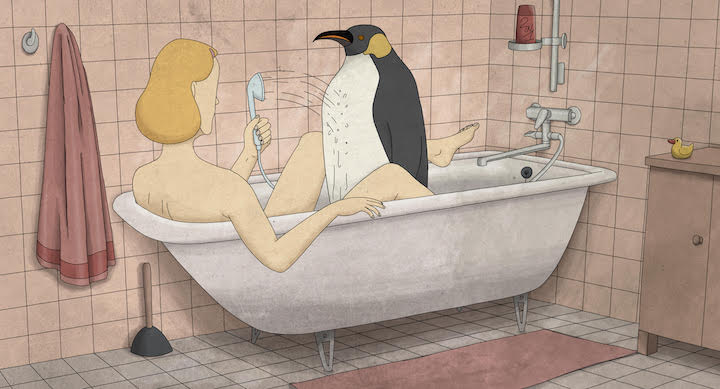
Credit: Penguin (Rebel Frame)
Penguin is the latest animated short from director Kaspar Jancis, whose previous credits include Cosmonaut and Piano. In Penguin, a couple is forced to confront their relationship issues, as well as a global crisis, as a semi-aquatic sea bird waddles into their lives. Penguin has been selected for the Official Competition at this year’s Annecy International Animation Film Festival. Cartoon Contender spoke with Jancis about the short’s themes, horror inspirations, and more.
Q: Penguin manages to be both an environmental story and a marriage story. How did you decide to combine the two?
KJ: I started with an idea of a "were-penguin" - a human taking the shape of a penguin by a mysterious curse or surgery. I had a political allegory at first in my mind, but after writing the third draft, I ended up with a relationship theme, as it became more meaningful. As part of the story takes place in Antarctica, there was a great opportunity to compare splitting an iceberg with splitting a relationship, and from there bring in the climate topic. I never start my movie ideas with readymade topics. I try to find interesting elements, and I combine them, from there, figure out what the film is about. This time, I found an interesting combo that we could call “relationships climate crisis.”
Q: There’s a body horror element to the film. The transformation is largely played for laughs, but some images gave me flashbacks to The Fly. Was David Cronenberg at all an influence?
KJ: No, I like The Fly, but I didn't see it as inspiration. I got my inspiration from watching old werewolf films. But I didn't want to make any kind of rip-off or genre-driven film, so the influence is not so dominant.
Q: The film has several great visual jokes. My favorite is a theater marquee that reads, “Bride of the Wolfman - Coming Soon Penguin.” What inspired you to pair the Wolfman with a screaming mermaid?
KJ: When playing around with human and animal hybrids in my first draft, I had a fake mermaid skeleton in the house of the main character. I dropped this first draft after seeing Poor Things. It was too similar in many ways, and I had to change the approach, as it didn't feel fresh anymore. But I needed this cinema sequence to give a hint from where the inspiration came from. Pairing a werewolf and mermaid is a funny gag, but mermaid and werewolf can represent also represent archetypal characters in toxic relationship psychology.
Q: Penguin doesn’t have much dialogue, although one line comes up a few times: “It’s okay.” What about this line stands out for you?
KJ: The line "it's okay" came first from the psychologist cabinet scene. I thought that the slogan could be a great logline. There is a contradiction: what we want to believe and what is reality in both relationship and in climate crisis. "It's okay" is representing a comfort zone that is hard to leave.
Q: The hand-drawn animation in Penguin is in the spirit of your previous films, Cosmonaut and Piano. How did Penguin’s production differ from those works?
KJ: Yes, I have my unique style in those films. In my previous stop-motion work, Antipolis, I tried something different, and now it felt fresh again to return to the style of my 2D films. It is the story that dictates the style. Penguin was fitting well. It has also some references to my film Crocodile. From stop-motion, I brought along shadows and light elements that were missing from my previous 2D films. I am very happy with that decision. The visual language became more captivating, thanks to my great partners in the project.
Q: It’s clear from the beginning that the central couple has issues that they’re ignoring, much like how people are ignoring what’s happening in Antarctica. If the penguin didn’t come into their lives, where do you think the man and woman would’ve ended up?
KJ: Who knows? Sometimes people can cope with a disbalanced relationship, come through the bottleneck, and start over. But it cannot happen without transforming. I think that crisis is not actually a crisis as we see it. It's a transformation point. Often, when looking backwards, you are grateful for your crisis because you end up in a better place than before the crisis started. I personally sympathize with the incubating penguin. She is a real protagonist of this movie. For her point of view, the story is simple but meaningful. The dedication and trust are the qualities that we tend to underrate in our society of so many options. Actually, in reality, the incubating emperor penguin is male, but let's not go into this, not to confuse the audience.
Q: Penguin is playing at Annecy this year. Several of your films have competed at Annecy in the past. What are some of your favorite memories from the festival?
KJ: I came to Annecy for the first time as a student. I was wearing my left shoe on my right foot and right shoe on the left foot. I knew seven phrases in French and had many conversations without having any idea what the response was. Next time, I came with a movie, and then I cycled around the lake. Last year, I had a throat singing competition with a famous Hungarian director. It's always something to remember, even when the memory gets slightly foggy, like the morning mist on the way to your hotel room.

Nick Spake is the Author of Bright & Shiny: A History of Animation at Award Shows Volumes 1, 2, and 3. Available Now!