A website dedicated to animation, awards, and everything in between.
Chimney Town: Frozen in Time Director Yusuke Hirota Interview | 2026 Annecy Animated Feature

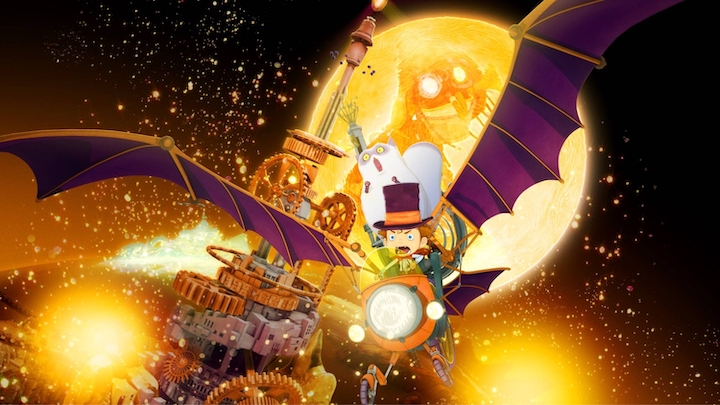
Credit: Chimney Town: Frozen in Time (Studio 4°C)
Yûsuke Hirota previously directed the 2020 animated feature, Poupelle of Chimney Town, based on Akihiro Nishino’s book. Hirota returned to direct its sequel, Chimney Town: Frozen in Time, which was selected to play at Annecy. Cartoon Contender spoke with Hirota about how the sequel’s production differed from its predecessor, a potential third film, and more.
Q: You directed Chimney Town: Frozen in Time and its predecessor, Poupelle of Chimney Town, through Studio 4°C. How did these two productions differ from one another, and in what ways were they similar?
YH: There are many ways to answer that question — in terms of the environment, the circumstances, the story, the techniques, the design, and so on. But on the most fundamental level, the biggest difference was the starting point of the filmmaking process.
The previous film began with an existing picture book, and our challenge was to expand that world and story into a feature film. With this film, however, there was no original source material in that sense. We had to begin by asking ourselves what kind of story we wanted to tell. That made the process extremely creative, but it was also a tremendous challenge.
What the two films share, however, is the theme of “believing.” Believing in something is never easy, but it can give people great strength. Lubicchi’s growth as a character, built around that theme, forms the central story arc common to both films.
Q: While the film is called Chimney Town, much of the story takes place in the Thousand-Year Fortress. What prompted this change of scenery?
YH: As we continued our script meetings, it gradually became clear that the story should center on Lubicchi’s reunion with Poupelle. Around that time, Nishino-san proposed the idea of reconstructing the story of his picture book Tick Tock: Frozen in Time as a story about that reunion with Poupelle.
One of the inspirations for the world we created — a world that deals with life itself — was Shinigami, a classic rakugo story from traditional Japanese performing arts. In that story, every human life is represented by the flame of a candle. That idea became the starting point for the Millennium Fortress: a metaphysical otherworld where the lives of people from all over the world gather.
Q: The original film was based on the book by Akihiro Nishino, who also wrote the screenplay. Nishino returned to write Chimney Town: Frozen in Time. What’s your collaborative process like?
YH: We began with the plot created by Nishino-san, and over a long period of time, we developed the story through many discussions with him and the producers. During those meetings, our art setting designer, Hirokazu Sato, also joined the process. He helped give shape to the images and ideas of the world that had emerged through our discussions, and in turn, those visuals often fed back into the story and inspired new ideas.
Q: Both Chimney Town films have a distinct mix of 2D and 3D techniques. Likewise, their aesthetic offers a retro-fusion blend that’s very steampunk-esque. Do you think steampunk is the right word, or would you use another to describe it?
YH: In the previous film, Poupelle of Chimney Town, I think certain elements — such as the industrial cityscape and Lubicchi’s anti-establishment motivation — could certainly be described as steampunk. But we were not consciously trying to work within that genre.
This new film takes place in a completely different world, so I feel it moves somewhat away from that description. That said, when creating a warm fantasy world, a highly modern or near-futuristic level of civilization can feel a little distant from the emotional tone we are aiming for. I believe that a slightly old-fashioned, retro level of civilization — both in the worldbuilding and in the design — is well suited to creating a fantasy world that feels familiar and inviting.
Q: Halloween factors into both Chimney Town movies. Why do you think this holiday matches the material so well?
YH: Halloween is the day when the world of the living and the world beyond are said to come together. In that sense, it has a natural connection to a story about beings from distant worlds reuniting, as well as to the presence of monster-like characters. We have tried to maintain that Halloween atmosphere consistently throughout the Poupelle series.
Q: Based on where the film leaves off, I feel there’s room for a third Chimney Town film. Are there plans for one already in the works?
I am personally very curious to know where this story might go next, but unfortunately, there is nothing I can clearly say at this point. According to Nishino-san, the original creator, the story of Poupelle of Chimney Town is actually only one part of a much larger narrative. So I do think there is plenty of potential for a sequel.
Q: I never really thought about how the two hands on a clock meet almost once every hour. Did this occur to you before making Chimney Town: Frozen in Time?
YH: I heard that Nishino-san discovered this idea when he was creating the picture book Tick Tock: Frozen in Time, while searching for a story hidden within something familiar and close at hand. When I first heard it, I was struck by how unique that perspective was.
In Japanese, the hands of a clock are called hari, meaning “needles,” whereas in English they are called “hands.” That alone gives this inanimate object — a clock — a certain sense of story. In Japan, there has long been a concept known as tsukumogami, the idea that objects and tools can acquire a soul after many years.
When that idea merged with the narrative quality of the clock’s hands, it led to the inspiration for a story about people finding each other again. That unique discovery became a very important source of creative stimulation when we adapted the story for film.

Nick Spake is the Author of Bright & Shiny: A History of Animation at Award Shows Volumes 1, 2, and 3. Available Now!