A website dedicated to animation, awards, and everything in between.
Julián Review | I Wanna Be Where the Mermaids Are

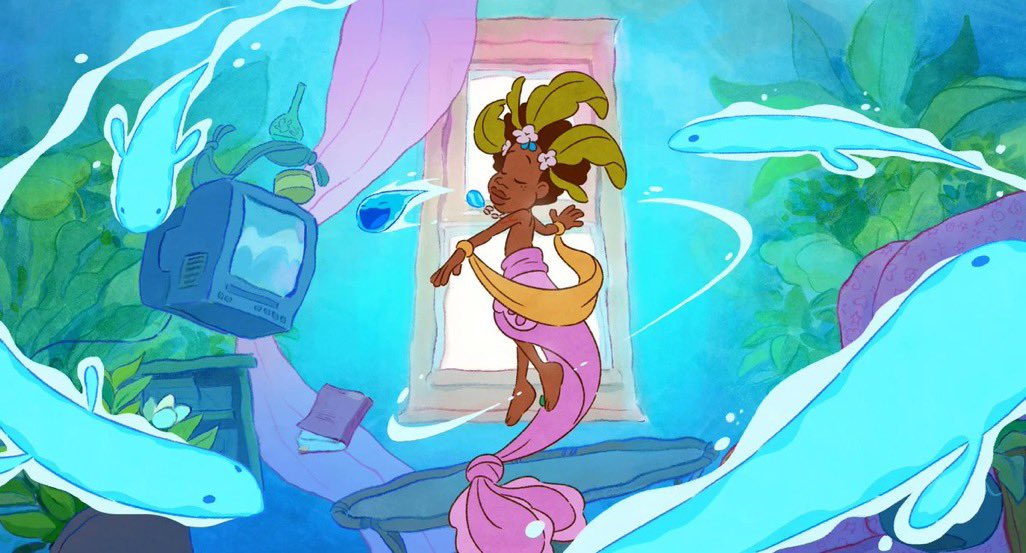
Credit: Julián (Cartoon Saloon)
There may be more LGBTQIA+ representation in family-oriented animated films than ever before. Yet it still feels like many animation studios are doing the bare minimum, often tiptoeing around the pink elephant in the room. Even when filmmakers try to incorporate queer themes, there’s often pressure from executives to “tone it down.” Cartoon Saloon’s Julián, based on Jessica Love’s picture book, fully embraces its titular character. Some may read it as a queer allegory, while others may interpret it as a trans story. In any case, little about Julián is ambiguous. The film as a whole is wonderful.
Knyght Darius Jack gives a lively voiceover performance as Julián, who arrives at his Abuela’s house in Brooklyn for the summer. Julián is drawn to Abuela’s numerous treasures, especially her jewelry. While the other boys in the neighborhood are into sports, Julián befriends three girls who are getting ready for the annual mermaid parade. At first, the girls aren’t sure Julián has what it takes to be a mermaid. After hearing his colorful ideas, though, they’re convinced he’s one of them. Abuela and her friends assume Julián is a ladies' man. Julián is a hit with the girls, albeit not in the way they think.
Some of the earlier scenes between Julián and Abuela can drag as his constant curiosity inadvertently makes a mess of her house. Their relationship reaches a turning point when Abuela first walks in on Julián in his mermaid attire. Without sharing too much, what starts as an uneasy scene builds to a genuinely heartfelt resolution. That’s not to say Julián has weathered the storm. While the central characters are refreshingly accepting, Julián is bound to encounter those who aren't as welcoming. Even just one experience outside of a bathroom can stick with a person forever.
Director Louise Bagnall's film not only explores how this impacts Julián, but also Abuela. Although she wants Julián to be himself, she doesn’t want to see him ostracized either. This leads to arguably the hardest scene to watch. You can see Abuela doing everything in her power to approach the topic delicately. No matter how she puts it, though, it’s crushing for Julián to hear. Your heart breaks for Julián and Abuela, who are both traversing uncharted waters, uncertain what course to take.
While Julián is a co-production with Melusine Studio, Aircraft Pictures, and Sun Creature, it has Cartoon Saloon's signature. It’s another feast for the eyes with storybook visuals that paint with every color of the rainbow. Blue is perhaps the most important color, as Julián befriends a water creature that may or may not be a figment of his imagination. I wish the film played around a little more with these water sequences, although it isn’t until the climax that they really open the floodgates. Likewise, the film accurately captures the tight-knit spirit of Brooklyn, but the New York setting feels constrained until the final act. In a way, though, this mirrors Julián’s journey as he gains the confidence to come out of his shell, unleashing the mermaid within.
Julián may be the most American production in Cartoon Saloon’s library. Of course, New York is a diverse locale, exploring Julián’s Caribbean heritage as well. There was a time when Abuela surely felt like an outsider in this country. She found a community that made her feel at home, however. Abuela may not entirely understand what Julián is going through. What she does know is that Julián is going through a transitional period, and what he needs above all else is empathy. It’s an important message for parental figures watching, although the fact that Julián is aimed at a younger audience is the most encouraging thing of all.

Nick Spake is the Author of Bright & Shiny: A History of Animation at Award Shows Volumes 1, 2, and 3. Available Now!