A website dedicated to animation, awards, and everything in between.
Haboolm Ksinaałgat (Soul Catcher) Directors Pamela Post & Amanda Strong Interview | Oscar-Eligible Animated Short

Credit: Haboolm Ksinaałgat - Soul Catcher (Spotted Fawn Productions)
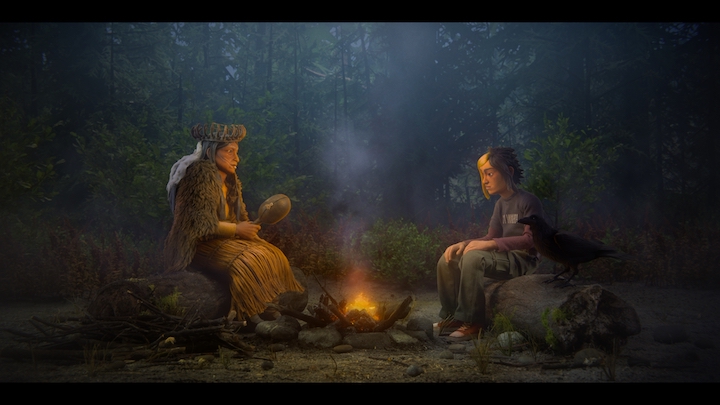
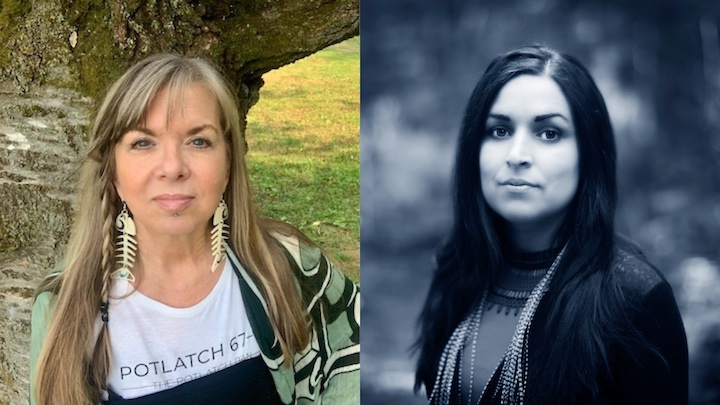
Award-winning journalist Pamela Post based Haboolm Ksinaałgat (Soul Catcher) on her Ts’msyen father’s upbringing. She teamed with stop-motion studio Spotted Fawn Productions and co-director Amanda Strong to tell a generational story centered on Lu’oo’ya (Echo), a young Indigenous person who retrieves the soul of a century-old totem pole that a missionary made Ts’msyen children throw into the Skeena River to “drown the devil” in their people. Soul Catcher won the Grand Jury Prize for Best Animated Short Film at the Edmonton International Film Festival (EIFF), qualifying it for Oscar consideration. Cartoon Contender spoke with Post and Strong about how stop-motion suited Indigenous storytelling, setting a traditional Ts’msyen healing prayer to music, and more!
Credit: Pamela Post, Amanda Strong
Q: Haboolm Ksinaałgat (Soul Catcher) is a true story based on screenwriter/co-director Pamela’s Ts’msyen father’s childhood on the Skeena River. Pamela, why did you want to tell this particular family story and Amanda, how did this collaboration come together?
PP: As a journalist, I’ve told my Ts’msyen family stories in documentary form, but during the pandemic lockdown, I was inspired to focus on just one of my dad’s stories and tell it more poetically. I wanted to celebrate Ts’msyen culture and right a wrong done to him as a child through art.
AS: Pamela was a fan of my studio, Spotted Fawn Production, and our stop-motion, and reached out to me as she was developing her script. I was moved by the visual and spiritual power of her family story within the setting of the Northwest Coast; a place I now call home with my partner and child. What started out as a mentorship, quickly became a collaboration of co-direction together. Five years later - a film was born.
Q: Is the protagonist, Lu’oo’ya (Echo), also inspired by a specific individual, or are they meant to reflect a wide range of young Indigenous people?
PP: The visual inspiration for Lu’oo’ya was from my son Asher, who voice-acts the role and who used to sport a vivid streak of saffron yellow in his dark hair. In the film, Lu’oo’ya’s gender is ambiguous, also a nod to my son, who is transgender. So Lu’oo’ya is both specific and universal in that they’re an Indigenous teen being mentored by an ancient shaman, a beloved supernatural grandmother-like figure. The film follows Lu’oo’ya’s powerful vision quest/initiation to wake up out of the trance of technology and embrace the deep spiritual power of their Ts’msyen culture and reclaim what was stolen.
Q: The film is filled with spellbinding supernatural Ts’msyen cultural references and objects. Why did you choose those specific cultural aspects?
PP: I wanted the film to be a visual kaleidoscope of Ts’msyen culture. It was a big ask of Amanda to create so many of our naxnox (supernatural objects) authentically and in miniature, but the results exceeded my expectations.
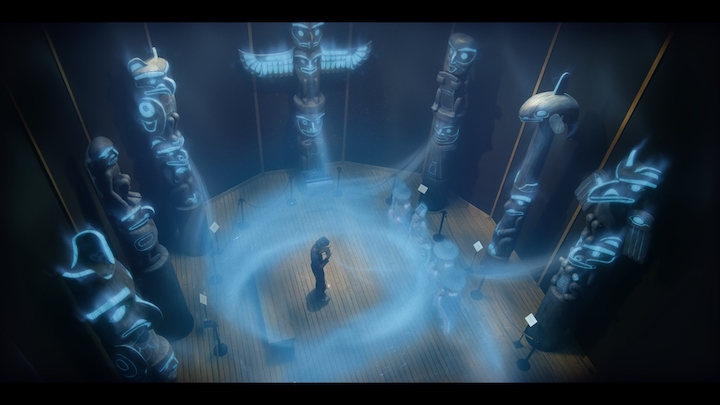
AS: I was particularly excited to put together a team to portray Northwest Coast First Nations culture and to commission Northwest Coast artists to create original totem pole designs, the soul catcher amulet, and other Ts’msyen treasures like chilkat blankets, rattles, copper shields, and regalia. Our team of artists and animators fell in love with the story and made magic.
Credit: Haboolm Ksinaałgat - Soul Catcher (Spotted Fawn Productions)
Q: Stop-motion feels perfectly tailored for this story, as we see how the Soul Catcher amulet and the totem pole aren’t merely inanimate objects. They carry histories that are alive. Did you decide to produce the film in stop-motion because of its practical touch?
PP: To me, stop-motion is uniquely suited to Indigenous storytelling because of its sculptural quality, both the slowness of the process and the material nature of the puppets all evoke the supernatural.
AS: Most of my storytelling is rooted in stop-motion animation. It’s a process and community-centered way of working that I’ve spent over a decade learning. This story, like many of my films, inspires me to build inviting and engaging worlds within the meticulous process of stop-motion. For me, stop-motion is an art form that, through the weaving of time, care, and attention, these stories truly live on screen. It’s a privilege to work in this medium.
Q: How were the film’s puppets, props, costumes, and sets constructed?
AS: I had the great honor of collaborating with Patrick Zung and Nora Rodgers of Standing Figure Inc. on Soul Catcher’s puppet builds and costumes. This is our second film working together, which has helped immensely to realize Soul Catcher’s characters in such realistic detail, such as achieving practical facial animation with these puppets. Our sets and props were made in house at SFP, through the adept art direction of Lia Fabre Dimsdale and the foundational production design of Kate Stransky and Ben Plante. With their leadership and a fantastic team of artists, we are able to intrinsically represent epicenters of Pamela’s story from the Skeena River to the Northwest Coast Hall, all in the name of honoring her story and her community.
Q: The cast includes Tantoo Cardinal, who can also be heard as a character in Wildwood, another stop-motion project from this year. What was the casting process like?
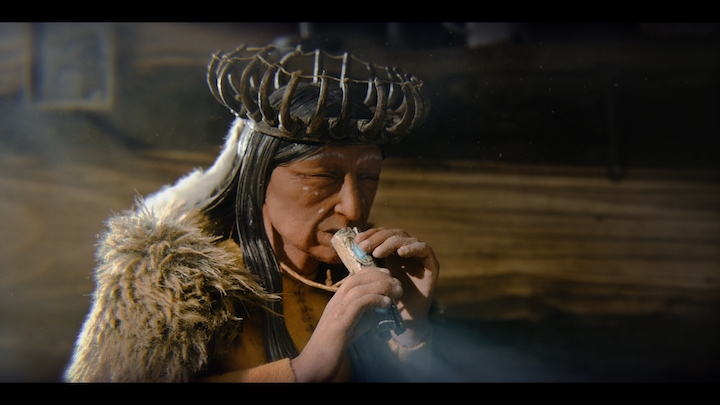
AS: I had the privilege of working with Tantoo on our last short film Inkwo For When the Starving Returns. That film led us to develop a strong friendship together, and I see her as a mentor given her legacy as an artist working in film and TV, which has paved the way for many Indigenous artists in our industry. There wasn’t a question in my mind about asking her to voice Gyilak’yoo, the Halaayt (Shaman) and spiritual guide for Lu’oo’ya and audiences in this film. She is the living embodiment of wise matriarchal leadership, and her roles reflect that, such as Ms. Hunter in Wendell & Wild and Iphigenia in Wildwood. She also embraced learning Sm’algyax (Ts’msyen language represented in our dialogue) from our language advisor, Dr. Mique’l Dangeli, with willingness and respect. I hope we continue to collaborate together for many more films to come. I'm in awe of her.
Credit: Haboolm Ksinaałgat - Soul Catcher (Spotted Fawn Productions)
Q: The film includes some beautiful music, including “Spirit Song,” a traditional Tsimshian healing prayer. How did music help shape the production?
PP: We were deeply honored to be gifted the “Spirit Song,” a traditional Ts’msyen healing prayer set to music, by my friend and mentor Ah’lidaaw Gitnack’angeak, who learned the ancient medicine prayer from her mother.
AS: It’s important for us to center Indigenous artists in all aspects of our creation process, including sonically. Ts’msyen musicians Asher Maclaren and Torah Zamora committed to perform the “Spirit Song” along with award-winning Lil’wat Nation musical artist Russell Wallace for the soundtrack, connecting Pamela’s community further with this film. The “Spirit Song” became a backbone to our overall sound production, led by award-winning composer Edo Vanbreeman, who recently worked on A24’s Backrooms, and Cree/Metis Musician Matthew Cardinal. The song lives across the whole film and has become its beating heart.
Q: Soul Catcher has won the Grand Jury Prize for Best Animated Short Film at the Edmonton International Film Festival (EIFF), which qualified it for Oscar consideration. What has it been like experiencing the film with festival audiences?
PP: In short, it’s been like a dream come true. Soul Catcher is a love letter to my dad and my Ts’msyen ancestors. To have other filmmakers, juries, audience members, and especially Ts’msyen people come up to me with tears in their eyes after seeing the film is something I’ll be processing with gratitude for the rest of my life.
AS: In such a short time within the festival circuit, it already has had such a vibrant life since its World Premiere at this year’s TIFF. It has been an unexpected whirlwind to have won a qualifying award so soon. All of our screenings have shown us deep love and appreciation for the story and process - which means the world to Pamela and me! This is why I’m compelled to make these kinds of stories and projects through my studio.
Q: Amanda is also developing her first animated feature. Can you tell me anything about that project?
AS: For several years I’ve been developing my first feature film called Noopiming- the Cure for White Ladies, based on the novella by Leanna Betasamosake Simpson, following up on past collaborations (Biidaaban: The Dawn Comes and Break Up) which feature characters from Noopiming’s literary universe. Noopiming follows a captivating young Indigenous genderless human frozen in a mystical lake who must reconnect with their fragmented self – their will, conscience, spirit, mind, and senses – through ancient ceremonies and the enduring power of friendship, to break free from the icy grip of trauma and rediscover the vibrant pulse of life. Noopiming is a stop-motion project whose story offers us an alternative to today’s exploitative and divisive societal climate, where resistance, decolonization, and traditional knowledge can offer hope for a future where all of us - people, spirits, animals, and ancestors- can live interconnected and find shared healing. With a script in hand, I’m excited to create a full-length work as we deserve more Indigenous representation in feature-length animation, fully led by Indigenous artists. I believe in this work wholeheartedly and the power of Indigenous stories within stop-motion.

Nick Spake is the Author of Bright & Shiny: A History of Animation at Award Shows Volumes 1, 2, and 3. Available Now!