A website dedicated to animation, awards, and everything in between.
Elsinore Review | Is Andrew Scott’s Oscar to Be or Not to Be?

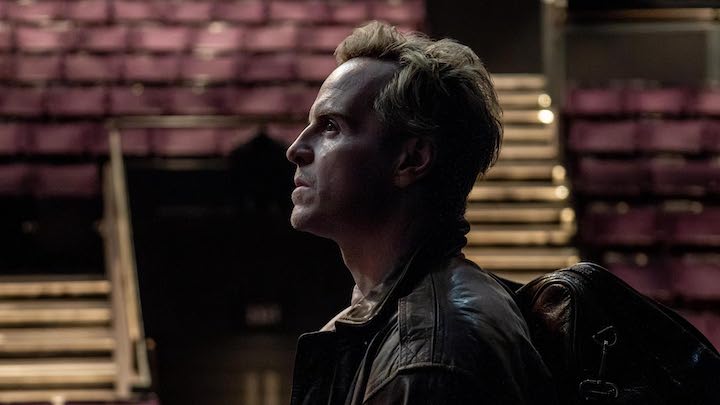
Credit: Elsinore (Focus Features)
In the span of one year, we could go from Jessie Buckley winning Best Actress for Hamnet to Andrew Scott winning Best Actor for his performance as Ian Charleson in Elsinore. Both have Hamlet in common, although the humanity behind the scenes is what draws us in. Hamnet was about coping with grief. To an extent, Elsinore is too, but Simon Stone’s film is more about making the most of the time you have left. Just as Hamlet inevitably ends in tragedy, Charleson’s fate is sealed from the opening scene. Unlike Hamlet, though, Elsinore manages to be hopeful above all else.
Ian Charleson is best known for his performance in Chariots of Fire. Even then, most people remember that Best Picture winner’s musical score and nothing else. Charleson takes whatever screen roles that come his way, but the theatre is his true calling. When Daniel Day-Lewis literally walks away from a production of Hamlet, Charleson is offered the role of a lifetime. Charleson knows that it’ll also be the last performance of his lifetime. Charleson has AIDS, and lesions are beginning to surface. While Charleson discloses this to the director, Richard Eyre (Johnny Flynn), he doesn’t want his diagnosis made public until he’s gone.
This being the late 80s, Charleson is far from the only person in his inner circle presented with a death sentence. He turns to a doctor named Margaret Johnson (Olivia Colman), who has prolonged the lives of others with AIDS. Charleson and Johnson both know his time is extremely limited, however. Johnson doesn’t exactly approve of Charleson doing such an emotionally draining play, especially one where death is a central theme. Regardless, she doesn’t fight Charleson when he decides to divide what’ll likely be the final months of his life between rehearsals and treatment. Even if Charleson makes it to opening night, he’ll still have to power through several more performances.
Beyond the hospital, Charleson has a small support group, namely the wonderful Billie Piper as a casting director and his closest friend. Some encourage Charleson to go public with his illness, but he doesn’t want that to be what the audience focuses on when he’s on stage. Charleson nevertheless finds the strength to come out to his cast and parents. Elsinore could’ve shined the spotlight on more of its supporting cast, some of whom feel underutilized. While well-written, Stephen Beresford’s script can tread on the familiar waters of other AIDS dramas like Philadelphia and The Normal Heart. Two things in particular set Elsinore apart from those films, however.
One is Scott’s magnificent performance as an actor doing multiple performances at once, memorizing Shakespearean dialogue while concealing his own pain. Scott should already be an Oscar nominee for All of Us Strangers, which I still believe is his best performance to date. The Academy may finally give Scott his due with Elsinore, although he doesn’t solely carry the film on his back. Simon Stone has made an endearing movie about the power of empathy and theatre. This is what ultimately distinguishes Elsinore from some other pictures of its kind. How Charleson died can’t be tiptoed around, but Elsinore emphasizes how he lived until the final curtain.
Awards Potential:
Best Picture (Oscars)
Andrew Scott: Best Actor (Oscars)

Nick Spake is the Author of Bright & Shiny: A History of Animation at Award Shows Volumes 1, 2, and 3. Available Now!