A website dedicated to animation, awards, and everything in between.
Futurama Season 13 | Review

Credit: Futurama (Hulu)
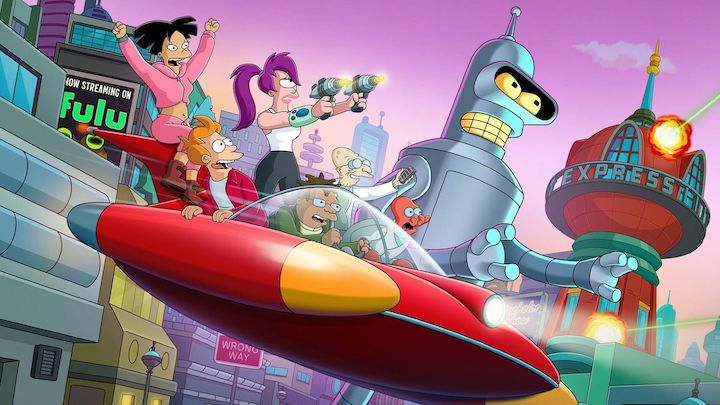
Are we back in the 90s? It certainly feels that way based on the animation output of the past few months. Mike Judge has two shows back on the small screen with Beavis and Butt-Head and King of the Hill. While South Park has been on the air for decades, its twenty-seventh season has arguably been its most relevant since 1997. Now Futurama, which premiered at the 20th century’s tail-end, is back for its thirteenth season… or tenth season depending on how you count it. I’m going with the former.
Along with Family Guy, Futurama was among the first major animated shows to be revived from cancellation(s). From its original run on Fox, to its straight-to-DVD movies, to its Comedy Central era, Futurama has been rebooted more times than your old desktop computer. While the Comedy Central run ended on what many considered the perfect note, “Meanwhile” did leave the door open for more stories. The door was reopened a decade later with the Hulu revival, which has already given us two new seasons. While solid, the show’s Hulu run hasn’t done much to evolve the characters or premise. For a show about the future that satirizes topical subjects, the past two seasons have ironically felt stuck in the past.
That was, until the episode “Otherwise,” which addresses the alternate reality that Fry and Leela left behind in the former series finale. The episode ended with Fry deciding to unravel the meaning of his déjà vu with Leela by his side. Season 13 doesn’t pick up where Season 12 left off. Rather, the season opener, “Destroy Tall Monsters,” centers on Bender realizing that he’s short. Is he, though? He always seemed to be average robot height, but Bender having an inferiority complex isn’t a stretch. In any case, it’s an excuse to eventually see a Godzilla-sized Bender terrorizing the city, much like Pacific Rim was an excuse to see cool-looking, giant robots. Guillermo del Toro even admits this in the season’s funniest cameo.
A close second would be Bill Nye the Science Guy in “The World is Hot Enough,” in which the Planet Express crew attempts to solve global warming. It’s not the first time Futurama has tackled climate change, although this environmental crisis has only intensified since Season 4’s “Crimes of the Hot.” At this rate, we’ll be lucky if the world isn’t on fire by 3025. The season contains other timely episodes like “Scared Screenless,” which revolves around screen addiction. The 2024 presidential election is also mirrored in “Murderoni,” where a fishy candidate outpaces a more qualified female opponent in the polls based on unfounded conspiracy theories. The results are more optimistic than our current circumstances.
Despite these obvious real-world parallels, Season 13 is less focused on tropical issues than the previous two. This provides room for more character-driven stories with the ensemble being put to effective use. The show’s central romance is at the forefront of “Fifty Shades of Green,” as Fry confronts the notion that Leela is his soulmate, but he might not be hers. It’s among the season’s sweeter episodes, along with “Crab Splatter,” where Leela’s parents take in a dumpsterless Zoidberg, and “The Trouble with Truffles,” in which Bender bonds with an overly optimistic runt on his latest get-rich-quick scenes. This season’s best episodes, though, are the ones that fully embrace Futurama’s scientific angle, reminding us that this show has some of the smartest writers in television.
“The Numberland Gap” is an episode clever enough to be taught in math class, with a mix of numerical puns and visual gags worthy of comparison to Chuck Jones’ The Dot and the Line. It also paves the way for the season’s third funniest cameo, Wonder Years star/math wiz Danica McKellar. Science and religion collide in “Wicked Human,” as Farnsworth attempts to provide a logical explanation behind an apparent rapture. One is grounded in facts and the other in faith. Whichever you subscribe to, spiritual and scientific people live and die by their belief system. In that sense, science and religion might be more similar than we give them credit.
The season ends on a high note with the Patric M. Verrone scribed “The White Hole," which explores time dilation, 3D-printed clones, and the creation of a new universe. To my surprise, a white hole is an actual concept, and not something that Verrone made up for the episode. While the finale is a standout of the season, we never see the new universe that’s teased throughout. At first, I thought maybe they were setting up another callback to the alternate reality in “Meanwhile.” Yet, the season never delivers on Fry’s proclamation to figure out what his drawing of an elderly Leela and himself was all about.
In a year where shows like King of the Hill and South Park reinvented themselves, one can’t help but wish that Futurama were taking similar chances. Since returning two years ago, Futurama hasn’t done much to shake up the status quo. That said, if you simply want more Futurama, the show is still smart, inventive, and consistently funny. As far as the Hulu run goes, Season 13 brings the best batch of episodes. It may not offer any all-time classics like “The Luck of the Fryrish,” “Jurassic Bark,” or “The Late Philip J. Fry,” but there are no duds like “The Prince and the Product.” Catching up with these characters always brings comforting nostalgia, but if Futurama wants to reach the next frontier, maybe it’s time to delve deeper into the multiverse or at least venture through the white hole.
Nick Spake is the Author of Bright & Shiny: A History of Animation at Award Shows Volumes 1 and 2. Available Now!