A website dedicated to animation, awards, and everything in between.
2026 Oscar-Eligible Animated Short Pow! Director Joey Clift Interview


Credit: Pow! (Joey Clift)
Brought up in a Native American household, powwows were a staple of Joey Clift’s childhood. That doesn’t mean he was always thrilled to be there. He spent most of his time lost in a game or searching for an outlet. As Clift grew older, though, he came to recognize the significance of powwows and his culture as a whole. He combines his heritage with his lifelong love of video games in Pow!, which has qualified for Oscar consideration through theatrical exhibition. Cartoon Contender spoke with Clift about 90s inspirations, working with a mostly Indigenous crew, and taking Native representation in animation to the next level.

Credit: Pow! (Joey Clift)
Q: The story opens with a retro, 8-bit aesthetic, although Pow! is clearly contemporary. Otherwise, Jake, the young protagonist, would be looking for AA batteries rather than an outlet. Did you always intend for the short to take place in modern times, or did you toy with the idea of doing a period piece?
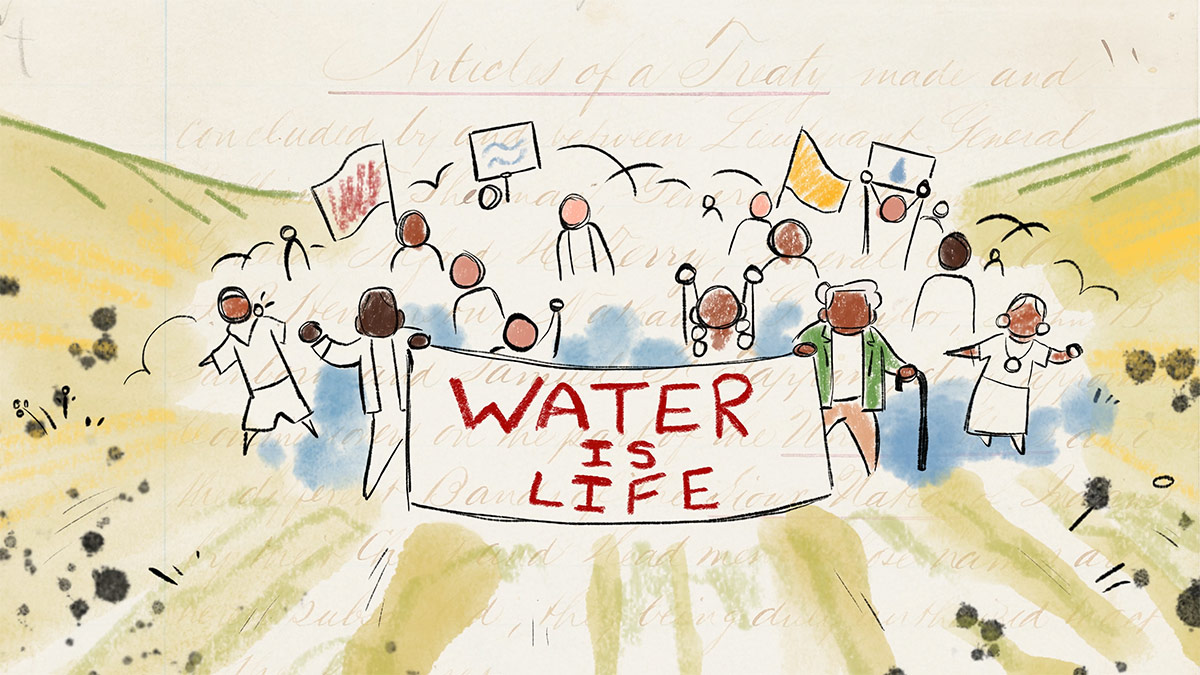
A: Pow! is loosely inspired by a few different experiences in my life. Growing up in the 1990s, I was often dragged by my mom to powwows where I spent a lot of time sitting on the bleachers playing Game Boy. A decade later, as a college student, I took an internship with my tribe, which involved helping film tribal events. Really, I spent a lot of that summer in tribal centers around Washington State and British Columbia looking for places to charge my phone. While doing that, I had a lot of great conversations with other Native folks, from youth to elders, about Native identity and what it means to be Native in the 21st century. I took a few elements from both of those experiences to craft the story of the film. There are also references to different events in Native history later in the short, mainly the Alcatraz occupation of the 1960s and the Dakota Access Pipeline protests of the 2010s. Though I never toyed with the film being a period piece per se, I tried to be a little vague about the exact year the film takes place to keep it from feeling too immediately dated. In my mind, it's set at some point in the past 10 years or so without being ascribed to any one day on the calendar.
Q: Were there any particular games that inspired the one Jake plays in the film? The pilgrim hat enemies definitely call Goombas to mind. Jake’s own life also essentially becomes a game, channeling Donkey Kong.
A: I reference a few specific video games throughout the film. The 16-bit intro, for example, is a direct reference to the SNES JRPG classic Earthbound. It got to the point where I was literally showing our animators Earthbound pixel art and making sure that the pixel height of our characters matched that of Earthbound, and I'm so glad our team humored my inner dork throughout that process. For the game Jake plays, I picture it being an homage to the sorts of third-party Super Mario knock-off platformers that were popular in the 1990s. The bear's character design references one of my previous films, mixed with a little bit of Super Mario. The Pilgrim hat enemy is for sure a Goomba, the bear's collectibles, corn, beans, and squash reference companion plants that are important to North American Indigenous people, and when the collectibles all fly out of the bear after he gets attacked by the pilgrim hat, that's a direct reference to Sonic the Hedgehog.
Q: Beyond video games, what were some other creative inspirations for the project?
A: Oh god, there are so many little references in this thing. The soundtrack is inspired by the powwow inspired funk of all Native rock band Redbone, for example. I chose Funk because that was the soundtrack of a lot of Saturday Morning cartoons of the 1970s, and it just felt like it fit the vibe. The flashback sequence is inspired by ledger art, which is a Plains Native art style from the 1800s. The comedic rhythm of the film was pretty liberally borrowed from The Simpsons, and the base look of the short is inspired by anime, specifically The Tale of the Princess Kaguya. Our powwow drummer character design was inspired by John Redcorn from King of the Hill, which, with the tragic recent passing of voice actor Jonathan Joss, I'm glad I was able to include that inspiration to help honor his memory. I pulled inspiration from a lot of different areas, and my hope was that it gives the film a little bit of a timeless quality and is the sort of thing that parents can show their kids for years to come.
Credit: Pow! (Joey Clift)
Q: Pow! plays with a few different styles. How did you settle on the look of the film?
A: Pow! features three different animation styles. 16-bit SNES JRPG style pixel art, watercolor anime-influenced animation, and a flashback sequence inspired by Plains Native ledger art. Those styles each represent a different character’s perspective on Native culture. That’s my super heady answer. My real answer is that sometimes, as a director, you just dump the things you love into a big blender, turn it to max, and hope it tastes good. I knew I wanted a 16-bit pixel art sequence, our character designer, Morgan Thompson, who is a fantastic Annie Award-winning animation artist and enrolled member of the Cherokee tribe, mentioned wanting to include ledger art in the film, we all were huge fans of anime and The Simpsons, and wanted to use those as inspiration. Once we had all of our combined ideas on the table, then it was a matter of seeing what fit where and then realizing that by incorporating all of those elements, we were giving ourselves a cool thematic opportunity that would elevate the film visually and give the story a little more heft. My favorite part of directing is the collaborative process, and I have to give credit to the team for everyone sprinkling in their own flavor.
Q: The premise stemmed from your childhood experiences, getting dragged to powwows where you usually spent more time on your Game Boy. At what point in your life did you start to look at powwows and your heritage differently?
A: It was a mix of a few different things. As a teenager, I remember my mom coming into my bedroom with tears in her eyes, explaining to me that after 150 years, which is several generations of Cowlitz advocating, my tribe had finally received its federal recognition. I'm an alumnus of a high school that had a mascot that was based on a Native stereotype, and I hung out with a lot of Native student activists fighting for the name to be changed. The conversations I had as I interned for my tribe in my twenties introduced me to a lot of great people who had fought for decades for Native rights. Learning that it was illegal for Native people to participate in our culture, people went to jail for it, until the late 1970s, was a big eye-opener for me. Over the years, I developed a greater awareness of my culture, but also a greater awareness of how hard my people fought against a literal attempted genocide for us to even be able to participate in our culture. All of that just gave me a greater perspective and showed me that when my mom took me to powwows as a kid, she wasn't just trying to bore me. She was doing her part to continue this culture that people tried to take from us, which, if you look at it that way, it makes our culture the coolest thing ever.
Q: In what ways do you think Native representation has changed in the animation industry, and in what ways do you think there’s still progress to be made?
A: Speaking as someone who writes cartoons for a living, there have been some huge changes in animation! Spirit Rangers on Netflix, a show I was fortunate to write for, was the first show in the history of United States animation created by a Native person (the genius Chumash TV writer Karissa Valencia) with an all Native writers room and Native characters played by Native actors. That came out in 2022! Molly of Denali, another groundbreaking show when it comes to Native representation, came out in the late 2010s. We're seeing more Native characters onscreen that are developed the right way, with Native writers behind the curtain, Native actors in front, and Native artists helping develop those characters and those stories. Additionally, when I pitch Native stories and characters to Non Native executives, I feel a real sense of earnestness from them to get things right and to give me the resources I need to tell those stories effectively. That said, these are small gains. A recent research study came out showing that only around 1% of characters in kids' programming are Native. There are probably only a few dozen Natives working in animation, and Molly of Denali and Spirit Rangers are both ending their runs. I hope that this movement in authentic Native representation in animation continues and that, 20 years from now, we're not still reflecting on how good 2022 was. What we have is great, but it's a drop in the bucket, and we need more. My hope is that Pow! and indie projects like it can help fill that gap.
Q: Pow! has qualified for Oscar consideration through theatrical exhibition. What are some standout festivals that you’ve taken the short to?
A: I've been fortunate to have a great screening run with Pow! since we premiered in late March. We've screened at around 70 festivals, everywhere from New Zealand to New York, as well as a ton of screenings in small tribal communities around the country. Our world premiere was at MaoriLand in New Zealand, which is the largest Indigenous focused film festival in the southern hemisphere. Seattle International Film Festival was an amazing homecoming. They even organized a screening on the reservation I grew up on, just two blocks from the house I lived in as a kid. I had a ton of fun screening at festivals as big as Palm Springs International Shortsfest, Bentonville Film Festival, Hamptons International Film Festival, and Sidewalk Film Festival, where we took home the Best Animated Short award. A few other standouts are Nevada City Film Festival, Cleveland International Film Festival, Montclair Film Festival, Hawai‘i International Film Festival, Cordillera International Film Festival, and Vancouver International Film Festival. We also had the good fortune to screen at San Diego Comic Con this year, as well as at a Macklemore Concert put on by the fantastic nonprofit NDN Collective in South Dakota on Indigenous Peoples' Day. I like to joke that Pow! opened for Macklemore, but it's not a joke! We really did!
Q: The short builds to a heartfelt moment between Jake and his grandmother. Is this character at all based on your own grandmother?
A: The grandmother character in Pow! is a little bit of a composite of a few different people in my life. My grandmother is where I get my Cowlitz heritage from, and I can't thank her enough for keeping those cultural fires burning for me. The grandmother in Pow! is also inspired by the activists that took part in the Alcatraz Occupation of the late 60s and early 1970s, which, if you don't know what that is, Google it. It's crazy. Basically, a bunch of Native folks realized that in their treaties with the United States government, signed a hundred years prior, they could claim ownership over any decommissioned federal lands. When Alcatraz Island was decommissioned, several hundred Native folks took boats to Alcatraz and took the whole island over. The Grandmother in Pow! to me is meant to be one of those activists, but it's been around fifty years, and she's lived a life since. It's my small way of honoring the Native activists whose fight directly led to me being able to tell stories like Pow! in mainstream spaces.
Q: Pow! is largely comprised of an Indigenous crew, including Morgan Thompson, who won an Annie for her work on the student short, The Fox & The Pigeon. How did you go about assembling this team?
A: One of the amazing things about creating your own projects is you get to assemble a dream team of a lot of your various friends and connections! Our composer Jordan Kamalu and sound designer Jeff Carpenter are alumni of Spirit Rangers on Netflix. Our executive producers, Mik Moore, Simpsons alumni Donick Cary, and FlickerLab's Harold Moss, had previously worked with me on my Comedy Central digital series Gone Native and the indie documentary Hail To The Breadsticks. Our cast, Angela Startz, Rainy Fields, and Jim Ruel, are all people I've previously worked with in Native Hollywood spaces. I'd met Morgan Thompson at a few events prior to working with her on Pow!. Though I hadn't worked with her previously, when I saw her artwork, I knew she'd be a perfect fit to bring onto the project. Side note, I think Morgan might be the only Native to ever win an Annie Award! I'm so proud of this team. Pow! was entirely human-made, without AI, and I hope I get to work with these extremely talented folks on projects like this for years to come.
Nick Spake is the Author of Bright & Shiny: A History of Animation at Award Shows Volumes 1 and 2. Available Now!