A website dedicated to animation, awards, and everything in between.
The Undying Pain of Existence Director Oscar Jacobson Interview | Oscar-Eligible Animated Short

Credit: The Undying Pain of Existence (Filmakademie Baden-Württemberg)
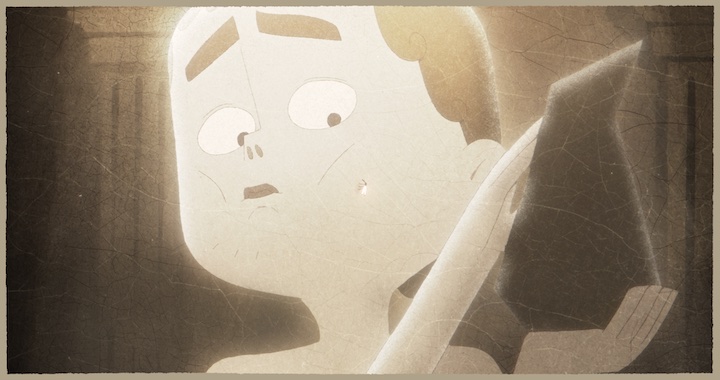
What’s an even more precarious position than being a nude model in an art class? Throwing a mosquito into the mix. That’s the setup for Oscar Jacobson’s The Undying Pain of Existence, which received an Annie Award nomination and a Student Academy Award nomination. The film has since qualified for Oscar consideration. Cartoon Contender spoke with Jacobson about sketching vulnerability, why nudity was nothing to hide, and more!
Credit: Oscar Jacobson
Q: What was the inspiration behind this short? Did it stem from having to draw a nude model in an art class?
OJ: Actually, I was inspired by my own experience with a very itchy skin condition. I’ve had to deal with intense itching all my life, but was always taught not to scratch. It started as a film about the pain of having to resist the urge, and the eventual liberation of doing it. The whole art class setting came in as a result of trying to make the situation as intense as possible, and only then did it turn into a much more metaphorical and universal story. This really taught me a lot about the creative process, and how an idea can evolve into much more than the initial idea.
Q: Did you always plan on the main character going full frontal, or did you consider pulling an Austin Powers with objects conveniently covering the genitalia?
OJ: No, it never crossed my mind to hide anything. I feel that would have drawn more attention to the nudity, and the nudity really isn’t the point. It just feels much more vulnerable to me when it’s all out in plain sight, and the audience sees what the artists see. Also, if it was covered up, we would not have gotten the crowd-pleasing close-up shot!
Q: The character designs also have a statue-esque look with sharp edges, while the overall aesthetic has a stone feel to it. How did you come to define the look of the film?
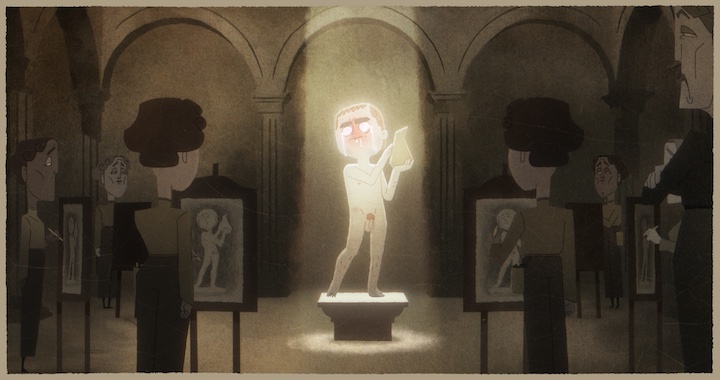
OJ: I was heavily inspired by old Renaissance art for many aspects of the film. I love the way everything feels so overly dramatic and theatrical in these artworks: the lighting, the poses, the facial expressions. I found that vibe very fitting for a protagonist that goes through such extreme suffering from such a small thing as a mosquito bite. So a lot of the style was influenced by old oil paintings and statues, which of course also fits thematically with the strict traditionalist art school.
Credit: The Undying Pain of Existence (Filmakademie Baden-Württemberg)
Q: Just about any pest could’ve challenged the model’s stillness. Why a mosquito?
OJ: Since the original idea was about itching, the mosquito was an easy choice. Actually, in earlier drafts, the itch came from some kind of rash. The mosquito was included for practical reasons; it was much more visually and audibly recognizable, it offered a clear inciting incident, and felt more relatable. The sound and the feeling of a mosquito is so specific and yet so universal.
Q: The mosquito brings about a moment of visual nirvana, almost as if a new realm has been opening à la 2001: A Space Odyssey. Can you take me through that sequence’s development?
OJ: From early on, I had a clear vision for how it should feel, what it should convey, and its role in the story. But the „how“ was incredibly difficult and gave me some sleepless nights. It remained quite vague until late in the process, when most of the film was almost finished. We actually did a week-long retreat with the editor (Revan Sarikaya), and two animators (Ilya Barrett and Leo Neumann) to develop the general structure of the sequence as an animatic, but there were still many uncertain parts even after that. It took a lot of back-and-forth experimentation to get to the final result. I’m someone who loves to try different art styles, and this was the perfect opportunity for it, since the story basically dictates it.
Q: The film ends with several distinct drawings, which are also showcased over the credits. How many people contributed illustrations, did any get left out of the film, and do you have a personal favorite?
OJ: I’m glad you asked! Eight drawings were made by other artists, and the rest by me. To have the final drawings created by different artists was an idea that I was really excited about, as a little meta thing to show a range of individual artistic expressions analogous to what’s happening in the film. None of the final ones were left out, but some artists did end up making a second version because the first one wasn’t clear enough to be understood. It’s hard to pick favorites, but I really like the one by Tanja Nuijten - the trippy symmetrical one with the many hands on his face.
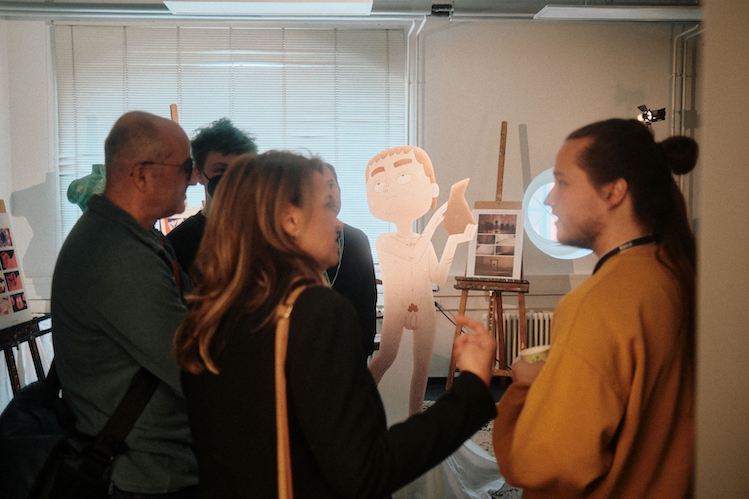
Credit: The Undying Pain of Existence (Filmakademie Baden-Württemberg)
Q: The Undying Pain of Existence has already received a few accolades, getting nominated for a Student Academy Award and an Annie. What has it been like seeing the film embraced?
OJ: I’ve been quite overwhelmed with the success of the film. I got to travel to so many places and meet amazing people thanks to it, and it’s been very encouraging. As someone who, for quite some time, thought directing wasn’t my thing, the fact that this film worked so well gives me confidence to continue on this path.
Q: Who do you identify with more, the nude model or the artists drawing him?
OJ: 100% the model! Even though I’ve never been a model myself, I put a lot of myself into his struggle. On the surface, this of course includes the itch he can’t scratch, but even more than that, the resistance to just be himself, show his flaws, and allow himself to be vulnerable.

Nick Spake is the Author of Bright & Shiny: A History of Animation at Award Shows Volumes 1, 2, and 3. Available Now!