A website dedicated to animation, awards, and everything in between.
AI, Animation, & The Academy | The Future of Artificial Intelligence at the Oscars

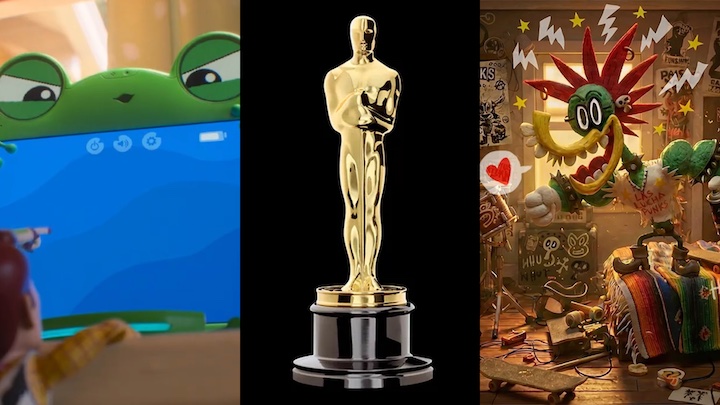
Credit: Toy Story 5 (Pixar Animation Studios), Oscar Statuette (AMPAS), Punky Duck (Jorge R. Gutierrez)
Earlier this year, the Academy of Motion Picture Arts and Sciences introduced several new rules regarding AI. In the writing categories, AMPAS specified that screenplays must be written by humans. Likewise, only human actors can compete in acting categories. So, Tilly Norwood and uncanny valley Val Kilmer won’t be eligible for Oscars. While many felt these changes were a step in the right direction, the new rules didn’t touch upon AI in categories like Best Animated Feature, Best Animated Short, or Best Visual Effects.
The Academy’s general rules say, “With regard to Generative Artificial Intelligence and other digital tools used in the making of the film, the tools neither help nor harm the chances of achieving a nomination. The Academy and each branch will judge the achievement, taking into account the degree to which a human was at the heart of the creative authorship when choosing which movie to award.” While it’s unlikely that a fully AI-generated film will get nominated in the foreseeable future, AI-assisted films can technically compete for an Oscar. A few already have.
With the trailer for Wildwood reaching nearly 90 million views on YouTube as of writing, Laika has reminded audiences that they’re the masters of hand-crafted artistry. While Laika’s stop-motion movies are painstakingly made one frame at a time, their filmography isn't devoid of AI technology. For Missing Link, which was nominated for Best Animated Feature in 2020, machine learning technology was used to clean up artifacts (via Engadget). The VFX team for Pixar’s Elemental, which received a Best Animated Feature nomination in 2024, similarly turned to machine learning to help stylize flames (via Variety). Although Laika and Pixar still largely rely on traditional animation methods, neither studio has written off AI, at least at the VFX and post-production stages.
Last year, Michael Govier and Will McCormack, who won an Oscar for If Anything Happens I Love You, used AI tools for their latest animated short, All Heart. Although All Heart’s storyboards, backgrounds, and characters were all human-made, the crew turned to AI for key framing, in-betweening, and creating additional assets. All Heart ultimately wasn’t nominated for Best Animated Short. Neither was Craig Lew’s Ahimsa nor Xindi Zhang’s Student Academy Award-winning The Song of Drifters, which also utilized AI. While the aforementioned films all qualified for Oscar consideration, voters remained apprehensive about AI.
Beyond the Academy, there were rumors that the 2026 Cannes Film Festival might accept Critterz, which AGC Studios has promoted as “the first mainstream commercial family feature created with A.I. integrated throughout the entire production pipeline” (via THR). The feature is based on Chad Nelson’s 2023 short, which went viral despite only having a 2.2 rating on IMDb. While Cannes accepted several animated films this year, Critterz wasn’t one of them. However, Cannes did accept Steven Soderbergh’s documentary John Lennon: The Last Interview, which turned to AI for about 10% of its runtime. For various critics, that 10% was enough to sink the whole production, questioning why Soderbergh didn’t just hire an animator for moments lacking archived footage.
Soderbergh isn’t the only big name who has experimented with AI. It was recently announced that Jorge R. Gutierrez (The Book of Life, Maya and the Three) would be making his project Punky Duck as part of Amazon MGM Studios’ GenAI Creators' Fund. When news broke over social media, the response ranged from surprise, to betrayal, to rage against the machine. While many provided thoughtful feedback on why they were disappointed in Gutierrez, others resorted to racist remarks and death threats. Some of these weren’t just directed at Gutierrez, but his wife and child as well.
It’s infuriatingly ironic that so many people would verbally attack Gutierrez and his family in the name of human-made art when their threats demonstrate the ugliest side of humanity. If this is how most people react when they don’t see eye to eye, maybe we do deserve to be replaced with emotionless machines. That said, did Gutierrez really think this news would go over well on Animation Twitter? Within days, Gutierrez announced that he’d no longer be participating in Amazon’s AI initiative. It’s unclear whether Gutierrez had a genuine revelation about how his involvement might negatively impact other artists or if the internet just bullied him into backing out. Either way, this hardly feels like a “win,” as AI still isn’t going anywhere.
I have decided to drop out of the AI program at Amazon. I will not be making a Punky Duck series. Actions speak louder than words.
— Jorge R. Gutierrez (@mexopolis) May 29, 2026
My intent was to showcase artists, both new and seasoned, both inside and outside the studios, driving this new tech.
My sincerest apology to… https://t.co/GJQZMkfZwd
There have been several turning points where animation as we know it has changed, from the use of Xerography in One Hundred and One Dalmatians to the original Toy Story making CGI the new norm. A handful of purists still argue that unless it's done frame by frame with pencil and paper, it's not animation. Of course, even most 2D-animated projects these days are done on computers. Some have compared AI to the boom of computer animation, but it may have more in common with performance capture. When Robert Zemeckis’ The Polar Express came out in 2004, many debated whether a performance capture film should be in contention for Best Animated Feature. Although The Polar Express qualified, it wasn’t nominated. The fact that the branch nominated Shark Tale instead is telling.
The branch would eventually nominate the Zemeckis-produced Monster House, which also used performance capture. It lost to Happy Feet, which largely relied on motion capture for dance sequences. With Happy Feet winning the Oscar, it seemed more performance capture animated films were on the horizon. In 2011, though, Happy Feet Two drastically underperformed. That same year saw the release of Mars Needs Moms, one of the biggest bombs in box office history, killing any hope for Zemeckis’ ImageMovers Digital. After that, motion capture animated films mostly fizzled out.
This isn’t to say that performance capture went anywhere. It remains commonplace in live-action and “photo-realistic” blockbusters, not to mention video games. Motion capture animated films are still being made as well. Quentin Dupieux used motion capture for Vertiginous (Le Vertige), which played at Cannes, and Peter Jackson hasn’t given up on Tintin 2 even after more than a decade. Compared to the mid-to-late 2000s, though, performance capture animated films aren’t as prominent as they once were. You could argue that AI will have a similar future. The genie will stay out of the bottle, but as far as the animation industry goes, traditional methods will win out.
There’s a major difference between performance capture and AI, however. Motion capture can be extremely expensive. To give you an idea, Zemeckis’ A Christmas Carol made over $300 million back in 2009. With a budget estimated to be as high as $200 million plus marketing, though, the film lost Disney somewhere between $50–100 million. Unless you have a surefire hit like Avatar: The Way of Water or Grand Theft Auto VI, motion capture could balloon your budget to the point that profitability is unattainable.
AI, meanwhile, is being championed as a way to save on time and money. It’s also more accessible than motion capture technology, with AI tools being available on your iPhone. AI is even being used to make performance capture more affordable. As such, AI’s presence among VFX artists will likely continue to spread. For all the pushback within the animation community, VFX workers and tech bros seem excited to play with this “shiny new toy.” At this year’s VFX Society Awards, The Wizard of Oz at Sphere won Outstanding Visual Effects in a Special Venue Project. Although numerous cinephiles bashed the 4D experience for altering a cinematic classic with “AI slop,” the VFX community embraced it.
The Wizard of Oz at Sphere has also been an undeniable financial success, making hundreds of millions. As far as AI animated films and shows go, though, we’ve yet to see one have a cultural impact. Sure, various AI videos have gone viral, but that won’t necessarily translate to financial success on the major studio front. Amazon MGM Studios will continue their AI initiative with or without Gutierrez. They aren’t the only big players that are investing in AI. Unless that investment pays off in a big way, interest in AI may fade with traditional animation prevailing. It’ll all come down to how much money stands to be made.
As much as CEOs claim they care about artists, the truth is that they’d love to replace people with machines who do as they’re told, promptly meet deadlines, and never take mental health days. Machines may pose a greater threat to CEOs when they gain sentience and unionize, but that’s a problem for tomorrow. As convenient as AI seems, it also has limitations. There’s potential for the technology to grow more advanced, but as Blue Eye Samurai co-creator Michael Green said at the Annies Awards in 2024, “All AI can hope to achieve is to copy the average of our efforts. It can flatten innovation in the name of efficiency, but that is only karaoke, and it’s bad karaoke.” If audiences grow tired of “bad karaoke,” the AI bubble might burst. Even then, AI is here to stay, whether we like it or not.
On the journalism front, a colleague of mine has repeatedly told me and others that if we don’t accept AI, we will “get left behind.” For the record, none of the articles on Cartoon Contender are or ever will be AI-generated. Alas, I sometimes feel like I’m the only member of a football team not using steroids. That’s not to say AI hasn’t infiltrated aspects of my life and work. When I interview someone over Zoom, the AI-generated transcript saves time on note-taking. When I require legal advice, chances are I’ll ask ChatGPT before spending $500 an hour on a lawyer. Attorneys are only slightly less soulless than AI anyway. There are even versions of spellcheck that incorporate AI to catch grammar mistakes, which I can’t deny is helpful.
In these regards, I feel AI can be like a vitamin. Where I draw the line is having AI write text for me or rewrite text. Then AI becomes like a steroid. If an athlete is caught using performance-enhancement drugs, they’ll typically be disqualified and stripped of their honors. Shouldn’t we hold filmmakers to the same standards at the Oscars? It’s unrealistic for the Academy to ban productions that use any form of AI, especially in animation. Concerning screenwriting and performances, though, AMPAS is drawing a line with AI. AMPAS could set a precedent for AI in animation as well. Of course, one question remains: when is AI a vitamin or when is it a steroid?

Nick Spake is the Author of Bright & Shiny: A History of Animation at Award Shows Volumes 1, 2, and 3. Available Now!