A website dedicated to animation, awards, and everything in between.
2026 Oscar-Eligible Animated Short Murmuration Directors Interview

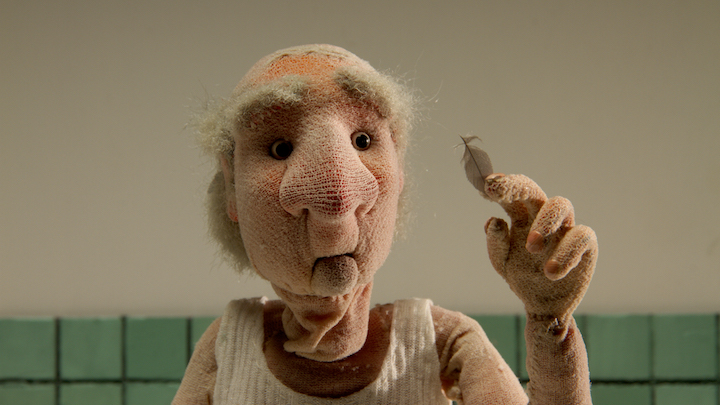
Murmuration (Janneke Swinkels & Tim Frijsinger)
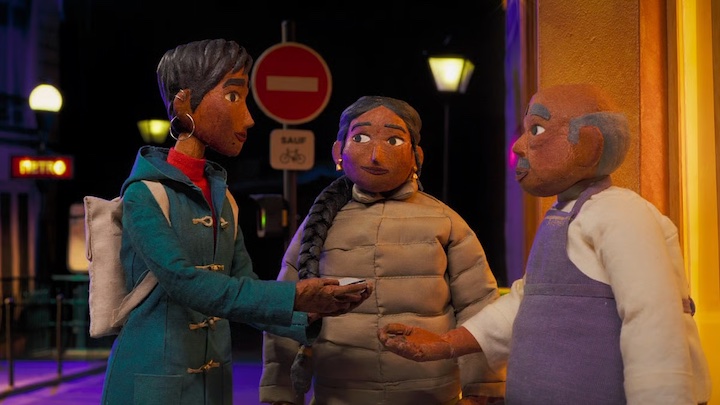
Janneke Swinkels and Tim Frijsinger are partners in life and in filmmaking. Their stop-motion animated short, Murmuration (Zwermen), revolves around Piet, an elderly man in a retirement home, changing into a bird. The premise is fantastical, but the inspiration comes from a personal place, being partially based on Swinkels’ grandfather. Winning Best Animated Short at the Melbourne International Film Festival, Murmuration is eligible for consideration at the 98th Academy Awards. Cartoon Contender spoke with Swinkels and Frijsinger about bringing a documentary lens to animation, the creation of the puppets, and how their film took flight.
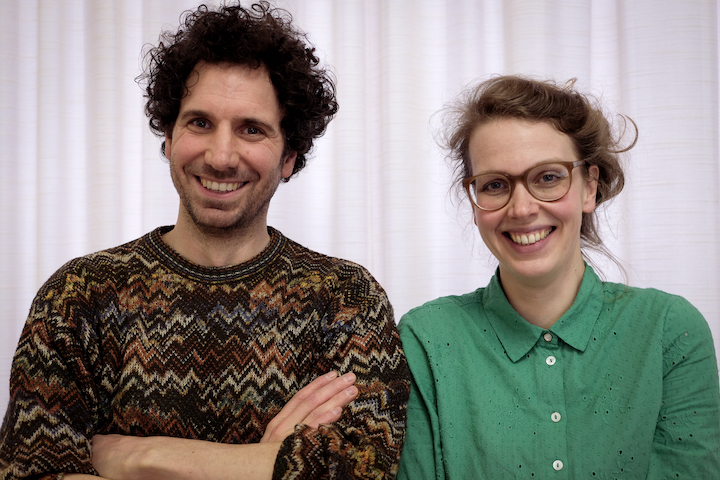
Tim Frijsinger & Janneke Swinkels
Q: The idea for Murmuration stemmed from a documentary that Janneke made about her grandfather, which led to her spending a lot of time in a nursing home. Is Piet’s design based on Janneke’s grandfather by any chance?
A: Not specifically in design, but more in character, Piet was based on Janneke’s grandfather in the first drafts of the script. However, some things in his character really didn’t fit in with the story: He didn’t like the participation at all, although he seemed to love complaining about it. This could’ve made a nice film on its own because there was something quite comical about it that we also loved. But it distracted from the story we wanted to tell, so gradually we had to change his (Piet’s) character quite a bit.
Q: How did your experience in documentary filmmaking impact Murmuration?
A: We tried to build the film as a small documentary, with us as observers of the quiet life in the nursing home while the story of Piet unfolds. We had a lot of total shots with many puppets in our mind at the first drafts of the script, but due to budget and time, we had to cut some of these scenes and make everything a bit closer to the characters, and simplify it. We still hope we could keep enough of the documentary feeling.
Q: This is your first stop-motion film. What inspired you to tell this story with puppets?
A: Stop-motion is a technique we’ve both always loved and admired. And for us, this story works the best this way. There is something special about being able to hold a character in your hands, and I think you feel that the world you see in our film also exists in real life. It adds a lot to that documentary feeling we were aiming for. When Mirjam Plettinx animated the first scene with Piet in his bathroom, we even got a bit emotional, because it looked so… alive! We’re very thankful to her, and to Geertrui De Vijlder and Rosanne Janssens, who all brought so much life and subtleness to the animation.
Q: Piet could’ve transformed into any number of animals in the film. Why did you select a bird?
A: Interesting question, at the beginning we had the idea that all the old people in the care home would change into animals, and all of them differently. So, some old lady becoming a cat-lady, for example. But when we started writing the man changing into the bird, it felt the most natural for us. I guess it had a bit to do with some similarities between old people and little birds. The frailty, big noses and the fluffy bits of hair. Also, we just really like birds
Q: Did you use real feathers for the film?
A: Yes, we used a mix of real feathers and fake fur. Every day we walk our dog from our home to our small studio in Maastricht, and there we collected all the feathers we could find on the ground. Bird shed at the end of summer, I guess, because that’s when we would find the most feathers. Or maybe it’s because there’s a lot of cats in our neighbourhood that unfortunately prey on the birds, so they may have helped us a little bit as well.
Q: Murmur Animation partnered with Beast Animation, which worked on the Oscar-nominated Wander to Wonder. How did this collaboration come about?
A: Spotted Bird (Peter Lindhout), our main producer in the Netherlands, already knew the studio and Janneke did an internship many years ago on stop-motion Oh Willy…, which was shot at Beast. So, when we were looking for a co-producer, it felt like the natural choice to go to them first, also because of their stop-motion experience. Beast mainly arranged the post-production in the end. And while there was some talk about shooting a part of the film in Belgium at Beast at an early stage of production, eventually we ended up shooting the whole film at Mascha Halberstad’s Holy Motion Studio in Arnhem (NL), which was the most practical option at the time and felt good immediately. Funny detail: she introduced us to Rosanne Janssens, who also animated on Wander to Wonder.
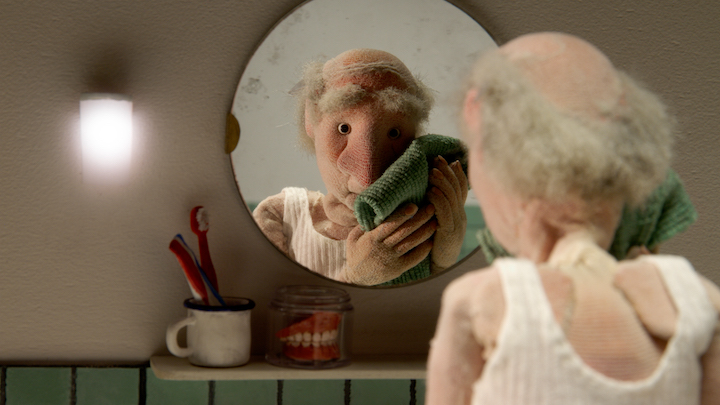
Murmuration (Janneke Swinkels & Tim Frijsinger)
Q: I feel like there are a few different ways to interpret the ending. Some might assume that Piet is dead. Others might say that he’s starting a new chapter of life. What’s your interpretation?
A: Ha ha, that’s a returning question we are a bit hesitant to answer. The story is pretty straightforward about Piet changing into a bird, so that’s how we’d like most to interpret it. And while the ambiguity is there, I think we made sure that this is still a believable option. It’s nice to hear that the different reactions we got afterwards tell a lot about the person who watched it and how this person thinks and lives. Some might think it is a comforting idea to change into a bird instead of dying, just joining a new flock. Others enjoy all the details in the film and the story, the small side story of a resident watering a plant, the woman always watching over and caring for Piet. Others see similarities with dementia and drifting away in fantasies. And there are also people that just say: This is such a simple story, he’s dying, and I knew that right from the beginning.
Q: Murmuration has qualified for Oscar consideration with its win at the Melbourne International Film Festival. If it gets nominated for an Oscar, will you be taking any of the film’s puppets to the red carpet?
A: That’s a big if! But yeah, if we get that far, it feels a bit like something that’s expected from stop-motion filmmakers, so we probably would bring them with us. Although we are not sure they would follow the dress code.
Q: How would you two describe your creative partnership?
A: It’s a way of working that developed naturally. We’ve been collaborating since before we graduated from art school, and doing creative work together has always felt intuitive. We’re also a couple and know each other through and through. So, we understand each other’s strengths and know how to divide responsibilities in a way that works for both of us. Sometimes we’re getting caught up in work and talk about nothing else during the day. But since we have a daughter, she does most of the talking. So that’s not so much of an issue anymore.
Nick Spake is the Author of Bright & Shiny: A History of Animation at Award Shows Volumes 1 and 2. Available Now!