A website dedicated to animation, awards, and everything in between.
Primal Season 3 | Review - How to Resurrect a Series

Credit: Genndy Tartakovsky’s Primal (Adult Swim)
On the heels of Samurai Jack’s mix of stylized action and visual storytelling, Primal felt like the next natural step in Genndy Tartakovsky’s evolution. It took everything he did before to another level. The show simultaneously stripped things down to their most - for lack of a better word - primal elements. In a series *almost* free of dialogue, Tartakovsky told a simple yet epic story through pulse-pounding music, bone-crushing sound design, and storyboards that translated masterfully to the finished animation. The series would pick up multiple Emmys, including Outstanding Animated Program for the episode “Plague of Madness.”
When it was announced that Primal might become an anthology with the third season, it made sense. Season 2 already appeared to be teasing this new direction with the standalone episode “The Primal Theory,” which shifted the focus to Charles Darwin. What’s more, Season 2 ended with Neanderthal Spear’s gut-wrenching death. It even capped off with a flash-forward revealing that Spear and Mira conceived a daughter, who grows up alongside Fang’s offspring. There was nothing left to say… or so we thought.
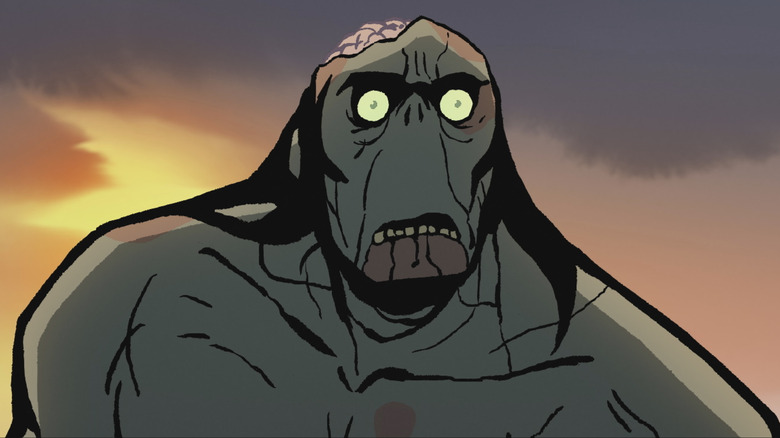
Season 3 continues Spear and Fang’s story, essentially scrapping Tartakovsky’s anthology proposal. At the same time, Season 3 almost feels like a different show, despite the presence of familiar faces. That’s because Spear is now a zombie. The season commences with a shaman reanimating Spear’s corpse, a retcon I feared might jeopardize the show’s legacy after concluding on such a high note. By the end of the season premiere, though, I was sold on this new direction. Although the shaman initially uses his body as a puppet for revenge, it isn’t long before Spear regains control of his mind. Of course, his mind isn’t all there. In fact, part of his brain is sticking out of his scalp.
Spear isn’t sure who he is. Yet, he has vague recollections of Fang and others he left behind. The first few episodes follow Spear as he traverses a hazardous terrain, gradually piecing together fragments of his shattered memories. There have been numerous zombie-centric shows and movies, but rarely is a zombie the center of attention. Season 3 almost calls to mind Jonathan Levine’s adaptation of Warm Bodies, telling its story from the zombie’s perspective. Of course, Primal isn’t a satirical romantic comedy. The season shares even more in common with James Whale’s two Frankenstein movies. Like Boris Karloff’s monster, Spear is a man of few words, but there’s a soul inside the hulking vessel that has a way of attracting havoc. The two don’t eat human flesh or brains either, although that doesn’t mean they don’t leave a trail of death.
Spear does eventually make his way back to Fang and a pregnant Mira. Where Mira is quick to accept her zombified beau, Fang is more critical. Spear attempts to prove himself as they go up against Andrewsarchus and other beasts. Since the previous season revealed that Mira and Fang live, there isn’t much suspense as to whether or not they’ll survive this onslaught of foes. Seeing how Spear wasn’t present in that flash forward, though, the season keeps you guessing where his story is going. Even if Spear regains his memories, he’s a rotting corpse. Can Spear actually pick up where he left off, or is this his chance to give a proper goodbye? Or will they just keep him in the shed like Ed in Shaun of the Dead?
As different as this season is, it preserves all of the essential elements that have always defined Primal. Tartakovsky once again directs every episode. He’s also behind much of the storyboarding, along with fellow Emmy-winner David Krentz and Oscar-winner Mark Andrews. Like the previous two seasons, Primal Season 3 is pure pulp, but now it has a hint of George A. Romero to go with the barbarian action. While the action remains expertly choreographed and the violence is as savage as ever, there’s a strong emotional core as well.
The biggest difference about this season (aside from the whole zombie thing) is that Spear and Fang spend several episodes apart. Even when they do meet up, their dynamic isn’t the same. Fang is a mother now, and she’s hellbent on protecting her children from any potential threat, even the human she once fought alongside. From the show’s very first episode, nature was against these two becoming allies. Yet, the human and T. rex formed a bond thicker than blood. It appears that not even death can separate them, but Spear becoming undead may tear them apart regardless.
Rejected, Spear endures an identity crisis, questioning where he belongs in this world. If anything, he now has more in common with the monsters he once battled than other humans. Spears finds himself being embraced in a gladiator arena, where he could reign as king. The arena sees Spear at his most primal self, yet ironically, each victory brings back a piece of his humanity. That more or less sums up the season. It manages to revisit the well while also evolving.
While Spear’s fate at the end of Season 2 felt fitting for a show draped in so much bloodshed, it also came off as somewhat rushed. I won’t spoil how Season 3 wraps up, but it’s one of the show’s most explosive and emotionally satisfying episodes with a conclusion that feels earned. Whether or not this is truly the end remains to be seen. If Primal does get a fourth season, Tartakovsky could return to his anthology idea, although maybe he’s still not done with these characters. Either way, Primal Season 3 is a textbook example of how to resurrect a series.

Nick Spake is the Author of Bright & Shiny: A History of Animation at Award Shows Volumes 1, 2, and 3. Available Now!